
Key facts:
Politicians and banks around the world are being called upon to do more to increase CBDC adoption.
The proposal includes offering profits and even making their use mandatory through new laws.
By implementing a series of strategies aimed at preventing people from rejecting central bank digital currencies (CBDC), the International Monetary Fund has launched a plan that aims to stimulate their global adoption.
The plan was presented on September 21, as part of a document titled “Central Bank Digital Currency Adoption”, where A series of recommendations are made involving politicians and central banks.
According to IMF officials, successful adoption of CBDCs will require the implementation of proactive policies and design decisions, which intermediaries (banks) and end users They should feel as beneficial.
The idea is to draw up strategies to encourage the use of CBDCs through a high-level framework with four pillars that, according to the IMF, will serve as an incentive. It has been named REDIacronym for regulation, education, design and incentives.
In this way, the implementation of a group of laws is being undertaken, which not only provide a legal framework for CBDCs, but also encourage compliance. This even contemplates the possibility of declare them legal tender and establish its use as mandatory.
In terms of education, it is recommended to develop communication strategies to raise awareness about CBDCs and teach how to use them.
“Educational initiatives should guide consumers step-by-step on how to safely manage digital wallets, conduct transactions, monitor their holdings, and understand the risks,” the IMF said.
In terms of design, they recommend that central banks focus on specific user groups and take advantage of intermediaries. to create a wide distribution and acceptance network of CBDC.
In the incentives section, there is talk of offering monetary and non-monetary forms of gain.
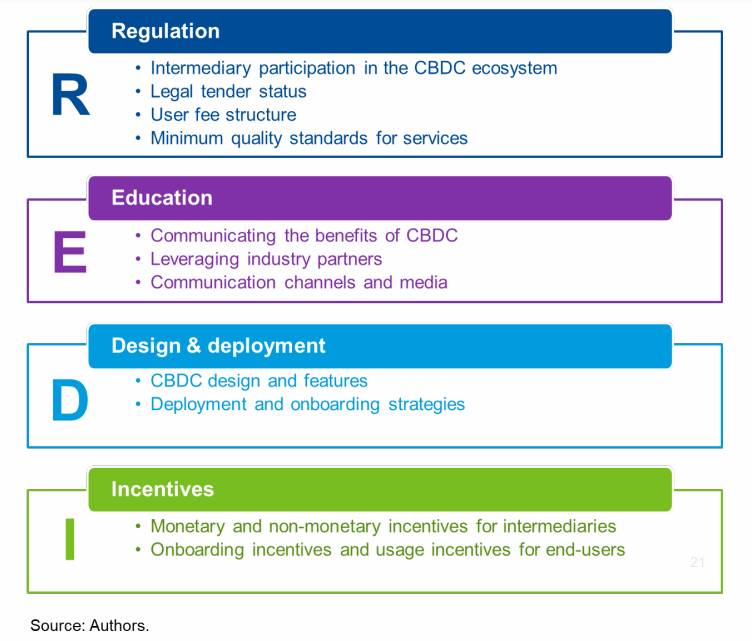
This includes benefits ranging from not charging fees, subsidizing costs for banks or companies that participate as intermediaries, creating new services with CBDCs, and monetizing user data (with their consent). It is also proposed to offer discounts and gifts for their use.
In this regard, it is recalled that some of these incentives They have already been offered in China and in Jamaica with the digital yuan and Jam-Dex, the CBDCs that have made the most progress so far.
As reported by CriptoNoticias, regional governments in China’s pilot zones distributed 180 million yuan in CBDC red packets and discounts; while Jamaican consumers received a 2% discount on purchases with CBDC.
Despite this, It is known that most of the CBDCs that have been launched are rejected by users. Although in China a higher level of acceptance has been reached through these incentive strategies.
Despite public pushback, most governments with CBDC projects remain adamant about moving forward with their plans, which has led many governments to expand their goals or launch wholesale currencies so they can also be used for cross-border payments.