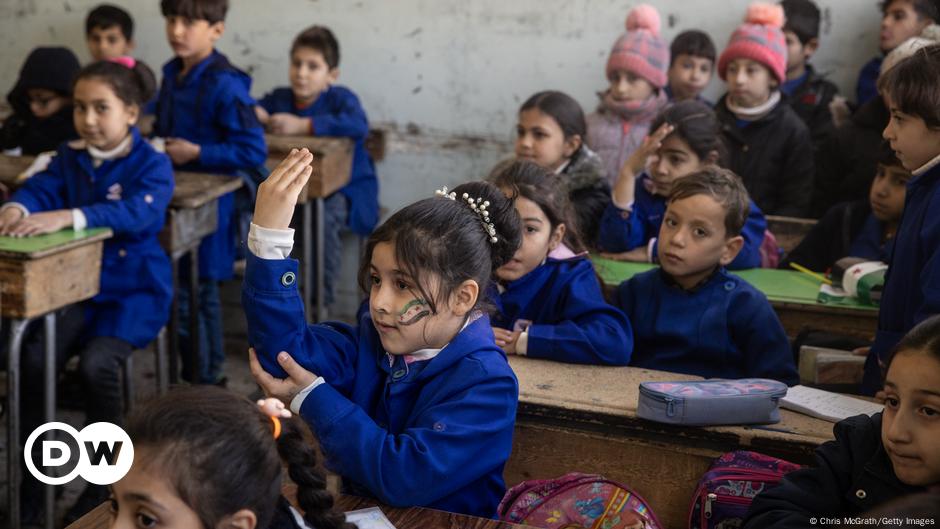
When more than 3.5 million Syrian students took exams this week, the first since the fall of longtime ruler Bashar Assad, they no longer had to answer questions on “Syrian nationalism.”
The transitional education minister, Nazir al-Qadri, canceled the exam subject at short notice. The theme was largely based on the glorification of Assad and his regime.
“It was good news for my eldest son, but it meant a lot to us [alarm] Bells. “We will have to wait for the next semester to see what will be taught instead,” Anas Joudeh, founder of the Nation Building Movement, a Damascus-based civil society initiative, told DW.
As the father of a son in seventh grade and a son in second grade, Joudeh grows fearful that Hayat Tahrir al-Sham (HTS), the group that ousted the Assad regime, installed an interim government in Damascus Thi, “wants to oust them from power.” Fingerprints on the curriculum, as Assad changed the curriculum to suit his ideology.
“It’s a problem. In fact, it’s a disaster.”
Islamist leanings
Al-Qadri previously worked for the education ministry in northwestern Syria’s Idlib province, which was under HTS control, for five years.
The cut in exam subjects was part of a nine-page list of changes to the school curriculum published by the Education Ministry on its official Facebook page in January.
For example, “protecting the nation” was changed from “protecting Allah” or “those who are cursed and lost” to “Jews and Christians.” Additionally, the definition of “martyr” was changed from one who died for the motherland to one who sacrificed his life “for God”.
Meanwhile, al-Qadri has downplayed the changes. In a statement, he said the only instructions he issued were related to the removal of material he described as glorifying the “dysfunctional Assad regime” and statements of the Syrian revolutionary flag from all textbooks.
The minister also said “inaccuracies” in the Islamic education curriculum had been corrected and special committees would revise the updates, which have not yet been determined but are due to be implemented before the start of the next school year in September.
Inclusive dialogue?
In turn, Joudeh is concerned that the sudden change may indicate that the transitional HTS government will not fulfill its promise to hold a national dialogue conference that includes multi-religious and multi-ethnic Syrian society in deciding these matters and Will impose her ideology. over the course.
Earlier this month, scores of teachers took to the streets outside the Education Ministry in Damascus. They condemned that the curriculum changes were decided without input from teachers or civil society and questioned the actual authority of the transitional government to make these changes.
HTS has been designated as a foreign terrorist organization by the United States and the United Nations due to its ties to the so-called “Islamic State” (IS) and al-Qaeda groups. The group is meant only for the interim leaders of the Syrian government, yet it is unclear when a caretaker government will hand over power.
HTS leader Ahmed al-Sharaa initially said he would remain in office only until March 2025. Later, he said that HTS would remain in office until the country drafts a constitution in two or three years and holds elections in about four years.
“Syrian leaders must involve civil society organizations and the Syrian people in the design and construction of the new Syria, taking into account their experiences and perspectives,” Alice Gower, director of geopolitics and security at London-based consultancy firm Azure Strategy, told DW. Keeping.” ,
“Syrian education, in particular, is an important component of creating a sense of unity and national identity.”
millions of children in need
However, school curriculum is not the only concern on the minds of Syrian parents, as 14 years of war have destroyed Syria’s education system on many levels.
Due to the fragmented political situation with the northwest being under HTS control, the semi-autonomous Kurdish region in the northeast, and about 70% of the country being under government control, children were in separate education systems, if at all.
While schools and universities remained open under government control, millions of children in other regions were not enrolled in schools or participated in any type of non-formal education, such as courses in community centers, at workplaces, or on online platforms.
“About 2.5 million children are not attending school as a result of the war,” James Elder, a spokesman for the United Nations Children’s Fund (UNICEF), told DW. He added another million and is in danger of being eliminated.
Another consequence of the war is the dire state of educational infrastructure. “One in three Syrian schools are still either destroyed or being used as shelter for displaced families,” Elder said.
In his view a dual approach is needed. “As the country moves into a new era, continued collaboration is essential to design an inclusive curriculum that reflects the rich diversity of the country, while at the same time, strengthening existing systems and ensuring that education is Investment is needed so that every child in Syria “resumes or continues their learning journey,” UNICEF’s Elder said.
“The longer these children remain out of school, the more exposed they are to child labour, child marriage, trafficking and recruitment by armed groups.”
Joudeh, a father and activist in Damascus, says the immediate future should be used to train teachers on how to communicate about the transition and the near future should be used to start a national reconciliation process. Needed
“Ultimately, we need to discuss the values and symbols of this nation,” he told DW, adding that, in his view, “the curriculum is the most important issue.”
Edited by: Davis Van Opdorp