
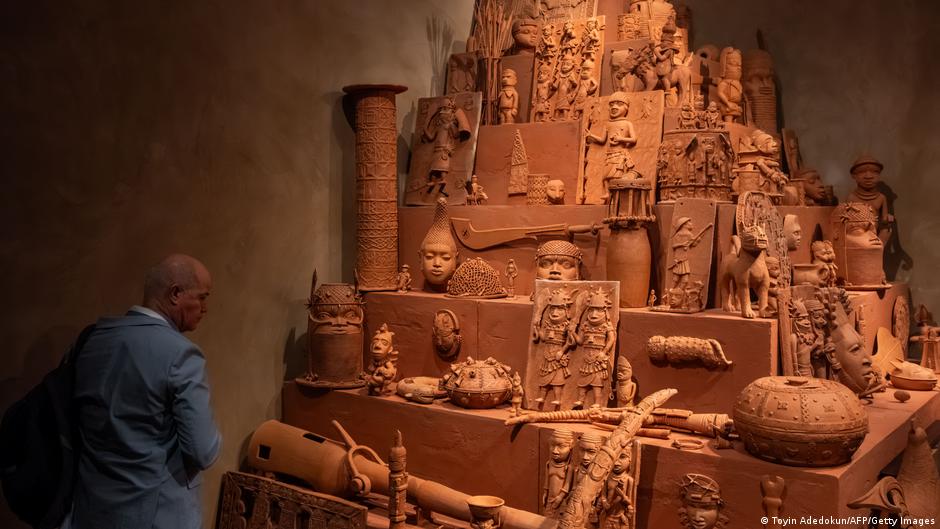
There is uncertainty over the fate of the much-awaited Museum of West African Arts (MOWAA) in Benin City, Nigeria.
The museum’s origins were initially linked to the restoration of the Benin bronzes; When plans for the new state-of-the-art institution were first revealed in 2020, the museum was promoted as the “most comprehensive exhibit ever”. [of Benin Bronzes] In this world.”
But because of ownership questions, it has been clear for years that the bronzes would not end up in the new museum.
MOWAA’s focus is to serve as a powerhouse for contemporary African art as well as a research and conservation center to train a new generation of Nigerian archaeologists and art conservators.
But the fact that the museum is still often associated with the Benin Bronzes is important to understanding a complex controversy that has stymied the opening of the multi-million-dollar project.
The restored bronzes are now under the protection of the traditional rulers.
Benin bronzes refer to thousands of objects made by the Edo people from the 15th to the 19th century. They decorated the royal palace of the Benin Empire in what is now Edo State, Nigeria, until it was razed by British troops in an infamous 1897 attack.
The treasures ended up in the collections of various Western museums – including the British Museum, Berlin’s Humboldt Forum, and New York’s Metropolitan Museum of Art.
After years of claims by Nigeria, several European museums signed agreements to return the artifacts in 2022. A multi-stage restoration process is underway, with some items already returned.
In 2023, then-President of Nigeria Muhammadu Buhari signed a law stipulating that the traditional king of the Edo people, the Oba of Benin, was the owner and custodian of the artefacts.
Some critics fear the treasury could be privatized by a royal successor.
Currently, many of the bronzes are on display at the National Museum in Benin City, where a public exhibition of the treasures (which DW has seen) is being held from November 3-28.
Oba of Benin opens new museum
Oba Iwuare II’s supporters fear that MOWAA is plotting to wrest the Benin Bronze from the monarch, and so they are opposed to the new cultural institution.
“We consider the inauguration and operation of MOWAA illegal, considering it an insult to our prestigious throne,” Osaru Iyamu, one of the protest leaders, told DW.
Protesters last weekend disrupted MOWAA’s opening week event, which was scheduled to be held from November 11-15, by forcing their way into the main building during a preview event attended by international guests.
The guests – about 250 project partners, donors, diplomats and heads of cultural institutions – were evacuated and “taken to safe locations,” museum organizers said in a statement on Instagram. The opening of the museum has been postponed indefinitely.
MOWAA’s director, Philip Iheanacho, told DW that he was saddened by the disruptions and that museum organizers were hoping to have “a dialogue with all stakeholders to see if we can find a way forward.”
Oba Iwuare II reportedly wants to keep the museum under his control and rename it the Benin Royal Museum. He claims that this was the original name that was used to promote the institution and obtain funding for it.
“There is not a single institutional investor who has given us money who has any notion that we are anything other than a West African art museum. We have never pretended to be anything else,” Iheanacho says.
MOWAA is a non-profit trust that was created to be independent from government influence.
The project, which is estimated to cost $25 million (€21.5 million), is funded with support from the Nigerian federal government and the Edo State government, as well as a number of international bodies including the French and German governments, the Getty Foundation, the Open Society Foundations and the British Museum.
The matter has become complicated due to fake reports
Initial MOWAA plans promoted the project as the Addo Museum of West African Art. Edo – which is the name of the Nigerian state where the museum is located and the name of the people who are descendants of the ancient Benin Kingdom – was dropped from the museum’s name due to opposition from some local officials.
Reports are circulating that the Edo State Government has reclaimed the land occupied by MOWAA and will restore it to its former use as the Benin Central Hospital.
“This doesn’t seem to be true. The governor’s office assured me yesterday that nothing has been canceled in Mowa, declaring it a social media scam,” Annette Günther, the German ambassador to Nigeria, posted on Twitter.
DW has contacted the embassy for more information; A planned interview has been postponed.
Modern infrastructure ‘part of the restoration process’
Prior to the museum’s opening, various news articles profiling MOWAA focused on the absence of Benin bronzes in its display, upsetting the museum’s director.
The inaugural exhibition, “Nigeria Imaginary: Homecoming”, is an expanded version of the country’s renowned Venice Biennale show, which addresses Nigerian history, identity and current events.
Iheanacho wrote in an article, “Much of the Western press, preoccupied with the story of stolen objects being returned, seems to think that the inaugural exhibition reflects something else entirely: the confusion and disappointment that we are not simply a repository of returned objects and a sign of African people’s failures to conform to the narrative.” Opinion piece for artnet,
For Iheanacho, the development of infrastructure such as MOWA to promote new artistic voices and Nigerian expertise on cultural heritage is also part of Africa’s restoration process, he points out in his essay.
But for now, the complex dispute – in which politics, traditional royal culture and international donors are all entangled – is blocking this ambitious vision.
Interview by DW reporter Azizat Abiola Olaoluwa in Benin City
Edited by: Brenda Haas