

Strategy’s (MSTR) bitcoin (BTC) holdings have become the thermometer of institutional confidence. The recent evolution of this company reflects like few things the trust (or fear) of the institutional market towards the digital currency.
The company, which holds the largest corporate reserve of bitcoin among all publicly traded companies, see how your stock price moves almost in real time with sentiment towards BTCespecially after the correction that the digital asset has suffered in recent weeks.
Since its yearly high in July, MSTR shares have fallen 56%, going from $457 to about $199. This decline has gone hand in hand with the correction of bitcoin, which fell from its all-time high near $126,000 in early October to around $95,000 today.
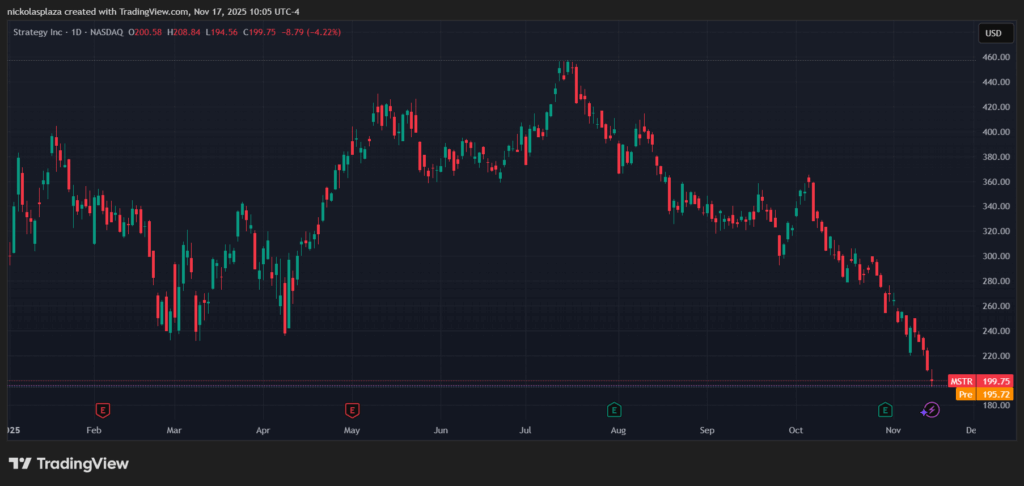
However, There is one piece of information that has generated special concern, it is the modified net asset value (mNAV). which currently stands at 0.93. When this indicator drops below 1, the market is valuing the company for less than its bitcoin holdings are worth.
For some investors this represents a discounted buying opportunity; For others, it is a sign of distrust in the company’s ability to maintain its aggressive accumulation strategy in an adverse environment.
The risk of contagion for companies with bitcoin holdings
The market’s real fear is that a prolonged crisis in MSTR will end up affecting the narrative of bitcoin as a corporate reserve asset.
If the pioneering company begins to falter, other companies that have copied its model (but with less financial muscle and lower tolerance for risk) could stop or completely paralyze their BTC purchases, as reported by CriptoNoticias.
However, several analysts insist that the risk of forced sales is very low. Miles Deutscher, for example, has outstanding that Even with a 70% drop in the price of bitcoin, Strategy would not have to liquidate its holdings.
“There are no margin calls and their loans have an average maturity of 4.8 years,” he said. «The only extreme risk is that the price of BTC remains low for years and the capital markets stop financing it. Even in that case, they could sell small quantities and delay payments,” the analyst added.
Strategy’s movements that generated alarm
Added to all this was the alert that went off when Arkham Intelligence detected that Strategy had moved 43,415 BTC (about $4.26 billion) to more than 100 different addresses. Many interpreted the move as a prelude to fire sales to obtain liquidity.
The reality was much more innocuous: these were simply internal transfers and migration to a new custodian within Coinbase Custodysomething common in the management of institutional portfolios of this magnitude.
For his part, Jeff Dorman, chief investment officer and co-founder of Arca, a digital asset management company, boarded the fascination and criticism towards Michael Saylor, company president, and expressed that he will never understand “how people can so confidently spout such stupid and inaccurate opinions that are so easily refuted.”
Dorman stated that “you only need to talk for less than 5 minutes with any debt/equity expert to understand that you will never have to sell your BTC shares unless bitcoin has fallen so much that your sale is an afterthought and irrelevant.”
The expert argued that MSTR selling BTC not a concern at allsince Saylor owns 42% of the shares. «There are no clauses in the debt that require the sale. Interest expenses are low and manageable; Let’s not forget that the core technology business is still generating positive cash flow,” Dorman concluded. In fact, investors often refinance debt rather than default on their maturing obligations.