
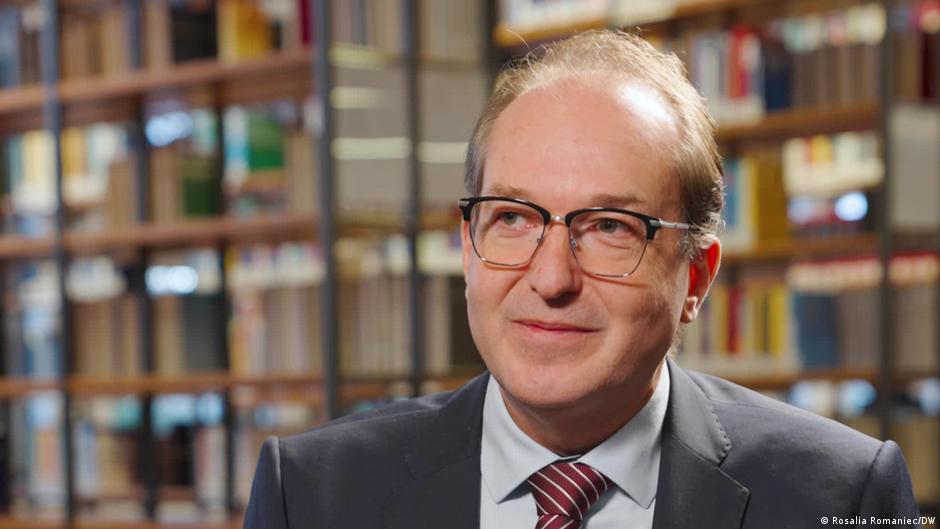
Germany’s Federal Interior Minister Alexander Dobrindt, from the conservative Christian Social Union (CSU), said in an interview with Deutsche Welle that he had not made any exaggerated promises when he announced strict migration policies upon taking office.
“My path is very difficult and that’s exactly how it is perceived,” he told DW. He added, “From day one, we took the necessary decisions to ensure that border controls were tightened, people were turned away and family reunification was suspended.”
In turn, Dobrindt considers the 60% drop in the number of initial asylum applications in Germany as “clear evidence that illegal migration is declining significantly.”
Irregular or undocumented migration refers to the movement of people across borders to reside without proper paperwork. Critics call it “illegal migration” inhuman and misleading,
‘Trigger point for radical parties’
Interior Minister Dobrindt said migration “has been the biggest trigger point for radical parties for many years.”
Although he said the politics have already changed in this case, he also said, “There’s a time lag between understanding that the politics are taking a U-turn on migration, and the emotional experience.” [of it] In someone’s inner circle.”
So far, the far-right party Alternative für Deutschland (AfD), which is somewhat right-wing extremist, is gradually gaining more ground in the polls, despite what they have called a government U-turn on migration policy.
The ruling coalition consists of the conservative Christian Democratic Union (CDU), its sister party the Christian Social Union (CSU) and the centre-left Social Democrats (SPD).
Meanwhile, migration experts attribute the decline in asylum seeker rates to tighter German border controls. The end of the civil war in Syria and tighter controls on the Balkan route from Greece to Austria have also led to the decline in numbers, Birgit Glorius, a migration researcher at Chemnitz University of Technology, told the German public broadcaster. daily news,
The right to asylum remains in place
Interior Minister Dobrindt also said that he would not restrict the individual right to asylum. “We have an individual right to asylum,” he said in the interview, “I don’t question that, but I do question the abuse of it.”
“We have to fight it to the best of our ability,” he said.
Dobrindt also said he would like to see more movement at the European level to slow migration and redistribute migrants across the bloc. One goal of the EU migration pact, which is due to take effect next year, is to make the distribution of refugees within the EU more equitable. Germany is encouraging countries of first entry to be more consistent in processing asylum seekers and not to allow them to travel onward.
“However, the return of people to these countries for first-time entry is often difficult and should be made possible,” Dobrindt told DW.
Along with other EU member states, Germany’s interior minister wants to find a partner country in Africa to set up a so-called “return hub”. These refer to areas where rejected asylum seekers can be deported, even if they did not come from that country.
“Currently several countries are discussing whether they want to take it together and with which partner country they will do it,” the minister said. “But we will definitely need a partner country from the African continent.”
Previous attempts to outsource asylum procedures from Italy to Albania, a non-EU country, failed partly due to legal barriers and high costs. The UK government has also suspended its efforts to deport asylum seekers to Rwanda.
Fewer Afghan citizens accepted
Part of the new government’s plan to curb migration to Germany is to end its special entry program for Afghans who worked with German agencies or forces during their mission in Afghanistan.
Interior Minister Dobrindt indicated that by the end of the year, all Afghan citizens with a “legally binding entry commitment” would be brought to Germany. Most of the estimated 2,000 people who are currently eligible are waiting to leave Pakistan.
So far, Dobrindt has allowed only those who have filed a case for entry before administrative courts to relocate to Germany. “This is a problem we have inherited,” the interior minister said, placing responsibility on the previous coalition of Social Democrats, Greens and liberals. “This is an old burden that we inherited from the previous government.”
Germany’s former government had promised to protect people who worked for German institutions in Afghanistan or were at risk of persecution by the Taliban. Dobrindt said he was reviewing these cases “in accordance with law and order.”
Russia is a potential threat to Germany
The German Interior Minister also did not deny that Russia and other foreign powers are trying to destabilize Germany. In addition to attacks on data cables in the Baltic Sea and the threat posed by drones seen at airports, Dobrindt also mentioned cyber attacks. He suggested that some originated in parts of Russia, and warned that they may be more frequent.
“I believe that in the coming months we should expect to see an increase in the number of cyberattacks, as well as more drone sightings and overall hybrid threats,” Dobrindt told DW.
He also described as “complete nonsense” AfD co-chairman Tino Kruppalla’s recent controversial statement that NATO ally Poland could pose a threat to Germany. He further added, “I think it’s insulting, and honestly I think it’s quite disgusting to try to incite such stupid sentiments in society.”
In a talk show, Kruppalla said that at present he does not see any threat to Germany from Russia, but any country can become a threat to Germany. When asked whether he also meant Luxembourg, Poland or Finland, for example, the AfD co-chairman said, “Of course, Poland could also be a threat to us.”
Don’t ban AfD, but ‘control it’
The interior minister rejected the possibility of initiating proceedings to ban the AfD. “I have always been clear that it is the responsibility of politics to drive the AfD out of existence, not to ban it,” he said.
He attributed the AfD’s steady rise in popularity to polarization within German society. Dobrindt argued that this should be countered by policy changes, not party sanctions.
According to Deutschlandtrend, the latest political opinion poll from Germany’s public broadcaster ARD, the CDU/CSU has just one percentage point higher approval than the AfD, which says it wants to completely curb migration.
This article was originally published in German.