
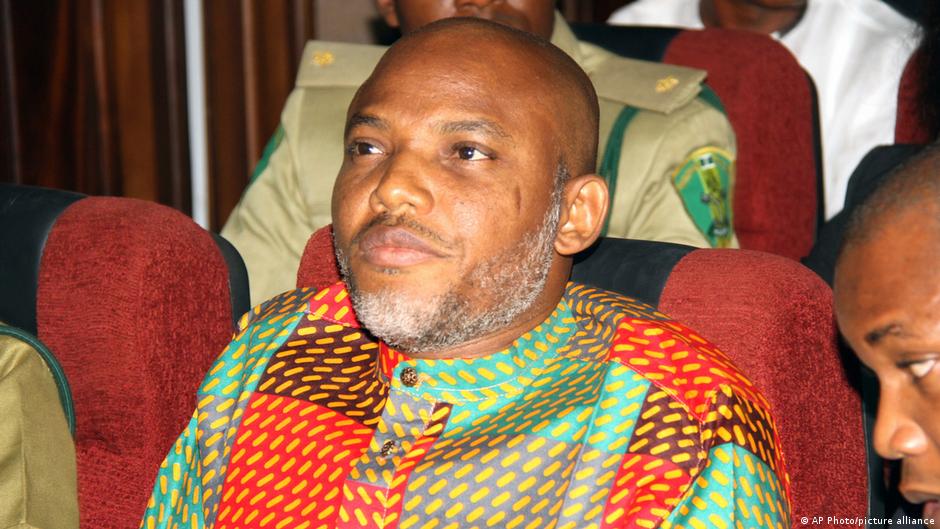
A Nigerian court on Thursday convicted Nnamdi Kanu, the leader of a separatist group, on terrorism-related charges.
Kanu founded the Indigenous People of Biafra (IPOB) separatist group, which sought independence from Nigeria.
“His intention was absolutely clear because he believed in violence. These threats of violence were nothing but terrorist acts,” Judge James Omotosho said in the Federal High Court in Abuja.
The conviction followed a long trial, with the case going back to comments he made in 2015.
What did the judge say to Kanu?
Kanu was not in the courtroom when the judge delivered his verdict, throwing him out for unruly behaviour.
The separatist leader had dismissed his lawyers and refused to call defense witnesses, claiming there were no charges against him.
He claimed that the court did not have jurisdiction to try him.
Judge Omotosho said Kanu claimed that “no court can find him guilty,” which he described as a “direct affront on the power of the courts.”
Kanu’s IPOB has also been accused of violently enforcing so-called “sit at home” protests following the arrest of the separatist leader in 2021, which have shut down local markets, schools and travel. IPOB has stated that criminal gangs are responsible for the violent enforcement of the sit-ins.
The economic protests cost the country 7.6 trillion naira ($5.3 billion, €4.5 billion) and resulted in at least 700 deaths, according to SBM Intelligence – a Lagos-based geopolitical consultancy cited by the Associated Press.
Prosecutor Adegboyega Awomololo urged the court to impose the death penalty.
Awomololo said, “He has shown no respect for the administration of justice. Even within the court his conduct has been full of arrogance. The punishment prescribed for offenses in counts 1, 2, 4, 5 and 6 is the death penalty. This court has the power to do so and must do so with dignity.”
Who is Nannamadi Kanu?
Kanu founded a banned group, the Indigenous People of Biafra (IPOB), to advocate independence for the southeastern region of Nigeria.
The judge said, “The right to self-determination is a political right. Any self-determination not carried out in accordance with the Constitution of Nigeria is illegal.”
KANU and IPOB alleged mistreatment of the Igbo ethnic group, which makes up a large portion of Biafra’s population.
The separatist leader used his London-based Radio Biafra to call for the independence of the oil-rich state, but in 2015 he attracted the attention of authorities when he said “we need guns and we need bullets.”
He was arrested during pro-Biafra protests later that year. He denied that the statement was in fact a call to arms.
In 2017, he jumped bail and fled the country after the army raided his house.
Why is the Biafra independence movement going on in Nigeria?
The Biafran demand for independence is reminiscent of a short-lived independent state that seceded from Nigeria in 1967 and lasted until recapture in 1970.
This period is known as the Nigerian Civil War and resulted in between 500,000 and 2 million deaths from starvation among Biafrans.
It itself originated from Nigeria’s time as a colony of the British Empire, when the country was divided into several pre-colonial kingdoms – predominantly Hausa and Fulani Muslims in the north, and Yoruba and Igbo Christians in the south.
After independence, economic and political instability led to ethnic tensions, with violence against the more prosperous Igbo minority. Between 10,000 and 30,000 Igbo people were massacred in the Northern Region, with more than 1 million forced to flee to Igbo-dominated areas.
Edited by: Carl Sexton