
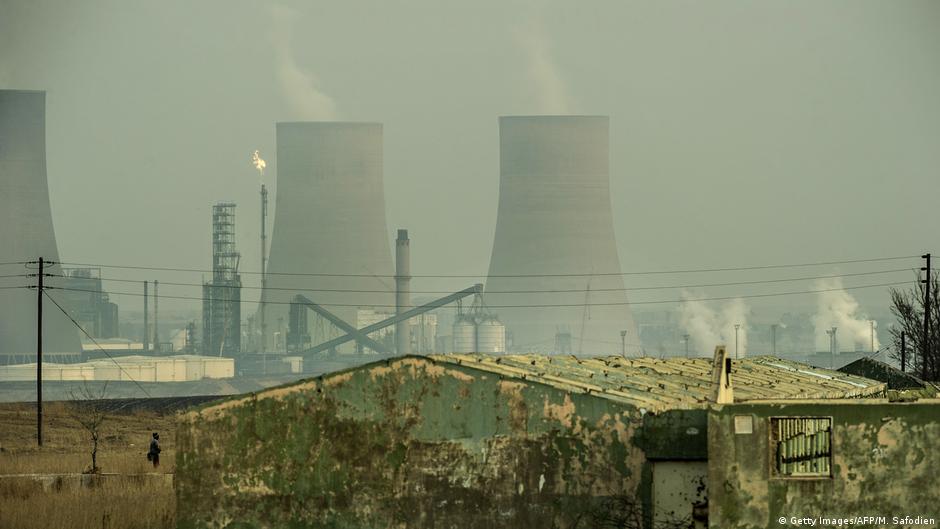
As COP30 in Belém looks for ways to phase out fossil fuels, South Africa has already charted its own path. In July, South African President Cyril Ramaphosa described his country’s Northern Cape as “at the forefront of the clean energy revolution”.
But a preliminary study presented at the People’s Summit – a parallel event organized by NGOs and civil society – warns of the risk of the region becoming a “sacrifice zone”. Environmental experts use this term to describe areas that are burdened by pollution and threatened by resource exploitation or industrial projects.
Researchers say that unfair taxation in these areas plays a key role in profiteering multinationals and leaving local communities behind.
Taxation and climate
“We wanted to show how taxation and climate are deeply linked,” Jaco Olofsen of the Cape Town-based NGO Alternative Information and Development Center (AIDC) told DW. He links the findings to climate discussions in Brazil, linking it to United Nations Tax Conference talks in Nairobi, Kenya.
The study is part of a forthcoming report by AIDC, Brazil’s Justica Nos Trilhos and the Philippines-based Asian People’s Movement on Debt and Development. It argues that the struggle for transition minerals reinforces long-standing extractive patterns in the region.
The organizations presented three case studies from South Africa, Brazil and the Philippines – highlighting “how mining and gas companies benefit from tax incentives, potentially enabling tax evasion and illicit financial flows, and raising broader questions about development and climate justice,” Olofsen said.
special economic zone
The Northern Cape is South Africa’s largest and driest province, shaped by a mining boom for more than a century that has enriched a handful of powerful companies, the most famous of which is the diamond industry.
Communities with high unemployment rates still suffer the toxic legacy of extraction. In Kagung, northern South Africa, residents report respiratory illnesses linked to manganese dust and explosive debris. Abandoned dumps and asbestos remains still spread across parts of Namaqualand, threatening the fragile ecosystem and public health.
The South African government’s recovery plan relies on two special economic zones (SEZs), both of which promise investment, jobs and play a central role in South Africa’s hydrogen and critical minerals strategy.
While they also offer generous tax incentives – including a 15% lower corporate income tax rate, VAT exemptions and payroll incentives – there is little public accounting of the real costs, according to the study.
The future port of Bouégouebaai is planned to host a deepwater facility and a green hydrogen export hub, which will be operated by petrochemical giant Sasol.
Yet Sasol – one of 57 companies responsible for 80% of global carbon dioxide emissions Carbon Measures Database – stated as early as 2025 not to stop coal based production Even as it invests in hydrogen for export markets.
However, this week, Sasol told DW in a written statement, “It is not expanding coal-fired generation in South Africa,” and “it remains fully compliant with South Africa’s air-quality standards by April 2025 and is committed to cutting greenhouse gas emissions by 30% by 2030.”
royalty and tax losses
“We need to ask whether countries should subsidize fossil fuel companies or finance mining operations solely for export,” tax justice researcher Olofsen told DW.
“And equally important is whether these corporations are being taxed appropriately – especially when so many corporations are structured through, or effectively based in, tax havens.”
Unlike Boégoébai, Namakva Sage Overlaps with an existing operation: the massive Gamsberg zinc mine owned by India’s Vedanta Zinc International.
Vedanta faces a worrying environmental track record overseas, including in Zambia and India.
According to the study, its local expansion – framed as a way to “redress past injustices” – raises concerns about surveillance, community impact and the appropriateness of giving additional tax incentives to already planned private investments.
DW asked Vedanta how the company intends to address the environmental impacts for which it has been criticized, but has not yet received a response.
Beyond environmental issues, Vedanta and its partner Frontier Rare Earths both channel their South African investments through Mauritius and Luxembourg, where there are lower withholding taxes on royalties and dividends, the report said.
While not illegal, such structures increase the risk of profit shifting and tax losses – an important issue as Global South nations push for a UN tax convention to curb illicit financial flows.
Mining giant Vale faces investigation
In Brazil, studies led by the Instituto Justica Fiscal revealed that the Swiss subsidiary of mining giant Vale was allegedly at the center of a mining tax strategy to reduce the company’s tax burden in Brazil. Vale alone has reportedly lost a total of R$1.83 billion (€306 million) in local mining taxes.
For years, Vale allegedly sold iron ore to its subsidiary in Switzerland at below market value. From Switzerland, the ore was then sold to China at a much higher price, allowing the company to avoid taxation on the real value of the product.
But no ship ever passed through Switzerland. In 2024, the company confirmed that it maintains subsidiaries in Switzerland, without giving reasons, noting that China remains the main buyer of Brazilian iron ore so far.
Jaco Olofsen told DW that this is not the structure described in the case of South Africa’s Northern Cape, but that “there are mining companies in South Africa that outsource their marketing and sales to a related entity based in a tax haven.”
“But that offshore company often provides no real services. Its main function is to shift profits away from high-tax jurisdictions such as South Africa and Brazil and into places with low or no taxation.”
Separately, Vale has faced allegations linking its mining operations to environmental destruction. Minas Gerais, Brazil State and serious human rights violations.
Edited by Cai Nebe