
For Matthias Ruth, there is no question of moving his business away from China – despite growing government warnings about the risks of investing too much in the country.
As the managing director of Frankfurt-based rare earths and commodities trading firm Tradium notes, China remains fundamental to the business, as the country has almost complete dominance over the increasingly important rare earths sector.
“For example, China has covered more than 95% of the rare earth market, you cannot replace it in a short time,” he told DW. “These are long-standing and trusted business relationships, and the ingredients and processes are proven.”
For Ruth and many other companies in Germany, China remains an obvious place to do business. For a long time, the German government fully embraced and encouraged that position.
However, the country’s authoritarian transition under President Xi Jinping – which has seen China back Russia after its invasion of Ukraine – has transformed EU-China relations.
The geopolitical situation has changed and for the last few years, the German government has talked about “de-risking” [reducing dependencies on a single country for components, goods or raw materials — the ed.] From China, not least because of the risk of foreign companies facing harsh measures from Chinese authorities.
Recently, German Chancellor Friedrich Merz said of German companies operating in China: “When I meet them I always tell them: ‘If things go wrong it’s your risk, please don’t come to us.'”
Earlier this week, German Finance Minister Lars Klingbeil visited China to discuss the two countries’ growing economic ties.
Speaking in Beijing, he said Germany “sees fair competition under threat and also sees industrial jobs under threat,” but he stressed the need for dialogue, saying: “We have to talk with China rather than about China.”
a love story in cars
China is clearly a relationship that German industry finds difficult to abandon, and with good reason. Earlier this week, China overtook the US to once again become Germany’s top trading partner. Trade between the two countries stood at €185.9 billion ($215 billion) between January and September this year.
For decades now, major German industrial giants have prioritized the huge Chinese market and investment volumes remain high.
according to a A recent study by the Mercator Institute for China Studies in BerlinGerman foreign direct investment in the first half of 2024 accounted for 57% of total EU investment in China, accounting for about 2.3% of German GDP. It said investment volumes are still increasing, with corporate investment expected to increase by €1.3 billion between 2023 and 2024.
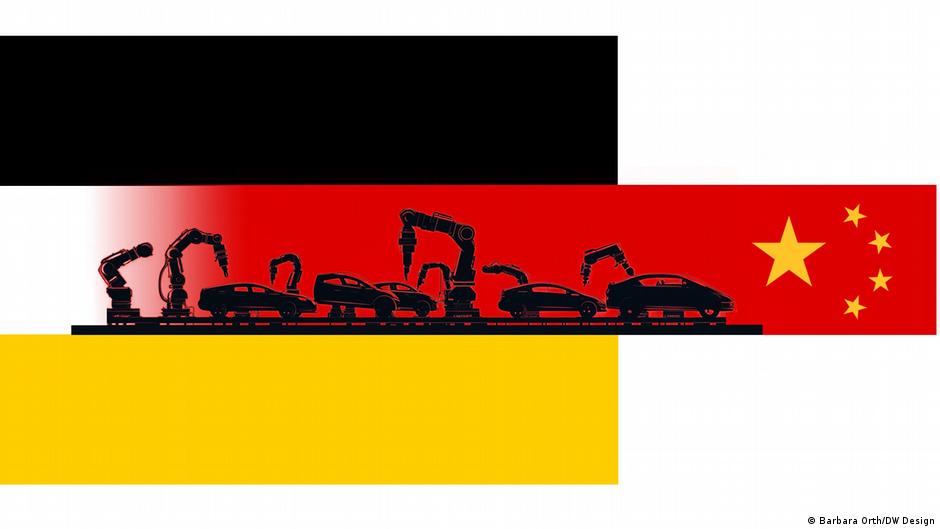
Car manufacturing is one of the areas in which Germany and China are most at loggerheads. Some of the largest German carmakers, such as Volkswagen and BMW, have invested and earned billions of dollars in China over the past few years, and despite recent serious struggles, still maintain hopes for long-term success.
BMW recently invested €3.8 billion in a battery project in the city of Shenyang and the company told DW it has no major plans to move away from the country.
“The BMW Group is represented in the Chinese market by two joint ventures and operates several plants there,” Britta Ulrich, a spokeswoman for the carmaker, told DW. “In our largest single market worldwide, we pursue a long-term market strategy, which we regularly review and adjust as necessary. There are no fundamental changes to our activities in the region.”
However, despite China’s continued importance to German carmakers, relations are undergoing a fundamental shift – and not just because of geopolitics. The intense competition that German carmakers now face from Chinese rivals and the perception that part of that competition has been achieved through Chinese industrial practices undermines global trade rules.
“It is important that both sides have equal competitive conditions and equal opportunities,” a spokesperson for the German Association of the Automotive Industry (VDA) told DW. “In this context, China is called upon to approach Europe with constructive proposals, persistently and swiftly stop anti-competitive behaviour, and ensure free trade under the current situation.”
Yet despite China’s continued importance to German business, financial pressures are coming from all sides. German exports to China have declined by 25% since 2019, while main German carmakers Volkswagen, Mercedes and BMW have seen their market shares decline rapidly over the past few years as China ramped up its own electric vehicle production.
A VDA spokesperson said that while “required de-risking is being rigorously adopted and implemented by companies in the automotive industry,” it “must be politically enabled, not just demanded.” They also emphasize that reducing risk should not mean “closing the markets”.
“The best policy is to do everything possible to promote business space, competitiveness and growth,” he said. “This not only creates a stronger negotiating position but also promotes investment and innovation domestically.”
The cold reality of market pressure
Rare earth trader Matthias Ruth says it’s important to remember that his business contacts in China are also affected by geopolitical tensions.
“The current difficulties arise mainly from political decisions, not from the suppliers themselves,” he said.
Their business has been mainly affected by China severely restricting the export of rare earths, which has also disappointed their suppliers. “They also face disadvantages and challenges from existing export restrictions,” he said.
He says his company faces not political pressure to “reduce risk” from China, but the cold reality of market pressures due to global tariffs and China’s export restrictions.
“For a supplier like us, this means that long-established sourcing routines no longer work as reliably as they used to,” he says. “We still rely on our old Chinese partners, because for many materials, there is no way to avoid China.”
Still, he noted that his company is putting more time and effort into establishing supply options outside China. “This is not about politics telling us what to do. This market is forcing every serious trader and raw material processing company to rethink their sourcing strategy – and this pressure will only increase. This is the daily reality.”
Edited by: Rob Mudge