
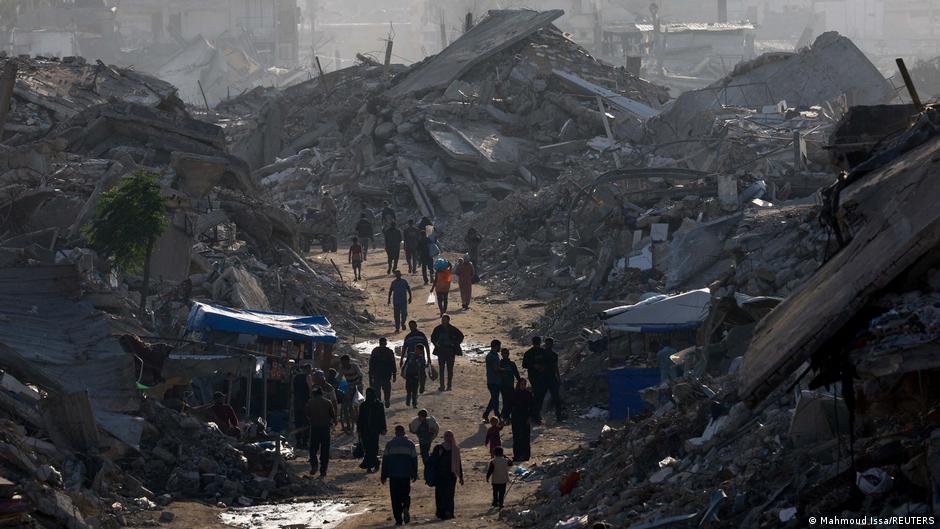
The International Stabilization Force (ISF) for the Gaza Strip will be tasked with securing border areas, protecting civilians and aid operations, securing humanitarian corridors, and ensuring the demilitarization of Gaza, among other tasks envisioned in US President Donald Trump’s peace plan.
However, even after the UN Security Council approved the formation of the ISF last week, it is still not clear which countries will participate in it.
Egypt, Turkey and Azerbaijan have already indicated they would be willing to participate, as have two Asian countries: Pakistan and Indonesia, the world’s two most populous Muslim-majority nations.
key to muslim nation peace plan
Former Pakistani Ambassador Hussain Haqqani told DW that the fact that several Muslim-majority countries are considering this mission is no coincidence.
The European Union as well as the United States, Germany and several other Western countries have classified Hamas – whose October 2023 attack on Israel triggered the war in Gaza – as a terrorist organization.
In contrast, support for Hamas remains high throughout the Arab world. According to Haqqani, this is why “the Pakistani people, Israel and the Pakistani government believe that the stabilization of the Gaza Strip cannot be entrusted solely to Western armed forces.”
Haqqani, who is currently a senior fellow at the Hudson Institute in Washington DC, said US President Trump probably also recognizes this. Trump has sought military contributions from Muslim-majority countries
Haqqani said this was because “it would be more reassuring for the Palestinians and the people of the Gaza Strip if the stabilization forces deployed there were not perceived as supporters of Israel.”
What will Pakistan have to do to join ISF?
However, Haqqani also said that there are several pre-conditions for Pakistan’s participation, the first of which is that other Muslim nations also participate in the stabilization force.
“Secondly, Pakistan wants a clear signal that the stabilization of the Gaza Strip is a step towards recognizing Palestinian statehood as the final solution,” Haqqani told DW.
“Thirdly, Pakistan does not want to see itself in a situation where its troops have to fight against, for example, Hamas or the Israeli armed forces.”
Katja Mielke, a Pakistan expert at the Bonn International Center for Conflict Studies (BICC), said armed escalation would be extremely risky for the Pakistani government.
“There are strong liberal and leftist forces in Pakistan that strongly support Palestinian interests,” Mielke told DW.
He said that, with regard to Trump’s plan, these forces already suspect that “joining the ISF could weaken Palestinian interests and Pakistan itself making a stooge of the Israeli state,” which “is certainly a risk for the government in Islamabad in terms of domestic politics.”
Indonesia waits for signal from Arab world
Like Pakistan, Indonesia also places great emphasis on the participation of Islamic countries.
Earlier this week, Indonesian Defense Minister Sjafri Sjamsoedin was quoted as saying that Indonesia would be ready to send troops with the ISF if the Arab countries give the green signal.
Additionally, Szaffrey reportedly said Israel’s approval would also be required.
Hikmahanto Juwana, an international law professor at the University of Indonesia, told DW that Indonesia is committed to the ISF because its citizens stand in solidarity with the Palestinians.
He said Indonesia’s commitment is based on the preamble of its constitution, which states, “Colonialism must be ended in the world because it is not consistent with humanity and justice.”
Furthermore, Indonesia has extensive experience in UN peacekeeping missions.
“For these reasons, our government is ready to send troops,” Juwana said.
Dennis Surasana, head of the Konrad Adenauer Foundation office in Jakarta, also considers Indonesia’s foreign policy traditions as a strong reason for potential involvement in the Gaza Strip.
“Since the Asia-Africa Summit in 1955, Indonesia has seen itself as one of the leading countries of the Global South,” Surasana said.
“Peacekeeping missions or UN peacekeeping forces and participation in them are traditionally viewed by governments as an act of solidarity between states of the global South, as part of South-South cooperation,” Surasana told DW.
Surasana pointed out that Indonesia is committed to a two-state solution between Israel and the Palestinians:
“Although Indonesia still does not officially recognize Israel and therefore has no diplomatic relations with the country, Indonesian President Prabowo Subianto made it clear in his speech to the UN General Assembly in September that he will recognize Israel’s right to security and existence within the framework of a two-state solution.”
Maintaining stability in the Gaza Strip
“And there is another important point: despite its solidarity with the Palestinian side, the Indonesian government does not accept Hamas as the legitimate representative of the people in Gaza,” Suarsana said.
“On the contrary, another condition for its participation is that the Palestinian Authority… agrees with the ISF,” Surasana told DW.
The Palestinian Authority currently administers part of the West Bank and is seen as a rival to Hamas.
Indonesian law professor Hikmahanto Juwana said that if these conditions are met, there will be stability in the Gaza Strip. He said Indonesia, with a population of more than 285 million, is ready to deploy about 20,000 troops to the International Stabilization Force.
“On this basis, violence, including renewed aggression, between Israel and Hamas must be stopped,” Juwana said.
Pakistan expert Katja Mielke said stability is also important from the Pakistani perspective.
“The country is putting itself at a certain risk internationally with its commitments, for example with regard to Qatar, which is said to have good relations with Hamas,” he told DW.
This article was originally published in German
Edited by: Darko Janjevic