
Since joining the EU more than 12 years ago, Croatia has built its image as a cooperative partner within the 27-nation bloc.
Unlike its more problematic neighbor to the north, Hungary, Croatia has not pursued a foreign policy that deviates from the EU mainstream and has supported all EU sanctions on Russia. It has also played a constructive role with other countries in the Balkans that wish to join the EU.
Even from the point of view of domestic politics, everything seemed more or less stable. Croatia has experienced slow but steady economic growth. A coalition led by the conservative Croatian Democratic Union, or HDZ, has ruled the country for years. The coalition led by Prime Minister Andrej Plenkovic is now in its third term.
Some have described Plenkovic as a “servant of Brussels”. He is considered a liberal, but at the same time, he is able to keep the more conservative forces in his party and in Croatian society in general satisfied.
This stability also benefited Croatia’s minorities, and especially the Croatian Serbs, the country’s largest minority. Right-wing nationalists often tried to scapegoat the Serbs but the Independent Democratic Serb Party, or SDSS, was Plenkovic’s longtime coalition partner. This meant that anti-Serb excesses were mostly a marginal political phenomenon.
Popular music show encourages far-right extremists
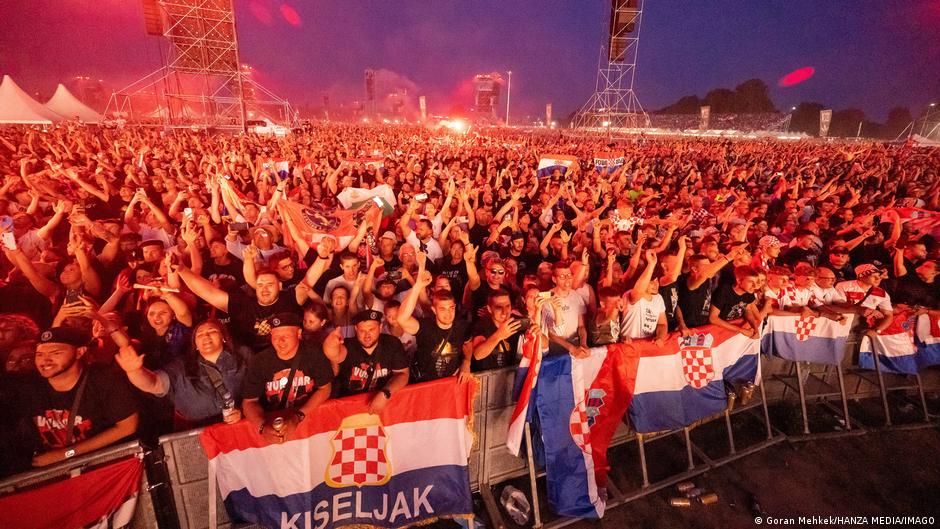
All that seemed to change this summer. The turning point came during an open-air concert of Croatian rock singer Marko Perković, whose stage name is “Thompson”, after the machine gun he used during the Croatian War of Independence between 1991 and 1995.
Perkovic is known for his nationalist and even far-right lyrics. One of their biggest hits begins with the call, “For the Motherland – ready!”, the salute used by Croatia’s Nazi-era Ustasha regime, which ran concentration camps during World War II.
Previous concerts have been canceled due to their far-right focus, but this has not diminished their popularity. About 500,000 people attended the concert in Zagreb on 5 July, held at the city’s hippodrome. Before and after the concert, fans displayed Ustasha insignia and chanted slogans. The police present at the concert did not intervene.
The day before the concert, Prime Minister Plenkovic attended the rehearsal with his children and had his photo taken with Perkovic. Other ministers and members of Parliament also claimed to have attended the concert.
Croatian journalist and regular columnist on cultural affairs Jurica Pavicica said that the concert acted as a starting gun for the country’s far right.
“There were a lot of people there and a large number of neo-Nazi statues,” he told DW. “The previously moderate-conservative government succumbed to this mob.”
‘The space for freedom is shrinking in Croatia’
Perkovic’s concert had a significant impact. Throughout the summer, veterans’ associations held protests in various cities, trying to stop cultural festivals they considered too liberal.
Croatia’s Serbian minority is being continuously targeted. In early November, black-clad members of the Torcida Split football fan group violently disrupted a folklore and theater evening in Split. The purpose of this event was to start the days of Serbian culture festival. The football militants shouted fascist slogans and insulted the Serbs.
On 7 November in Zagreb, masked persons tried to prevent the opening of an exhibition at the Serbian Cultural Centre, until police were able to disperse them. The masked men chanted the same Ustasha slogan, “For the Motherland – ready!” And also threatened and humiliated the Serbs.
Two days later, individuals in Rijeka tried to disrupt a martial arts tournament in which Serbians were competing before being stopped by police.
Croatian politicians reacted very slowly to these developments. Prime Minister Plenkovic condemned the incidents and said there was no room for intolerance in Croatian society. He rejected accusations that his government was tolerating fascist Ustasha ideologies.
Vesna Tercelic, head of the Zagreb-based Documenta – Center for Dealing with the Past, sees it differently. Tercelic believes that the actions of some of Croatia’s most senior politicians are responsible for the growing xenophobic and aggressive atmosphere in the country.
“It is sad to see how the space for freedom in Croatia is shrinking,” he told DW.
Is Croatia’s Prime Minister guilty?
Tercelic said, “Croatia has not faced its past and its institutions are unable to in the present – and I really wonder whether they want to guarantee freedom of expression, creativity, media and education to all people living in the Republic of Croatia.”
Linking the past and the Ustasha has been going on for some time, he said, but this latest step is the most problematic.
“I hold the Prime Minister directly responsible,” she said.
Pavcic, a cultural affairs columnist, sees what is happening in Croatia as part of a general political movement in the right direction across Europe. If Croatia’s Prime Minister is responsible, Pavčić believes it is because of his lack of strong action against the far right.
“It’s a mixture of opportunism, cowardice and a sense that the entire political momentum has shifted to the right,” he said.
So far, Croatia’s newly resurgent far right has mostly limited itself to threats or intimidation. But Pavcic said that in general the atmosphere has become more aggressive.
Asked if he believed this would lead to violence, he responded, “Yes, it’s possible. It wouldn’t surprise me.”
This article was originally written in German.