
The arrival of cryptocurrency exchange-traded funds (ETFs) has been seen as a driving force for retail and institutional investing. However, the litecoin fund (LTC)—issued by Canary Capital and which debuted on October 28—has a performance that reflects that litecoin is disappointing on Wall Street.
With minimal or sometimes zero net capital flows, the Litecoin ETF shows how little appetite there is for this asset among traditional investors. This financial instrument exhibits a demand pattern that is far from the enthusiasm that usually accompanies these financial products.
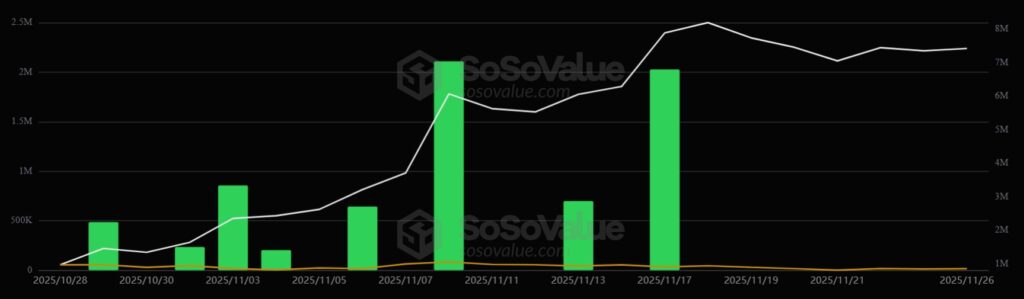
In almost a month, the fund has barely recorded eight days with capital inflows, compared to twelve full days without net movements, an unmistakable sign of lack of interest.
His last significant entry came on November 17, when he received $2 million. After that point, the fund had seven consecutive sessions without capital flows, its worst streak since its debut. This can be seen in the following graph.
These results contrast with the common expectation that an ETF will act as a bridge for those seeking simple, regulated exposure to a digital asset. In the case of LTC, the market message is forceful: An ETF does not guarantee adoption, price increases, or success.
Utility vs. narrative, the gap that weighs on litecoin
Mike Fay, cryptocurrency market analyst, had already warned of this scenario before the launch of the ETF. According to Fay, today the engine of “adoption” It is not the real utility of the assets, but the capital flows directed to investment instruments.
And, in his opinion, Litecoin does not have a sufficiently attractive narrative or a differentiated value proposition that motivates investors to include it in their portfolio.
This reading contrasts with the case of bitcoin (BTC) ETFs, which They have managed to consolidate themselves as a reserve of value in the imagination of Wall Streetdriving demand for its financial vehicles.
Ethereum, a precedent that explains part of the phenomenon
The weak performance of the Litecoin ETF finds certain parallels in what happened with the ETFs linked to ether (ETH), launched in mid-2024 in the United States, as reported by CriptoNoticias.
Despite the technical strength of the Ethereum network and its central role within the decentralized finance (DeFi) ecosystem, these products failed to replicate the overwhelming success of bitcoin ETFs.
While ether funds saw periods of good performance – particularly between June and July of this year – their overall numbers remain modest against the market-leading digital currency.
In total, ether ETFs manage around 18 billion dollars in net assets, a figure that pales when compared to more than 117 billion of dollars managed by bitcoin-based financial products.
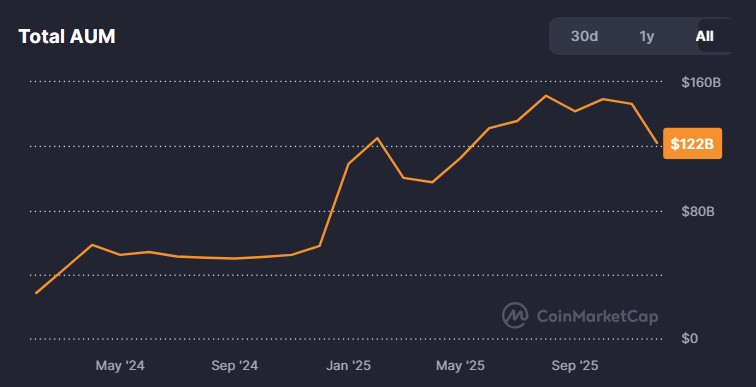
This stark disparity illustrates investor caution and confirms that the introduction of an ETF, although relevant from an infrastructure point of view, does not by itself guarantee a sustained flow of capital if the underlying asset lacks a sufficiently robust value narrative.
The lesson that Litecoin leaves on Wall Street
The poor performance of the Litecoin ETF suggests that market demand is highly selective. Today, investors appear to prioritize digital assets that combine narrative strength, perceived utility, and a track record of proven resilience. Litecoin, in this context, is failing to meet those expectations.
The disappointment of the product in its first month leaves a relevant lesson: the maturity of the market forces cryptocurrencies to compete not only in technology, but also in cultural and financial relevance. In that race, at least for now, the Litecoin ETF is disappointing on Wall Street.