
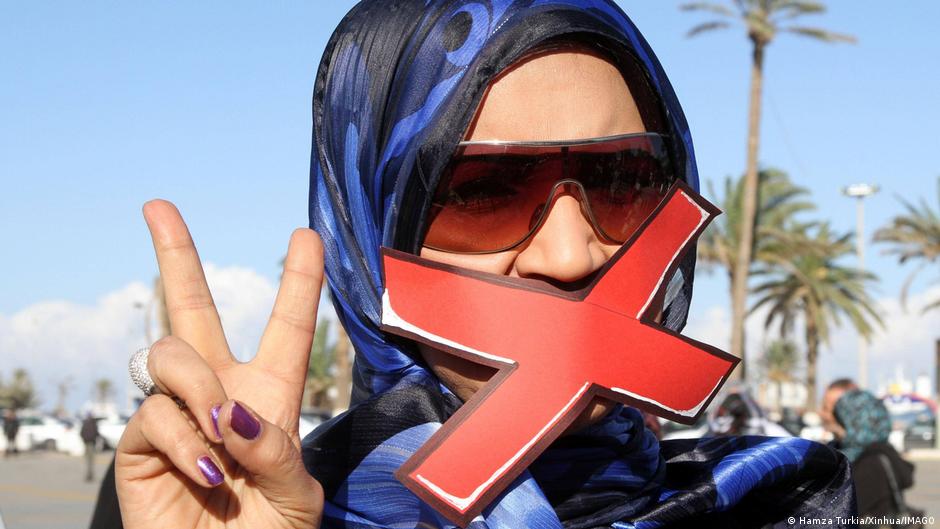
Within the first week of the current United Nations (UN) campaign in Libya, “16 Days of Activism against Violence against Women and Girls”, the murders of three Libyan women made headlines.
Social media influencer Khansa al-Mujahid was shot while driving near Tripoli. Gynecologist Amani Hazza was murdered by her family members in the city of Misrata, and the woman’s body, found in a basin southeast of Tripoli, has not yet been identified.
Attorney General al-Sediq al-Sour in Libya’s western political capital, Tripoli, called for an immediate and transparent investigation into the crimes.
However, Asma Khalifa, a feminist and co-founder of the Libya-based think tank Tamazight Women’s Movement and a research fellow at the German GIGA Institute of Middle East Studies, says she has no expectations that the investigation will be successful and the perpetrators will be held accountable.
“Libya lacks laws to protect women, and even if there are laws, there are no police to enforce them,” Khalifa told DW.
“Without accountability there is no protection for Libyan women,” she underlines.
An effort to create a comprehensive framework to recognize all forms of violence against women, including physical, sexual, psychological, economic and digital violence, is pending from November 2023.
During the initial phase of the 16-day UN operation, Hannah Tetteh, the Special Representative of the UN Secretary-General for Libya and head of the UN Assistance Mission in Libya, reiterated the need for legislation.
“In particular, I would like to emphasize the urgency of adopting the draft law to protect women from violence – an important law drafted by Libyan experts,” she said. Said In a statement.
Libya’s competing governments are increasing women’s insecurity
“Violence against women is neither a new nor a sudden phenomenon,” said Ali Omar, director of the Britain-based non-governmental human rights organisation. libya crime watchTold DW. “The violation rate has been high for years.”
However, Omar says many crimes are never reported.
“Victims are pushed into silence because they fear their perpetrators, social pressure, stigma, and social or religious interpretations,” she said.
Moreover, some factors make it almost impossible to get reliable data, Ali Omar said.
First, there are no reliable statistics on violence against women in Libya. The country has been without a centralized government since longtime leader Muammar Gaddafi was overthrown and killed in a NATO-backed rebellion in 2011. Three years later, the North African country split into rival administrations. Prime Minister Abdul Hamid Dbeibah heads the Government of National Unity, or GNU, which is referred to as the “Libyan Government” on its official Facebook website. The administration is based in Tripoli and is UN-backed and internationally recognized.
In the country’s eastern city of Benghazi, Prime Minister Osama Hammad leads the Government of National Stabilization, or GNS. Hammad is backed by General Khalifa Hiftar, a strongman in Libya’s east, and his Libyan National Army.
Both sides are supported by foreign governments and armed groups.
Additionally, cases of violence in government institutions are rarely reported due to the influence of armed groups, Asma Khalifa said.
In her view, this void leaves women vulnerable to political intrigue and violence by armed groups.
“The armed groups not only control the country’s resources, but also control Tripoli, where they are trying to exert influence by fighting each other,” he told DW.
“It is not uncommon for women to marry someone influential in an armed group just to make life a little easier,” Khalifa said.
In her experience, this exposes Libyan women to another level of violence.
“Since 2020, when I started tracking news of women being murdered, most of them had husbands at home who were either members of armed groups or had previously fought in wars or experienced some kind of trauma,” Khalifa told DW.
Keeping weapons in private homes is very common in Libya, he said.
workers pick up the pace
Khalifa also said that a large portion of the Libyan population has normalized domestic violence and that insensitive attitudes about it are “quite prevalent.”
However, this may change.
In late November, Libyan activists launched online campaign It translates to “do not marry a militia man” in Arabic, according to a statement by Imad Trabelsi, interior minister of the Tripoli government’s national unit.
After the murder of Khansa al-Mujahid, he commented in a video that the police could not do anything in this case. He also said that it is impossible to station a police officer in front of every house or car and crimes happen even in major countries.
On Monday, four days after its launch, the campaign had received over 19,200 clicks and over 3,000 comments on Facebook.
Edited by: Carla Bleiker