
The drop responds to high expectations for an interest rate cut in December.
This is a good sign for alternative assets, such as bitcoin.
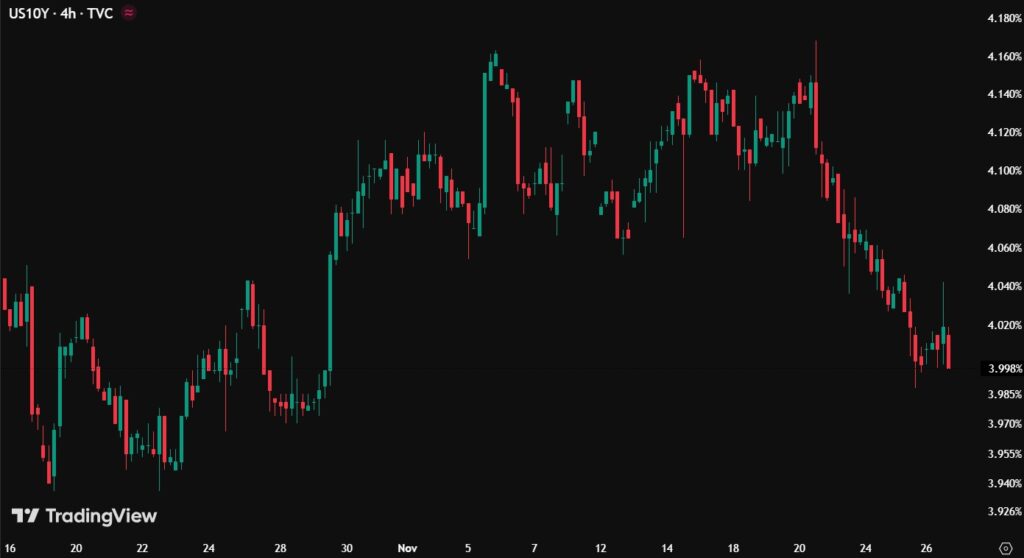
The 10-year US Treasury yield fell below 4%.
As seen in the graph below, the profitability of US debt fell to levels not seen in a month:
The yield on Treasury bonds works as a rate that reflects how much an investor earns relative to the price at which they purchase that bond. Although the interest paid by the bond is fixed, Its price on the secondary market varies according to demand.
When more investors seek refuge in US debt or anticipate changes in monetary policy, demand for these instruments increases, raising their price.
And because interest remains constant, a higher price means that fixed payment is spread over a larger base. So the performance—or yield— decreases.
Treasury yields fall as rate cut looms
Yields fall mainly when the market anticipates that the Federal Reserve (FED) will reduce interest rates. In this context, investors buy more bonds to ensure returns before new issues offer lower interest rates. That greater demand pushes prices up and pushes the yield down.
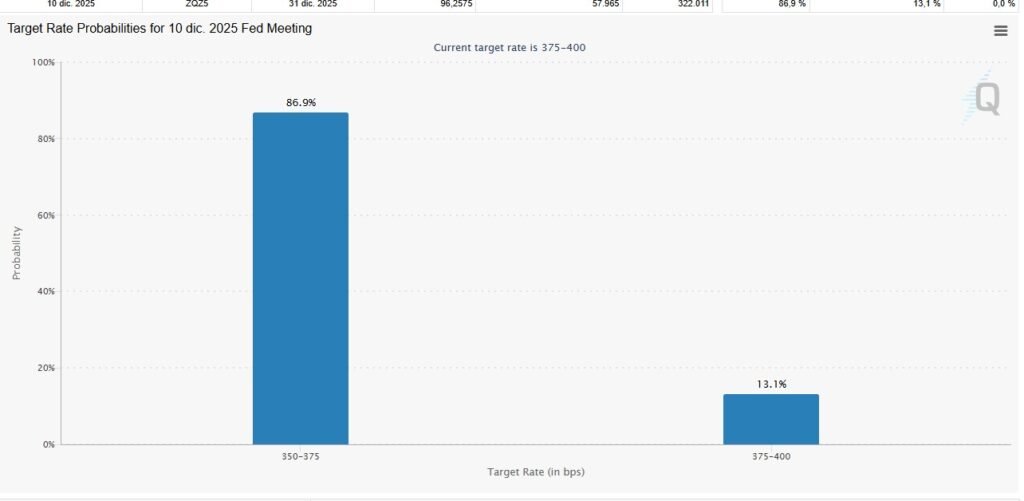
Indeed, the bearish movement is associated with the growing expectation that the FED will lower interest rates at the next meeting of the Federal Open Market Committee (FOMC), scheduled for December 10.
CME Group data show that the market assigns a probability of 86.9% to a reduction in the target range towards 3.50%-3.75%, compared to just 13.1% that estimates it to remain at 3.75%-4.00%.
This drop in performance has several implications for the market. On the one hand, fixed income loses relative attractiveness compared to assets with greater appreciation potential, favoring instruments considered riskier. On the other hand, an environment of lower rates and lower yields releases liquidity, which facilitates part of the capital to migrate to other marketssuch as stocks or digital currencies like bitcoin.
What does it mean for bitcoin?
For the Venezuelan economist specialized in bitcoin and digital assets, Daniel Arráez, the drop in yield below 4% strengthens the influx of liquidity towards alternative assets, such as BTC. “The appetite for riskier assets is enhanced and it distances you from safe assets,” he explains.
In dialogue with CriptoNoticias Arráez pointed out that, in this context, “the liquidity produced by releasing these assets would significantly favor bitcoin and other digital assets.”
He also highlights that both the reduction in yield and an eventual rate cut in December are “a liquidity boost.” This, again, opening investors’ appetite for risk assets that can generate higher returns.
However, it warns that geopolitical factors—including tensions in the Caribbean and the evolution of the conflict in Eastern Europe— They could alter the scenario and once again favor the search for refuge.
Looking ahead to the FED meeting on December 10, the market remains attentive to signals about the path of rates.
If the cut is confirmed in December, bitcoin could operate in a historically favorable environment, although subject to macroeconomic and geopolitical conditions that define the pace of global liquidity.