
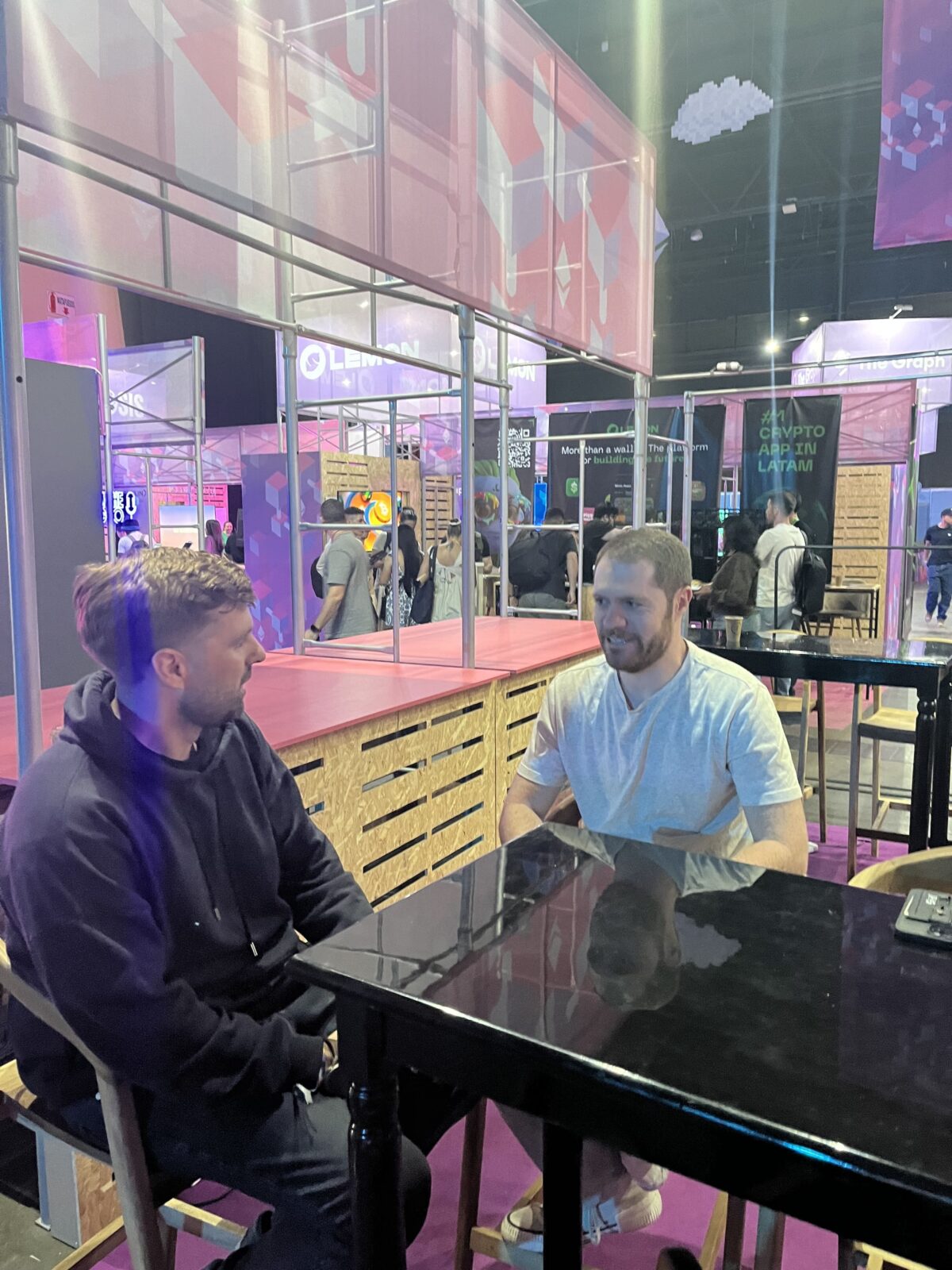
A new update has arrived on Ethereum: Fusaka. In this framework, Jason Chaskin, researcher at the Ethereum Foundation (EF), emphasized that one of the most relevant elements of this hard fork marks a turning point for the network.
Chaskin, in an exclusive interview with CriptoNoticias during Devconnect Argentina, summarized what, in his opinion, is Fusaka’s central contribution:
It is the first time Ethereum can scale data availability without compromising decentralization.
Jason Chaskin, Ethereum Foundation researcher.
The EF researcher’s claim was based on the Ethereum Improvement Proposal (EIP) known as “Peer-to-Peer Data Availability Sampling” (PeerDASin English), the new data availability system to be activated with Fusaka:
That mechanism is the centerpiece of a strategy that would allow Ethereum to process more information without requiring nodes to increase their hardwarewhich would favor decentralization.

In addition, Chaskin also highlighted the EIP-7951included in Fusaka, a proposal that enables a cheaper signing method for keys based on modern standards, such as passkeys used by Face ID or fingerprints.
As he explained, this allows a user to authorize a transaction using your usual biometric methodswithout depending on seed phrases, reducing friction and bringing the Ethereum experience closer to that of everyday applications.
On the other hand, Fusaka also says that other important EIPs. For example, the EIP-6800 («Verkle Trees»), a structure that reduces the weight of the data and makes verification within the network more efficient; with EIP-7782a higher gas limit per block is set by default, which enables to include more operations in them.
Jason Chaskin explains PeerDAS’ contribution to the design of Ethereum
The core of Fusaka is PeerDAS, a system that allows you to distribute information in fragments and verify its availability without each node having to download the entire network.
For Chaskin, this capability marks a substantial milestone for Ethereum:
Ethereum is experiencing a historic moment. Finally, the network can fragment data, something it sought from day zero.
Jason Chaskin, Ethereum Foundation researcher.
By reducing the amount of data an operator needs to process, PeerDAS does more light operation of a node and makes it easier for more people to execute them without depending on specialized infrastructure.
A decentralized network remains alive because the nodes are distributed and cannot be shut down.
Jason Chaskin, Ethereum Foundation researcher.
The process is based on two technical elements: «probability sampling and cryptography. This guarantees that complete data is available,” according to the researcher.
In other words, these two technologies allow you to confirm that all the data is available without requiring its complete download.
If something doesn’t match, the protocol identifies it and can reject the block. This would prevent a single entity from controlling the availability of information.
With PeerDAS you download only one eighth of the dataset and you can still verify that the entire network has the data.
Jason Chaskin, Ethereum Foundation researcher.
PeerDAS also boosts the scalability of Ethereum
From this data fragmentation, the network also obtains a benefit in scalability matter.
The key to PeerDAS is allowing nodes to remain small, even while massively increasing the amount of data.
Jason Chaskin researcher Ethereum Foundation.
PeerDAS makes it possible to handle a much larger volume of information without raising the requirements to operate a node, which enables the increase of the amount of blobs that Ethereum can include per block.
The blobsintroduced by the Pectra update, They are temporary “containers” where second layer (L2) networks publish the data necessary to test their transactions.
The greater the capacity to accommodate these blobsthe less competition for space and the easier it is for L2 maintain low and stable rates, even during peaks of activity.
The logic behind that statement is simple: if data capacity expands without sacrificing the ability to keep small nodes running, pressure on rates decreases.
PeerDAS keeps L2 rates low forever. For users, this means that L2 scaling is practically solved.
Jason Chaskin, Ethereum Foundation researcher.
The future after Fusaka and PeerDAS for Ethereum
Both Vitalik Buterin, co-founder of Ethereum, and Justin Drake, one of the most recognized developers of that ecosystem, have proposed the introduction of a virtual machine based on zero-knowledge technologies (ZK-EVM).
Although this is a long-term proposal for the base layer, Chaskin explains that much of that vision already works in practice through L2:
Ethereum already works this way, in some way. Many L2s are already being powered by this technology.
Jason Chaskin, Ethereum Foundation researcher.
Among them he mentions Lighter (an exchange built entirely on tests ZK), in addition to the ZK Sync, StarkNet and Linea networks.
The possibility of integrating a ZK-EVM directly into the base layer opens the door to a drastic leap in capacity, According to what Chaskin said:
The advantage is massive scalability. We are talking about between 100 and 1,000 times more.
Jason Chaskin, Ethereum Foundation researcher.
The key difference is that this performance today is offered by L2, but the vision aims to also incorporate it into the base protocol.
Still, he acknowledges that the transition involves risks. «It is a new technology. It does not yet have the proven track record that the current EVM does,” he warns.
Point out that failures may exist and their impact would be significantalthough methods such as formal verification and specialized audits are already being applied to reduce errors. Even with these precautions, he admits: “That risk still exists.”