

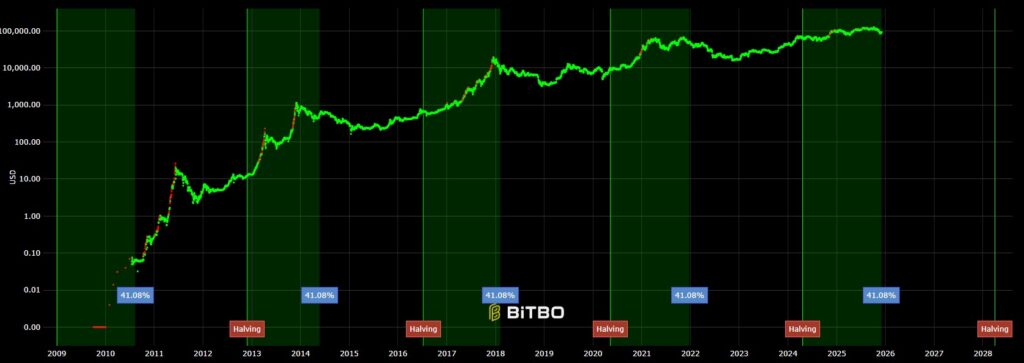
The historical graph of the price of bitcoin (BTC) shows something that, for more than a decade, was almost a dogma: the market cycle is governed by halvings. Every four years, a reduction in issuance triggered explosive bull phases followed by extensive corrections.
However, some analysts argue that, based on recent events on Wall Street, that cycle, best seen in the graph below, could be transforming full.
It happens that there are two institutional movements of enormous weight that signal a structural change that alters the usual dynamics of bitcoin. And that change comes from the evolution of the traditional financial system.
A pragmatic turn in favor of bitcoin
The first determining factor is the shift—not ideological, but pragmatic—of the large capital managers. Vanguard, the second largest administrator on the planet, will allow for the first time exposure to bitcoin.
Juan Rodríguez, Colombian on-chain analyst, resume like this: “Vanguard allows its clients exposure to BTC, due to its influence that will attract long-term investors, retirement and pension funds.”
This decision is not a simple product adjustment. It means that retirement funds, sovereign wealth funds and multi-generational portfolios can now incorporate Satoshi Nakamoto’s invention, whose market capitalization is 1.8 trillion dollars.
The most direct explanation is offers the Spanish bitcoin on-chain analyst Carmelo Alemán. As he sees it, Vanguard is “not changing its moral mind,” but rather is being forced by the market. “Just like what already happened with BlackRock, Fidelity or Schwab.”
“When your clients move billions towards an asset, you cannot afford to be the only closed door in the neighborhood,” says the specialist. According to Alemán, this has nothing to do with speculative bets, but with a turning point. “Bitcoin is no longer optional,” he maintains.
«If Vanguard – the most conservative firm on the planet – opens the door to bitcoin, it is because you can no longer look the other way. It is not an ideological turn, it is commercial survival.
Carmelo Alemán, market analyst.
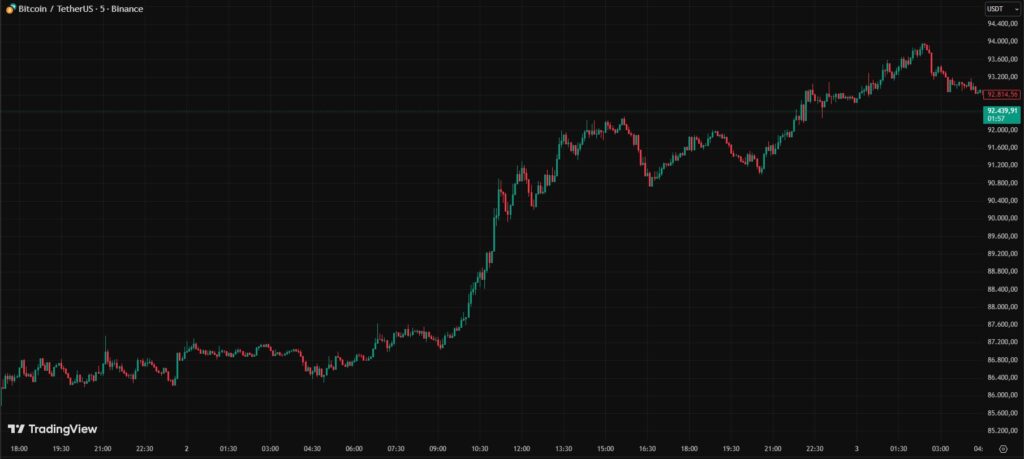
Proof of the impact of this factor is that, after hearing the news, bitcoin soared towards $91,000 on Tuesday, December 2. This is seen in the following graph:
Banks boost bitcoin
The second factor that is causing changes in the bitcoin cycle is the turn of traditional banks and financial entities in favor of BTC. This, remembering the change in position of JP Morgan, as well as the most recent announcement from Bank of America. This bank will allow its advisors to recommend an allocation between 1% and 4% in bitcoin ETFs starting in January, as reported by CriptoNoticias.
Hunter Horsley, CEO of Bitwise Investments, is one of those believe that, with these measures from the banking sector, the bitcoin and cryptocurrency ecosystem “is becoming popular” among investors.
BTC Andrés, commentator and bitcoin enthusiast, highlights that Bank of America’s move “ends a long-standing policy that prevented more than 15,000 advisors from proactively recommending products” linked to digital assets.
It is precisely this impact that leads to the change in the bitcoin cycle, since The tap of institutional investments in BTC is opened through that bank.
For Juan Rodríguez, BTC continues to incorporate users “of different profiles.” Which generates “changes in the cycles” of the digital currency. Thus, he exclaims: “whoever understands and values the long term, accumulates satoshis and redoubles efforts in the falls.”
Why is the bitcoin cycle changing?
Now, why would Vanguard and Bank of America’s moves cause a change in the bitcoin cycle? The answer lies on capital flow which, from now on, will enter bitcoin.
Considering the size of both financial firms and the massive amount of money in their environments, it is feasible that an important flow of resources ends up in BTC. This, taking into account the growing demand that exists at an institutional level for the most valued digital currency on the market.
As the price of bitcoin and its market performance responds to the principle of supply and demand, greater institutional participation thanks to Vanguard and Bank of America, as well as other financial entities, would boost the value of the currency. Even taking it to new heights, as suggested by Venezuelan investor and financial analyst Guillermo Fernandes.
He maintains that the influx of capital from Wall Street, added to institutional capital, will cause the bitcoin market “to be more prone to the behaviors and incentives of other public markets.”
«Large bitcoin treasury strategies will have large incentives to capture profits and rebalance the’cost basis‘—the average acquisition price—near the end of the year, and we will begin to see less defined cycles of 4 years, and closer to 4 quarters,” explained Fernandes.
Matt Hougan, investment director of the Bitwise firm, thinks something similar. The executive considers that the traditional four-year cycle of bitcoin could be altered due to growing institutional interest and regulatory changes in the United States. This, regardless of the halving.
Bitcoin bear market in sight?
However, this alteration or change in bitcoin cycles does not mean that, in the short term, bitcoin is on its way to a new price record.
Agustín Natoli, Argentine technical analyst and investor, explains that We are facing a point of exhaustion of the current cycle. “I don’t think we will make a new high in bitcoin prices, rather I think we are on the verge of a bear market,” said Natoli in dialogue with CriptoNoticias during the most recent edition of LABITCONF.
In his opinion, the market could be at a point where, despite the structural strength of the network, BTC price goes through a bearish period before the next halving in 2028.
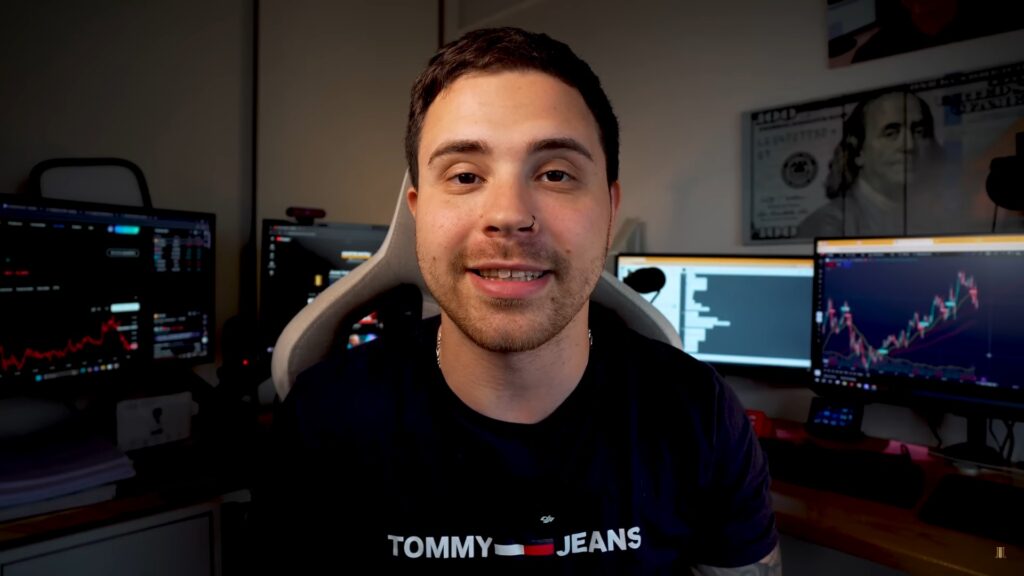
Analyst Iván Paz Chain maintains something similar. He dismisses the idea that ETFs are a support for the asset’s price and considers that the halving (and its respective cycles) continues to be what controls the price of bitcoin. For him, the bear market is imminent, which will take place in 2026.
In any case, bitcoin seems to be ceasing to be an asset that follows mechanical cyclesbut one that responds to global flows, decisions of giant managers and macroeconomic dynamics amplified by programmed scarcity.
Whoever understands this new environment, as Juan Rodríguez says, “accumulate satoshis and redouble efforts in the falls.” Because, according to most analyses, the current cycle is no longer that of 2012, nor that of 2016, nor even that of 2020. Bitcoin entered a different stage. One in which the traditional market no longer looks the other way. And when that happens, the cycles are redefined.