

For Grayscale, bitcoin will set new all-time highs in 2026.
The bitcoin “super cycle” driven by institutional adoption would be occurring.
The idea that the price of bitcoin (BTC) follows an unbreakable four-year “rule,” determined by the halving, is being seriously questioned by investment firm Grayscale.
The bitcoin market is linked to halving cycles, an event that halves the reward for mining Bitcoin. This has marked the cycles in which bitcoin bull and bear markets are experienced every four years. This means that after three years of strong increases, the fourth year (2026) becomes the bear market phase.
However, although the outlook is uncertain, the firm believes that “the four-year cycle thesis will prove incorrect and that the price of bitcoin could reach new highs in 2026.” The central argument is that this cycle has been different from the beginning.
This Grayscale projection suggests that Digital currency is in the midst of a “super cycle” driven by unprecedented institutional adoptionquestioning the validity of the traditional four-year cycle, altering the historical dynamics of the market.
Why did this bitcoin cycle break the mold?
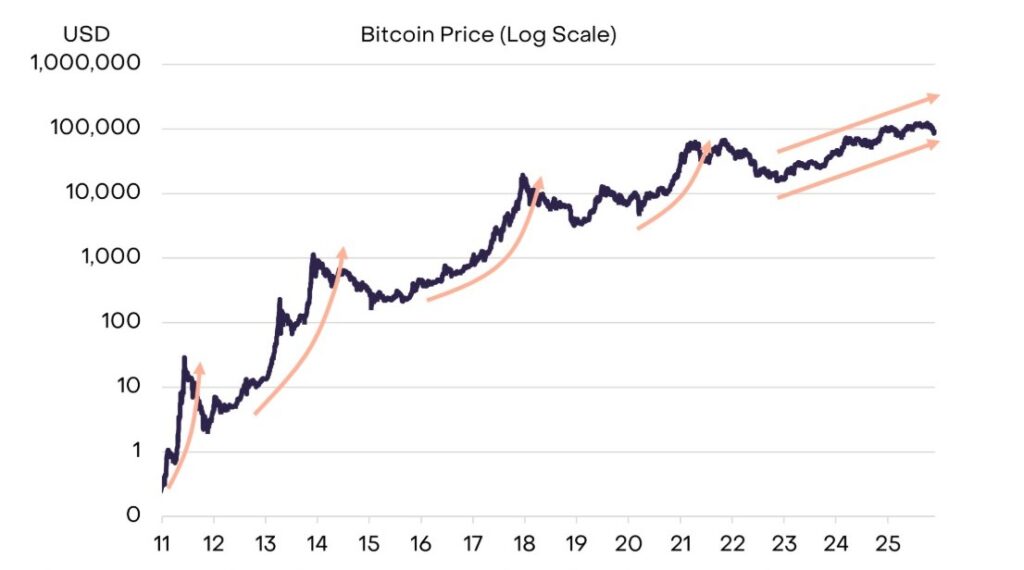
The Grayscale research team explains the two main reasons. The first is that, unlike previous cycles, “there was no parabolic price increase during this bull market that could indicate an overshoot,” he notes.
To better understand the difference with previous cycles, a graph is presented below, illustrating the evolution of the price of BTC throughout its historical cycles and the current trend which, according to Grayscale, lacks the parabolic slope.
While secondly, the structure of the bitcoin market has changed. “The new capital is coming primarily from ETFs and corporate treasuries, not from retail exchange platforms.”
That money flow transformation is key to understanding why bitcoin’s four-year rule could be blown up in 2026.
Grayscale analysts detect signs that bitcoin already hit bottom in November. “The asymmetry of Bitcoin put options is very high, especially for the 3- and 6-month tenors, suggesting that investors have already largely hedged the downside exposure,” they highlight.
Additionally, the largest put options in corporate treasuries are trading at a discount to net asset value, “which could also indicate slight speculative positioning, often a precursor to recovery.”
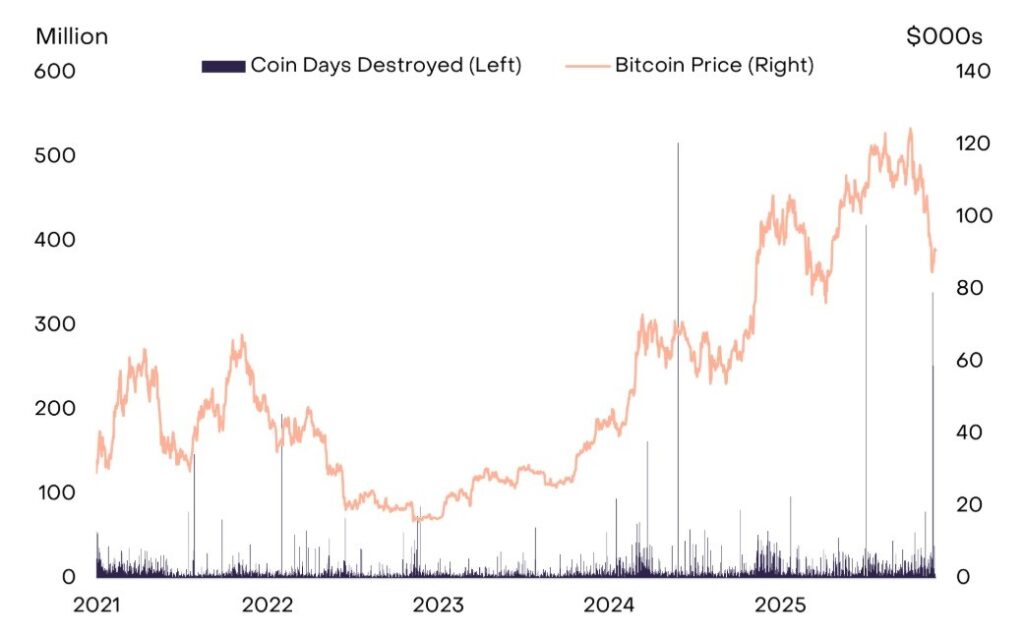
However, Grayscale acknowledges that institutional demand remains tepid. With futures open interest on the decline, negative flows into bitcoin ETFs through the end of November and new peaks in Coin Days Destroyed (CDD), an indicator that tracks the sales movements of old hodlers, known as “OGs” (a term that refers to the first and longest investors in bitcoin).
The chart illustrates the spikes in the CDD metric (vertical bars) along with the price of bitcoin, demonstrating the OGs’ selling movements:
“In many ways, 2025 has been an exceptionally good year for the digital asset industry,” Grayscale summarizes. Regulatory clarity in the United States opened the door to a wave of institutional investment that, according to the firm, “will lay the foundation for continued growth in the coming years.”
The bitcoin super cycle thesis is not alone
There is a division of opinion in the ecosystem about the validity of the traditional 4-year bitcoin cycle. Those who argue its obsolescence, such as Grayscale, point out that Institutional investment and greater regulatory clarity, mainly from the United States, have transformed the market.
Arthur Hayes, founder of the BitMEX exchange, is one of the defenders of this position, ensuring that traditional bitcoin cycles are “dead” and the pattern will fail in 2026 due to macroeconomic factors. He points to a massive liquidity injection by monetary policy makers in the United States and China, which would benefit the asset and prevent the 4-year bearish cycle from materializing.
For his part, Guillermo Fernandes, investor and consultant, agrees with this vision, pointing out that the influx of capital from Wall Street and institutional investment implies that the bitcoin market will be more prone to the behaviors and incentives of public markets, as reported by CriptoNoticias.
This would lead to less defined cycles over a four-year period and closer to quarterly cycles. The perspective of a market more aligned with quarterly incentives and less dependent on the halving calendar is gaining strength.
Opposing voices do not disappear
Not everyone shares the optimism. Henrik Zeberg, chief economist at SwissBlock, warns that “bitcoin is not the safe haven many believe; its correlation with the Nasdaq could drag it into a devastating fall.”
Willy Woo, another analyst from the same firm, assures that “there is still a bullish path, but we expect a bear market once global macroeconomic markets change.”
Bitcoin reached its all-time high of $126,000 on October 6, 2025 and then fell to $80,500 on November 21, a 32% decline. According to historical data, the average corrections in a bull market are around 30%, so the movement is within the norm, Grayscale points out.
The following graph shows the evolution of the BTC price from January 2023 to the end of 2025:
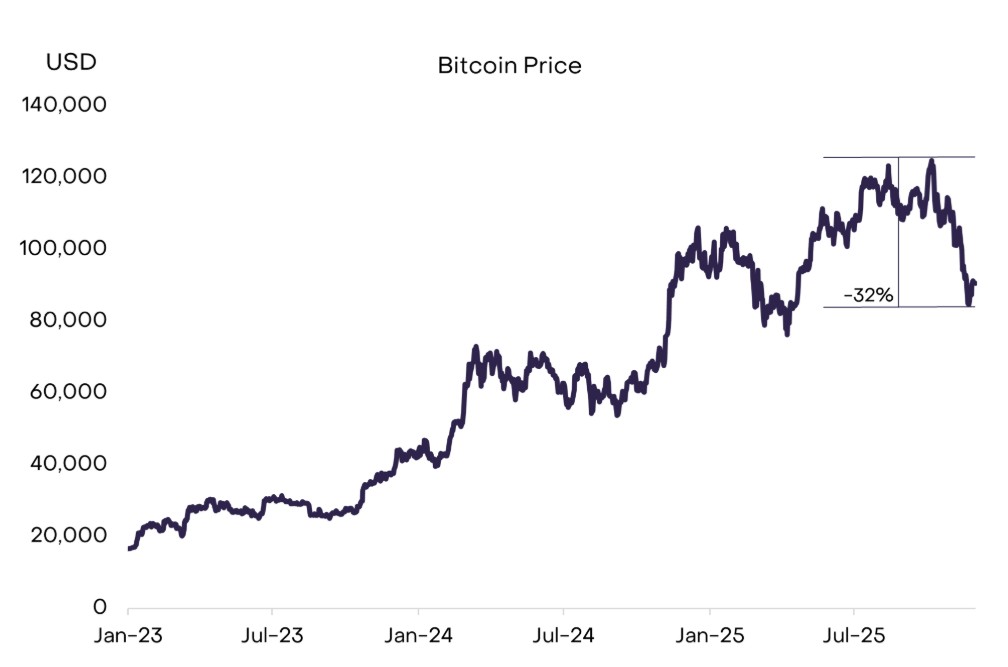
Since 2010, bitcoin has suffered at least 50 falls of more than 10%. In the current bullish cycle, which began after the November 2022 bottom, there have already been nine corrections of that magnitude. “It has been a bumpy period, but not atypical,” Grayscale recalls.
What can trigger bitcoin’s next move?
In the short term, the FED meeting on December 10 will be decisive. “Lower real interest rates should be considered negative for the dollar and positive for assets such as gold and bitcoin,” the report notes.
While in the medium term, the advancement of the cryptocurrency market structure bill (CLARITY Act) in the United States Congress could be the definitive catalyst.
If cryptocurrencies maintain their bipartisan nature heading into the midterm elections, “we could see greater institutional investment and, ultimately, higher valuations,” Grayscale concludes.
The view from Grayscale and other analysts that bitcoin will surpass the four-year “rule” in 2026 is heavily anchored in the evolution of its investor base toward the institutional, a shift that could rewrite the rules of volatility and growth for the digital asset.