

The UBA launched a cryptography research center with support from the Ethereum Foundation.
Students from a school in Buenos Aires will receive certificates from the Foundation starting in 2026.
The recent edition of Devconnect in Buenos Aires evidenced the deep link between the Ethereum ecosystem and Argentina.
This bond is not only reflected in the record participation of the event or in the enormous presence of Argentine developers who contribute to the protocol, but also in a growing set of educational and academic initiatives promoted together with the Ethereum Foundation (EF) in that country.
These Initiatives range from technical training in secondary schools to advanced university research projects.
The University of Buenos Aires joins the Ethereum Foundation
During Devconnect, Sebastián Mario Civallero, Secretary of Research at the University of Buenos Aires (UBA), provided details to CriptoNoticias about the launch of a new research space.
This is the Center for Cryptography and Distributed Systems. This project, operational since the beginning of November, “is associated with the entire ecosystem of the Ethereum Foundation”said Civallero.

The UBA director highlighted that, at the time of the launch of this space, Nathan Sexer, a prominent figure in the EF, participates with a hybrid role between community development, marketing and event logistics.
According to Civallero, the purpose of this center, approved by the Superior Council of the Rectorate of the UBA, is the following:
Bring together and energize the entire blockchain and distributed systems agenda, which as we know is multidisciplinary. Sometimes it’s more math, sometimes it’s more computer science, sometimes it’s more fintech.
Sebastián Mario Civallero, Research Secretary of the UBA.
In practice, that center coordinates research, training and collaboration with different departments within the UBA. This promotes an institutional space where these technologies can be addressed in an integrated manner.
On the other hand, Civallero explained that the initiative was articulated from a local bridge:
We approach (the EF) through the company Lambda Class, which today is part of the core of the Foundation.
Sebastián Mario Civallero, Research Secretary of the UBA.
The Lambda Class company made a substantial contribution to the creation of the new center, with a donation of “one million dollars”indicated Civallero.
Furthermore, “of that million dollars, 250 thousand dollars have already been spent on undergraduate, master’s and doctoral scholarships.”
Lambda Class is an Argentine software development company, specialized in cryptography, blockchain infrastructure and other technologies linked to the Ethereum ecosystem.
For example, as reported by CriptoNoticias, that company participates in the creation of new software to connect to the Ethereum network.
This trajectory allowed the UBA to connect with the EF and promote these academic initiatives and research projects.
In that sense, the manager added:
We consider it a priority to be close to the Ethereum Foundation. Without a doubt, today it is the key actor that is generating the most grants and does so from a distributed and co-governed place.
Sebastián Mario Civallero, Research Secretary of the UBA.
Finally, Civallero recalled that the UBA incorporates into its curriculum the teaching of programming languages such as Rust, distributed systems, as well as cryptography and zero-knowledge technologies (ZK, zero-Knowledge) “less than two years ago. These studies are promoted by teachers who also work in Lambda Class.”
While ZK techniques are currently adopted by Ethereum second layer (L2) networks, Civallero clarified that the teaching is “agnostic”. This, as long as they do not prioritize cryptocurrency chains over others.
An educational project in the experimental stage
Apart from what was explained by Civallero, in another exclusive interview With CriptoNoticias in Devconnect, Tomasz Stańczak, co-executive director of the EF, confirmed that the organization is working on a project which includes universities from that South American country:
This joint work would contemplate tasks such as supporting local programs or developments, involving PE developers in Argentine universities, bringing together people who talk about politics, design of mechanisms and finances.
Tomasz Stańczak, co-executive director of the EF.
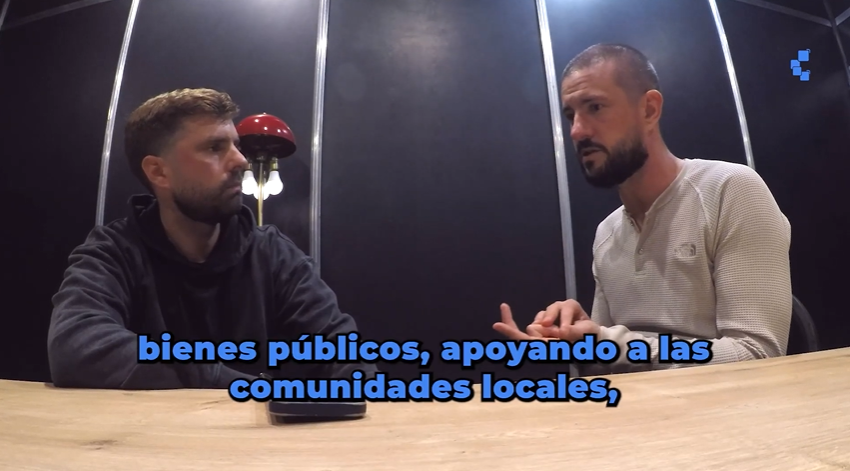
Although he explained that details remain to be finalized on how this project will be applied and developed, Stańczak emphasized that the goal goes beyond the code: The aim is to address “everything related to building a company as a whole” and not only in terms of technological development.
Official certifications and dialogue with new generations
As a continuation of the initiatives that began in 2024, when organizations such as ETH Kipu and different educational institutions promoted the teaching of content linked to Ethereum, the EF will expand its presence in local technical training.
In this context, Victoria Ezcurra, Digital Education Manager of the Buenos Aires Ministry of Education, told CriptoNoticias during Devconnect that, since 2026, students from the Estación Buenos Aires school will receive certifications endorsed by the EF in blockchain technologies.
The courses will include content from Solidity, the language used to develop smart contracts on Ethereum.

Ezcurra added that the ministry is working to have “more than 1,200 teachers participate in the first cohort of the Blockchain Fundamentals 2026 course.” The objective is to progressively extend the training to more institutions.
Finally, during Devconnect, students from technical schools and graduates of the Skills Agency for the Future participated in addition to the Ethereum Developer Pack, intensive training.
There they could talk with EF leaders, such as Aya Miyaguchiexecutive director of that organization. They shared their experience learning how to build decentralized solutions.