
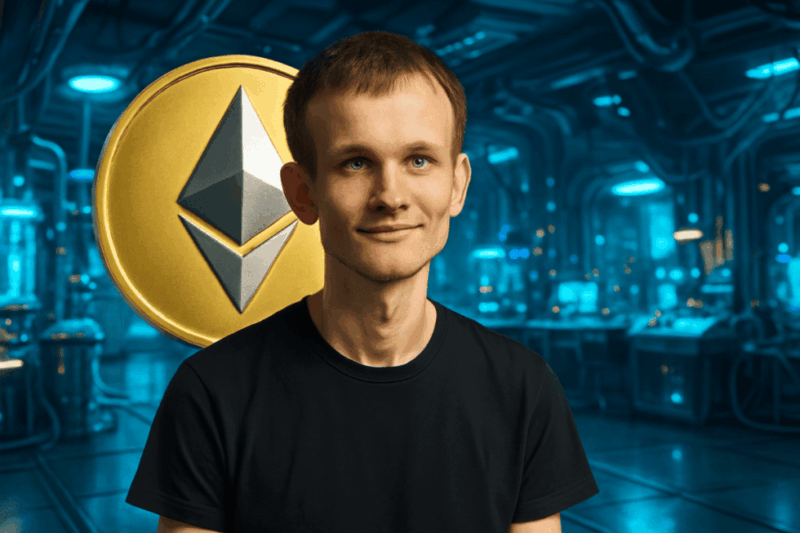
Vitalik highlighted that with PeerDAS blocks are validated without each node reviewing all the data.
The co-founder also pointed out the remaining limits on completing sharding and scaling L1.
Vitalik Buterin, co-founder of Ethereum, spoke out on December 3, 2025, minutes after the launch of Fusaka, the network’s latest update. This is the second hard fork this year for Ethereum, after Pectra, implemented in May.
As CriptoNoticias explained, Fusaka introduced the data verification system known as PeerDAS (Peer Data Availability Sampling).
For Vitalik, this mechanism represents the central component that was missing for Ethereum will reach its real model of «“sharding” (data fragmentation), an objective raised since 2015.
Sharding has been a goal for Ethereum since 2015, and data availability sampling since 2017, and now we have achieved it.
Vitalik Buterin, co-founder of Ethereum.
Buterin recalled that the network sought to divide the information into fragments so that no node had to download and review all the data.
That idea could only work if there was a technique capable of guaranteeing that each fragment was available and complete without each node verifying it completely. That method (data availability sampling, investigated since 2017) This is precisely what PeerDAS provides.
With PeerDAS, the network can reach consensus on blocks even though no individual node sees all of the data.
Instead, each node takes small, random parts and verifies them through a probabilistic process. If all samples match, it can be inferred that the block is complete and accessible.
According to Buterin, this approach “it is resistant even to 51% attacks”since the verification occurs on the client side and does not depend on the voting of the validators.
The contribution is substantial. Fragmentation always sought to allow more Users could operate nodes without expensive hardwarebut to achieve this, a system was needed that ensured the availability of fragmented data without compromising security.
PeerDAS fulfills that function: it reduces the amount of information each node must review while maintaining strong cryptographic guarantees about the integrity of the block.
In practice, this significantly decreases the bandwidth and processing requirements for the nodes. In addition, it opens space for second layer (L2) networks to increase their operational capacity without overloading the main layer (L1) of Ethereum.
In addition, in a recent interview with CriptoNoticias, Bartek Kiepuszewski, co-founder of L2BEAT, emphasized that Fusaka also It will give greater confidence to second layer networks.
That, given that, by increasing the availability of data within the L1, the L2 will now be less dependent on external companies to store your data.
Three pending limits: the path that Buterin considers incomplete
Even with the advances, Buterin held that Fusaka “has three aspects in which sharding (data fragmentation) remains incomplete.”
- The first is related to the power available for the L2:
Today L2 networks can already increase their capacity because PeerDAS reduces the amount of data each node must verify. This allows the total transaction volume grow proportionally to the square of the computing power available per node.
However, this benefit does not carry over to the main layer of Ethereum, since it is still limited by the need to execute all operations directly.
For L1 to scale equivalently, Buterin once again stated that “mature ZK-EVMs” are needed, i.e. Ethereum-compatible virtual machines capable of generating zero-knowledge cryptographic proofs (ZK, zero-knowledge).
These tests condense thousands of transactions into a single verifiable receipt, allowing validate a large set of transactions without reprocessing them on each node.
- The second limit is the so-called “bottleneck between proponent and builder” of blocks:
In the current architecture, the block constructor must access all data and assemble the entire block before the proponent publishes it.
Vitalik Buterin suggested that a «distributed assembly of blocks»where multiple actors build parts, avoiding depending on a single operator.
This idea points to reduce centralization risks in the block construction market, a sector today dominated by few participants.
- The third pending point is the absence of a fragmented mempool.
The mempool is the space where transactions wait before being included in a block.
For Buterin, this fragmentation is necessary to complete the vision of the shardingsince it would allow the pre-block flow can also be split and scaled.
Despite these limitations, Buterin called Fusaka’s arrival “a fundamental step in the design of blockchain.”
Finally, he made clear the priorities (at least for now) for the next two years:
Refine the PeerDAS mechanism, scale it carefully, ensure its stability, use it to scale L2s, and when ZK-EVMs are mature, apply it inwards to also scale Ethereum L1 gas.
Vitalik Buterin, co-founder of Ethereum.
The co-founder closed his message with an explicit recognition of the sustained work of Ethereum researchers and core developers, who advanced during almost a decade to achieve this goal.