
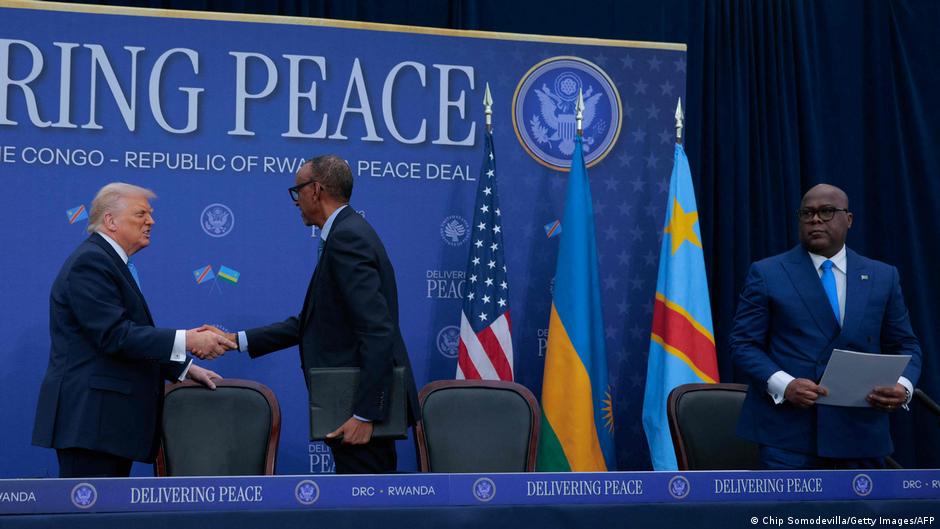
The ink is barely dry on the US-brokered peace deal between Rwanda and the Democratic Republic of Congo (DRC), but reactions reveal skepticism about whether the deal can deliver anything resembling peace – or whether it primarily serves US geopolitical and commercial interests.
On Thursday, US President Donald Trump hosted Presidents Félix Tshisekedi of the DRC and Paul Kagame of Rwanda in Washington for a signing ceremony that the White House described as “historic”.
Trump declared the agreement a “great day for Africa, a great day for the world.”
“They spent a lot of time killing each other,” Trump said. “And now they’ll spend a lot of time hugging, holding hands, and taking advantage of the United States economically like every other country.”
He then linked the peace signing directly to American access to minerals.
“We’re going to take out some of the rare earths,” Trump said. “Everyone is going to make a lot of money.”
Optimism and caution shape DR Congo’s peace narrative
Congolese Foreign Minister Therese Kaikwamba defended the government’s decision to sign the agreement.
“Our President has been very transparent about the principles that will guide the agreement,” he said, calling the Washington agreement part of a sequence of diplomatic milestones achieved in recent months.
Asked whether the Congolese public actually knew what had been signed, he expressed optimism.
“Do the Congolese people stand behind this? I believe so, because this is our path to long-lasting peace and peaceful cohabitation with our neighbors,” Kayikwamba told DW, acknowledging the ongoing debate.
“Does this mean that all expectations are reflected in the instruments in place? Probably not… But it is important to emphasize that this agreement is bringing us closer to peace and accountability.”
On Trump’s interest in critical raw materials, many of which are located in conflict areas currently controlled by rebels, Kaikwamba was cautious.
“There is a strong connection between economic opportunity and security… We cannot project ourselves into a future where partners benefit from our natural resources when the security of our people is not taken into account.”
Doubts about Washington’s peace effort
For some Congolese civil society leaders, the optimism displayed in Washington rings hollow.
Referring to the ongoing violence in the region after the peace treaty was signed in June in Washington, Maurice Carney, co-founder and executive director of Friends of the Congo, an NGO that advocates for peaceful and lasting change in the DRC, said he did not believe its ratification would have much of an impact.
“If the last five months [are] “Regardless of any indications, we do not expect fundamentally any changes in the near future,” Carney told DW. He stressed that commercial interests rather than peace were at the heart of the agreement.
He said, “The economic interests of the local elites in Kigali and Kinshasa and the interests of the global elites in Washington… they converge, and these are the interests that are being served, not those of the Congolese people at all.”
He specifically pointed to US technology and investment figures, which would benefit from access to lithium and coltan mines in eastern Congo. One such Colton site is currently held by M23 rebels, he said.
Carney warned that ordinary Congolese, especially the 70 million who live on less than $2.15 a day according to the World Bank, will receive no benefits.
“This is certainly not an agreement between equal partners,” he said.
Minerals have put Congo at the center of the power game
Carney and other analysts argue that the agreement reflects a US geopolitical strategy to counter China’s dominance in global mineral supply chains.
Access to Congolese cobalt, lithium and coltan, needed for fighter aircraft, electric vehicles and artificial intelligence technologies, has become central to Washington’s strategy.
“The geostrategic battle with China is also very important,” Carney said. He said that even under Biden, the US launched the Lobito Corridor through the G7 and the EU as a direct effort to undermine China’s Belt and Road Initiative – “not just in Congo, but also in the Global South.”
Despite diplomatic smiles, Kagame and Tshisekedi kept their distance
While Trump spoke of reconciliation during Thursday’s ceremony, Kagame and Tshisekedi did not shake hands and barely made eye contact.
For many citizens watching from the field, the leaders’ behavior was more impressive than the signing ceremony.
Marie-Louise Uwizeimana of Rwanda said, “The presidents of the two countries did not shake hands. This is very bad for the signing of the peace agreement.” “As a citizen living in this area, it shows that there is no peace yet.”
Kagame offered a measured approach, saying “there will be ups and downs on the road ahead, there’s no doubt about that.”
While Tshisekedi described the agreement as the beginning of a new and difficult path. But not everyone was convinced by Tshisekedi’s assurances.
“They call it a wonderful step, but I’m reluctant to use that word,” said Ildefonse Sinabubariraga, a Rwandan observer. “I am afraid of the implementation. Even when you look at President Tshisekedi’s reactions, he was not so confident about the signing. It is as if he is being forced.”
Fresh clashes were reported
Hours before Thursday’s ceremony, there were reports of fighting in the Congolese province of South Kivu.
“Several people were killed” in the shelling in the M23-controlled town of Kajiba, according to local official René Chubaka Kalembire.
Since the peace accord was signed, residents of eastern Congo said fighting has intensified.
“We are still at war,” Amani Chibalonza Edith told the Associated Press (AP) news agency. “There can be no peace as long as the front lines remain active,” said the 32-year-old resident of Goma, the main city in eastern Congo that was captured by rebels earlier this year.
“Yesterday, we saw that agreements were signed, but we don’t see any positive impact on the situation, and that worries us,” Samson Alimasi of Kamanyola town, near the border of Rwanda and Burundi, told the AP.
“We only see the bombs falling, without knowing from which side they are coming.”
Edited by: Keith Walker