
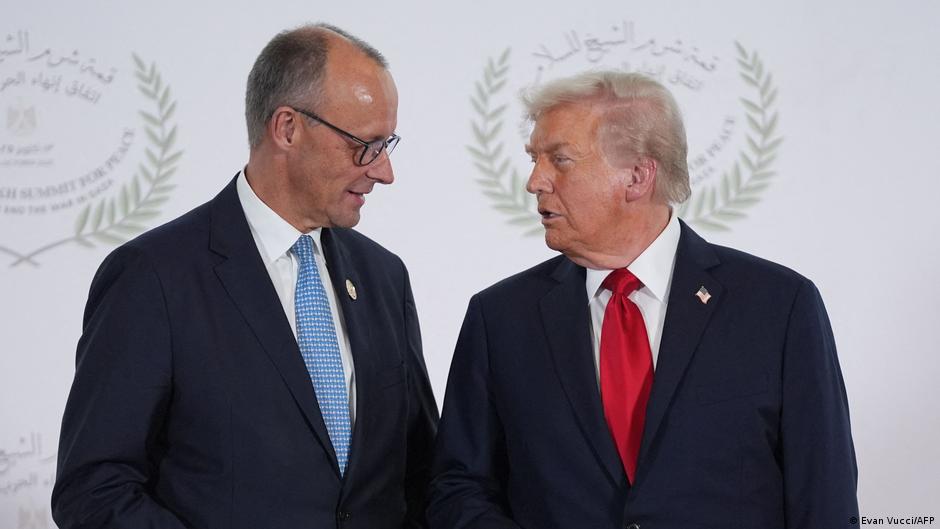
German Foreign Minister Johann Wadeful has opposed elements of the new US national security strategy put forward by the White House.
Wadefull said Berlin does not need external lectures on freedom of expression or the organization of democratic societies.
key points
- New US strategy takes unusually critical tone towards Europe
- US strategy raises questions about European rule of law and international bodies
- EU rejects accusations of tactics against the bloc
- Berlin also criticizes this strategy
What do we know about the new US strategy?
American documents It underlines US President Donald Trump’s “America First” worldview.
It signals a shift from Washington’s traditional global role to a greater focus on Latin America and migration and includes sharp criticism from longtime allies in Europe.
The newspaper said the US would support actors and political parties that oppose EU-led policy stances, including on immigration.
What did Germany’s top diplomat say on American strategy?
Speaking in Berlin alongside Iceland’s Foreign Minister Thorgedur Katrín Gunnarsdottir, Vadeful said such matters are governed by Germany’s constitutional order, citing separation of powers and freedom of the press.
Wadefull said the United States was and remains “our most important ally”. [NATO] Alliance. However, this alliance is focused on addressing security policy issues.”
The minister said that when it came to Germany, questions of freedom of expression or the organization of free societies were not part of the coalition’s jurisdiction.
“We consider ourselves capable of discussing and debating these matters completely on our own in the future and we do not need external advice,” Wadefull said.
However, he said he would now “analyze the new US security strategy in detail.”
Relations between Washington and Europe have become more strained since Trump’s return to the White House, with disputes over migration and free-speech debates raising tensions.
The US administration has also cultivated ties with the far-right Alternative for Germany (AfD), including a visit by a senior AfD lawmaker to the White House in September.
German politician says US strategy is ‘like Putin talking about Europe’
Jürgen Hardt, foreign policy spokesman for Germany’s ruling conservative CDU/CSU coalition, was also critical of the US strategy.
“The US President’s assessment of Europe is very much the same color, perhaps because of the information he receives from the right side as well as the wrong side. [wing] Radical parties in Europe, or sometimes it seems [Russian President Vladimir] “Putin is talking about Europe,” Hardt told DW.
Hardt expressed concern about the US strategy, suggesting that Trump “wants to be actively involved in politics in EU member states.”
“We didn’t [engage] In the US, and we hope the US is not doing the same in the German democracies,” he said.
The conservative politician also criticized the strategy of encouraging the rise of nationalist parties in Europe.
“We don’t need the Trojan Horse of Russia or China in German or European politics any more than we have it from the AfD or the Rassemblement National in France or even right-wing radical parties in Britain,” Hardt said.
How does it differ from prior US strategies for Europe?
The new strategy took a significantly more critical stance toward Europe than previous approaches, raising doubts about the sustainability of the US–European alliance.
While the U.S. National Security Strategy for 2022 under former Democratic President Joe Biden called Europe “an indispensable partner,” the new plan says “it remains unclear whether the economies and militaries of some European countries will be strong enough to remain reliable allies.”
The strategy criticizes “economic decline” and “civilizational destruction”, arguing that the EU and other international bodies “undermine political independence and sovereignty.”
Other criticisms of European policies in the document include:
- “Migration policies that are changing the continent and creating conflict”
- “Censorship of free speech and repression of political opposition”
- “cratering birthrate”
- “Loss of national identity and self-confidence”
The US strategy claims, “Should current trends continue, the continent will be unrecognizable in 20 years or less.”
David Dunn, professor of international politics at the University of Birmingham, noted the tone of “ethno-nationalism” in the new strategy.
“There is an implicit hint of racism in the document, as well as an attack on the idea of liberal values that is a betrayal of that tradition,” Dunn told DW, arguing that the U.S. strategy “is safe.”[s] Special criticism for Europe.”
The document specifically mentions worsening relations with Europe following Russia’s full-scale invasion of Ukraine in 2022.
It argues that the war has increased Europe’s “external dependence”, particularly calling on Germany to “build some of the world’s largest processing plants in China”. [and] Using Russian gas that they can’t get at home.”
The US strategy also attacks the rule of law in Europe, suggesting that European governments attempt to “subvert democratic processes”.
However, it acknowledges that “Europe remains strategically and culturally important to Washington”.
The strategy argues, “Our goal should be to help Europe correct its current trajectory.” “We will need a strong Europe to help us compete successfully, and work together with us to prevent any rival from dominating Europe.”
How has the EU reacted to this strategy?
The European Commission strongly rejects the allegations made against the EU by the US strategy.
Commission chief spokeswoman Paula Pinho rejected accusations that the EU undermines political freedoms and sovereignty, harms the continent with its migration policy and hinders freedom of expression, the German dpa news agency quoted her as saying.
However, Pinho did not want to comment further at this stage.
“We have not yet had time to look into it, to assess it, so we are not in a position to comment on it yet,” DPA quoted the speaker as saying.
Edited by: Shawn Sinico