
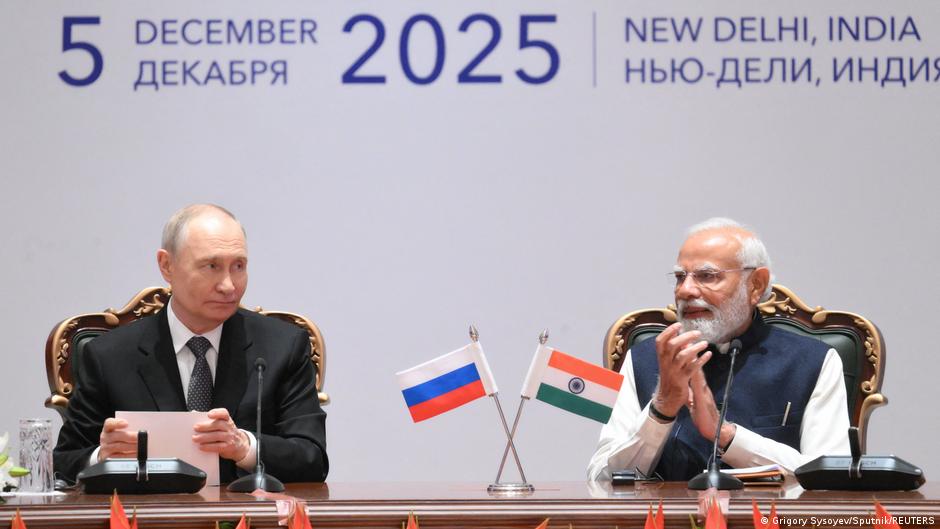
Russian President Vladimir Putin concluded his two-day visit to India on Friday and asserted that Moscow is “ready to continue uninterrupted shipments of fuel to the rapidly growing Indian economy.”
“Russia is a reliable supplier of oil, gas, coal and everything else necessary for India’s energy development,” Putin said at a joint press conference with Indian Prime Minister Narendra Modi.
Both Putin and Modi agreed that the partnership between Moscow and New Delhi remained “steady as the North Star” during eight decades of global turmoil.
Modi also announced that Russia and India are working to conclude a free trade agreement with the Eurasian Economic Union, a single market bloc that includes Russia and four other former Soviet nations.
Everything about the visit – including Modi’s breach of protocol when he personally welcomed and hugged Putin at Palam airport on Thursday – was carefully crafted to show that India’s ties with Russia remain solid despite external pressure.
Pressure on New Delhi to help end Ukraine war
Putin’s arrival is his first visit to India since Russia launched a full-scale invasion of Ukraine in 2022.
It comes as the US is imposing trade tariffs to pressure India to give up Russian oil, and other Western countries are urging New Delhi to make more diplomatic efforts toward ending the conflict in Ukraine.
In fact, ahead of Putin’s visit, envoys from the UK, France and Germany published A rare joint op-ed in an Indian newspaperCriticized Russia for prolonging the war and pursuing accountability.
The Russian leader’s visit has also become a symbol of New Delhi’s defiance as it pursues “strategic autonomy” in its foreign affairs.
India-Russia trade made new records!
During Putin’s stay in New Delhi, the two countries signed several agreements on migration, labor mobility, port access, shipping and health and food security sectors. India is expected to significantly increase its exports to Russia in terms of pharmaceuticals, food and consumer goods.
Ahead of the visit, the Kremlin indicated the two sides would also discuss alternative methods of payment to circumvent Western sanctions. In New Delhi, Putin announced that bilateral trade grew by 12% last year, setting a new record, and is expected to soon exceed $100 billion (€95.4 billion). Putin also specified that 96% of payments are now made in Indian rupees and Russian rubles.
Commenting on Ukraine, Modi said India “has advocated peace on the Ukraine issue from the very beginning.”
“We welcome all efforts to bring about a peaceful and permanent resolution of this matter.”
Ukraine deal could recalibrate US-Russia-EU relations
Modi’s comments are in line with New Delhi’s cautious approach, which has sought to promote a peaceful resolution to the Ukraine conflict while managing the competing demands of Russia as a major defense partner and the West as an important trade partner.
This diplomatic stance has sparked anger in Washington, but Rajan Kumar, a Russia expert at Delhi’s Jawaharlal Nehru University (JNU), believes the US will not object too much to Putin’s visit.
Kumar says that America itself is adopting backdoor diplomatic routes for a peace agreement in the Russia-Ukraine conflict.
“This parallel US engagement makes practical sense of India’s position in maintaining dialogue with Russia,” Kumar told DW.
However, Kumar warned that India could lose its scope for manoeuvre.
“If diplomatic efforts fail to resolve the war, India may face increased pressure from Western powers, resulting in additional sanctions or other restrictive measures aimed at limiting its relations with Moscow,” he said.
In turn, foreign policy expert C Raja Mohan argues that India should deal with the pressure by maintaining strong Russia ties in energy and defence, as well as deepening economic cooperation with the US and Europe.
“The ongoing dialogue with Ukraine may provide an opportunity to realign relations between the US, Europe and Russia,” says Mohan, arguing that India needs to strategically strengthen its ties with the three powers during this period of geopolitical realignment.
“The Ukraine conflict has exposed limitations in the West’s ability to militarily defeat Russia near its borders, leading to a change in the status quo negotiations,” said Mohan, a visiting professor at Singapore’s Institute of South Asian Studies.
EU is insecure because it is making a trade deal with India
Despite New Delhi’s assertive attitude towards Western pressure, steps taken by Washington and its allies have already had a measurable impact. Data for October 2025 shows India has reduced its Russian oil imports by 38%, the biggest drop ever.
The decline coincides with India increasing purchases from the Middle East and Africa.
The EU also has some means to put pressure on New Delhi, including a yet-to-be-finalized free trade agreement with India. However, Kumar says Brussels’ options are limited by the bloc’s own strategic and economic weaknesses in the current geopolitical environment.
The analyst believes EU members will maintain a separation between security matters and trade policy.
“This pragmatic approach stems from the EU’s own economic interests, especially as the bloc seeks to mitigate the impact of tariffs recently imposed by the Trump administration, making the India trade deal increasingly valuable to European economies,” Kumar said.
Have the Western powers lost India?
Veteran former diplomat Ajay Bisaria emphasized that President Putin’s visit to India is part of a well-established 25-year-old annual summit tradition, serving as an important platform for ongoing diplomatic engagement.
Bisaria also argues that India’s decision to host Putin at the critical stage of Ukraine peace talks is likely to draw strong criticism from the US and the EU.
“In short, while the US and the EU will keep a close eye on the summit, their response is expected to be measured and pragmatic rather than confrontational,” Bisaria said.
Amitabh Mattoo, dean of JNU’s School of International Studies, said Washington, Brussels and London should ask a fundamental question “Why did they lose India?”
“After more than a decade of deep ties, the US failed to invest in and nurture the relationship, causing it to weaken. In contrast, Russia remains a reliable ally that has consistently stood by India, underscoring their special and privileged partnership,” Mattoo told DW.
Edited by: Darko Janjevic