
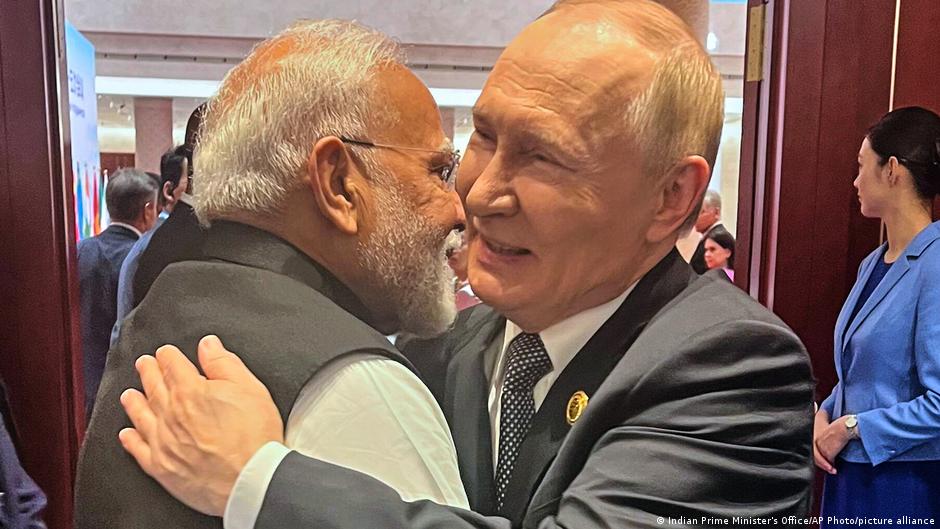
Russian President Vladimir Putin arrived in India on Thursday for a two-day visit, underscoring the partnership between Moscow and New Delhi that has endured nearly eight decades of geopolitical turmoil.
At the invitation of Indian Prime Minister Narendra Modi, the Kremlin chief is scheduled to attend the 23rd India-Russia annual summit in the Indian capital.
This is Putin’s first visit to India after Moscow launched a full-scale invasion of Ukraine in 2022.
The two countries have indicated that they want to strengthen their “special and privileged strategic partnership” – an official designation for Russia-India relations adopted in 2010 – and “exchange views on regional and global issues of mutual interest,” India’s Ministry of External Affairs said in a statement.
Ahead of the visit, Kremlin spokesman and Putin’s chief of staff Dmitry Peskov underlined the importance of protecting India-Russia bilateral relations and trade.
His comments come as India faces US tariffs on buying Russian oil.
Russia faces increasing Western sanctions over the war in Ukraine.
“We have to protect our business from pressure from abroad,” Peskov told journalists.
Peskov highlighted that alternative payment options to avoid sanctions are under discussion.
Labor migration is also on the agenda, as more and more Indians seek employment in Russia. Speaking to reporters, he also mentioned Russia’s defense deals, which include the sale of S-400 anti-aircraft defense systems, Sukhoi-57 fighter aircraft and small modular nuclear reactors.
India is by far the largest buyer of Russian arms internationally. Moreover, Russia is now supplying more than 35% of India’s crude oil imports, whereas earlier Ukraine supplied about 2%.
However, according to maritime intelligence firm Kpler, recent US measures targeting those doing business with Russian oil producers have prompted Indian refiners to diversify their suppliers.
US tariffs are pushing India towards Russia
Still, experts and diplomats contacted by DW say relations between India and Russia have proven resilient to Western pressure, including tariffs imposed by US President Donald Trump.
“Putin’s visit to India sends a clear message to the Western bloc that Russia will not remain isolated in global affairs,” Rajan Kumar of the Center for Russian Studies at Jawaharlal Nehru University told DW.
According to Kumar, India considers its relations with Russia strategically important, helping New Delhi balance its relations with both the West and China at the geopolitical level.
“Trump’s policies have created a trust deficit with the US and increased the importance of Russia. Similarly, isolating Russia would mean pushing it closer to China, a situation India would not like to see emerge,” he said.
And while Russia maintains strong ties with China, Moscow, in turn, is wary of Beijing’s growing geopolitical influence.
According to Kumar, this is why Russia is actively encouraging India’s participation in Eurasian geopolitics through multilateral forums such as the Shanghai Cooperation Organization (SCO) and BRICS.
Moreover, unlike Western countries, Russia does not lecture India on domestic issues or impose conditions on bilateral cooperation.
“Putin’s visit strengthens this ‘special and privileged’ partnership rooted in shared interests, historical trust and geopolitics,” Kumar said.
Why are Russia and India so close?
Relations between Moscow and New Delhi began soon after India gained independence in 1947.
The now defunct Soviet Union had built goodwill in India by supporting its industrial development and providing diplomatic support in its dispute with Pakistan over Kashmir.
In 1971, Moscow openly supported India in its war with Pakistan, while both the US and China supported Islamabad. India also began purchasing large quantities of Soviet-made weapons, and began producing some of them – such as the T-72 tank – locally under Soviet license.
Close defense ties with cash-strapped Russia followed the end of the Cold War in the 1990s, helping India mass produce Russian-designed missiles and fighter jets and later pursue development of its nuclear-powered Arihant submarines.
In 2002, India and Russia signed an agreement on space exploration, stating that Russia would help India in space launch and satellite technology. Other agreements, including on nuclear energy and uranium sales, were signed after Modi first came to power in 2014.
As the war in Ukraine throws Europe into turmoil in 2022, New Delhi was careful not to offend Russia or the West – urging an end to the war without directly condemning Russia’s aggression.
“As traditional partners, India and Russia have built a huge capital of trust and confidence which is now coming into use as both countries face a number of geopolitical challenges not only from the US but also from China,” D Bala Venkatesh Varma, former ambassador to Russia, told DW.
“At the summit, it can be expected that both leaders will reinvest in the bilateral strategic partnership,” Verma said.
India and Moscow want ‘strategic autonomy’ in changing world
“The US may pressure India to reduce engagement with Moscow, but India attaches great importance to its defense and energy ties with Russia,” Harsh Pant, head of the strategic studies program at the Observer Research Foundation (ORF), a New Delhi-based think tank, told DW.
He described Washington’s diplomatic stance as unexpected, which in turn prompts India to carefully consider its partnerships.
“This balancing act allows India to maintain strong ties with Russia while managing its broader strategic partnership with the US,” Pant said.
According to the analyst, while Russia and India are pursuing mutual interests and aiming for “strategic autonomy”, the roots of their partnership “go beyond the immediate pressures of the Trump administration”.
Balancing Moscow and Washington
Putin’s two-day visit will provide important clues about the foreign policy priorities of both India and Russia amid changes in power dynamics around the world.
“The timing of Putin’s visit to India underlines the fundamental approach of New Delhi’s foreign policy – strategic partnership is not a zero-sum game,” Kanwal Sibal, former Indian foreign secretary and ambassador to Russia, told DW.
He said, “America cannot dictate what India’s foreign policy should be. We have to adjust and resist.”
Sibal’s point is evident from India’s carefully measured approach towards the Trump administration. India and the US are currently negotiating a trade deal focused on reducing tariffs and addressing Washington’s trade deficit concerns with New Delhi. Additionally, New Delhi is pushing a landmark $1 billion (€860 million) deal between US-based GE Aerospace and India’s jet maker Hindustan Aeronautics Ltd (HAL), which is expected to buy US-made jet engines for India’s indigenous Tejas fighter aircraft.
Yet, India is also ready to roll out the red carpet for Russia’s Vladimir Putin.
According to Sibal, defense cooperation with Washington continues, “but this is not reducing Russia’s strategic importance.”
“India accommodates US partnerships where it is beneficial, while resisting pressure to abandon Moscow. Putin’s visit shows that India’s foreign policy is driven by its own terms, not Washington’s priorities,” he said.
Edited by: Darko Janjevic