

According to Hashdex, BTC enters December “battered, but not broken.”
In November, institutional conviction in BTC faced “its toughest test.”
After a month marked by historic institutional sales and extreme macroeconomic volatility, investment firm Hashdex assures that the “great bitcoin (BTC) reset” has concluded.
The company maintains that, although November represented the most severe adjustment of the year, the market enters in December at a transition point where Signs of exhaustion of the fall and catalysts converge that could facilitate stabilization.
For that entity, the bitcoin market enters the last month of the year “battered, but not broken,”
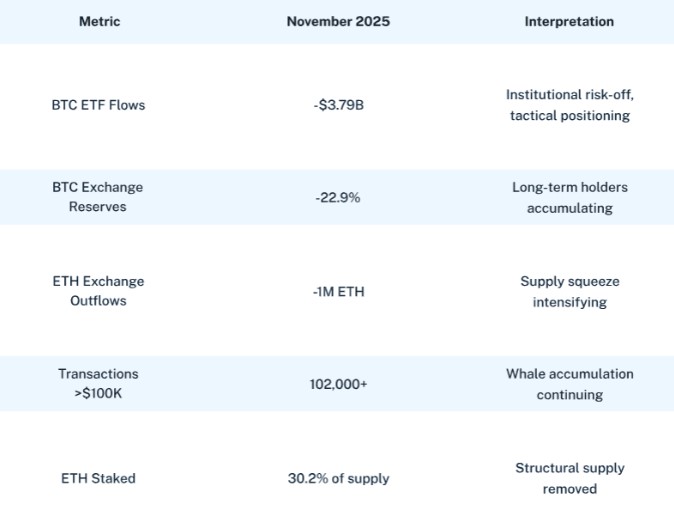
Hashdex highlights that bitcoin ETFs recorded $3.79 billion in outflows in November, their highest outflow monthly since its launch in January 2024. This exodus coincided with a drop of 18.02% in the Nasdaq Crypto Index, which the firm defines as “the worst monthly performance since June 2022.”
Hashdex highlights the magnitude of the turnaround in sentiment. “This dramatic pullback—just one month after BTC hit a new all-time high of $126,000—demonstrated how quickly sentiment can change when institutional flows reverse.”
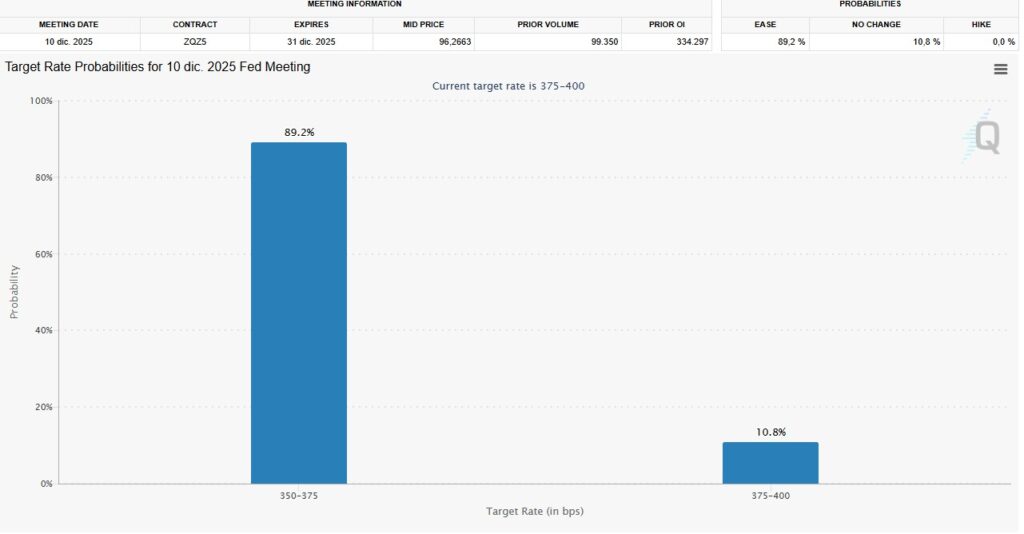
Uncertainty increased due to the divided stance of the Federal Reserve (FED). Hashdex reminds that the probability of a cut in December ranged from 96% to 40%. This, before stabilizing around 90%, as seen below:
Likewise, the firm recalled that the government shutdown in the US, which lasted for 43 days, “distorted economic data and pushed consumer confidence to its lowest level since 2022.”
Bitcoin as digital gold narrative put to the test
Regarding the performance of bitcoin, Hashdex highlights that the 20% drop brought its annual return to 2.27%, far behind the 16.45% of the S&P 500 “and the extraordinary 60.19% of gold.” This contrast, he says, was “the most severe test for the digital gold narrative.”
The situation was intensified by scrutiny of the company Strategy, whose positioning of 650,000 BTC “was under threat” due to a possible exclusion from the MSCI indices and forced sales of up to USD 11.6 billion, says Hashdex.
Despite the weakness in regulated markets, the firm emphasizes that on-chain metrics tell another scenario. In its report, it notes that BTC reserves on exchanges fell 22.9% from November 19 to 25, to 1.83 million BTC. This is its lowest level since 2018.
It also highlights that more than 102,000 transactions exceeding USD 100,000 were recorded in November. This is interpreted as a “patient capital movement that accumulated while institutional products liquidated positions,” according to that firm.
Signs of selling pressure on bitcoin persist
However, signs of selling pressure persist. The CryptoQuant analyst known as CryptoOnchain warned that the 30-day moving average of BTC inflows on Binance reached a yearly high of 9,170 BTC on November 28, something he described as “a significant bearish indicator.”
He also recalled that “a similar rally in March 2025 was followed by a strong correction.” In his vision, This growing supply on Binance “acts as a powerful headwind.”
Looking ahead to December, Hashdex identifies catalysts that could mark the end point of the bitcoin reset. In his report he states that the FED meeting on December 9 and 10 “should provide a clear direction for monetary policy.” Considering that the market already assigns a 90% probability to an interest rate cut, as reported by CriptoNoticias.
Hashdex concludes that November “could be remembered as the great reset”, the month when the year’s gains evaporated and institutional trust faced its “toughest test.”