
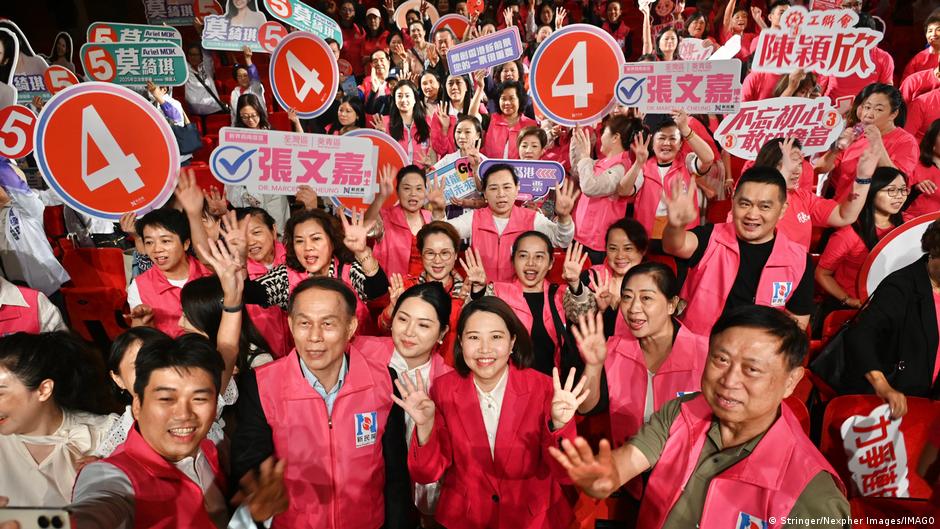
In the shadow of a devastating high-rise apartment fire that killed more than 150 people, Hong Kong is preparing to elect a new city parliament, known as the Legislative Council (LegCo), in voting on Sunday.
About 4.5 million Hong Kong residents will be able to vote for the former British colony’s legislative body. The Parliament plays an important role in Hong Kong’s government system, primarily in approving the budget.
However, only 20 seats in the 90-member parliament are elected by direct voting. In ten constituencies, the first two candidates receiving the most votes are directly elected to the LegCo.
Appointments to the other 70 seats are done by pro-Chinese committees. Of these, thirty are delegated by socially relevant groups such as finance, trade unions and tourism and the other 40 are delegated by the Election Commission. This process is enforced by electoral rules.
Beijing is investigating Hong Kong’s leadership
One thing is already certain: like the outgoing assembly, there will be no real opposition in the new Hong Kong Parliament.
Following new election laws handed down by China in 2021 in the wake of pro-democracy protests, the LegCo has been set up for “patriots only”, a euphemism for lawmakers loyal to Beijing.
Voters have since become more apathetic and analysts expect lower turnout on Sunday. Four years ago, turnout in the legislative vote was just over 30%.
Hong Kong’s electoral system is the result of a compromise agreed by China and the United Kingdom during the handover in 1997. The agreement with the UK states: “One country, two systems – Hong Kong will be administered by Hong Kongers with a high degree of autonomy from Beijing.”
However, since Hong Kong was returned to China, Beijing has been actively shaping politics according to its interests. The central government in Beijing does not tolerate any voice or political action aimed at establishing a Western-style democratic system in the administrative region. Most of the candidates in the race have been pre-selected by Beijing.
John Lee was the only candidate in the 2022 election for the previous Chief Executive. Beijing considers the former police chief and radical a “patriot”. According to the recently amended election law, non-patriots are not allowed to contest elections.
National security law restricts pro-democracy efforts
In the years following the 1997 handover, Hong Kong maintained a diverse political landscape. One political faction was promoting pro-Beijing policies, while the other faction was made up of parties leaning towards Western-style democracy. The latter coalition was also in favor of direct and universal elections for the Chief Executive and the Legco.
Ultimately, Beijing stepped in and cracked down on large-scale pro-democracy movements, including the one seen in 2019. The Chinese People’s Congress in Beijing subsequently passed a “national security law” for Hong Kong.
Since 2020, this law prescribes punishment for crimes defined as “treason,” “subversion,” and “collusion with foreign forces.” In practice, anyone who has contacts with foreign governments, parties or government-affiliated foundations can be prosecuted in Hong Kong.
Notably, Hong Kongers are no longer even allowed to hold a memorial service for the victims of the 1989 Tiananmen Square massacre in Beijing, which includes a march of mourners.
foreign workers close their doors
Ironically, the security law was imposed by the Hong Kong government as a replacement for a 2019 bill that sparked pro-democracy protests. The now-scrapped bill would have allowed Hong Kong suspects to be extradited to the Chinese justice system. The initiative failed and had to be withdrawn after months of street protests.
However, under the new and more stringent national security law, Hong Kong authorities have reported receiving more than 900,000 criminal complaints so far.
With any ties to the outside world placed under scrutiny, many international organizations have hastily left Hong Kong and closed their regional offices, including human rights organization Amnesty International and the German Friedrich Naumann Foundation.
Hong Kong’s disappearing democrats
By the summer of 2025, more than 300 suspects had been prosecuted under the national security law. About half of them were found guilty and sent to jail, including pro-democracy leader Joshua Wong and media tycoon Jimmy Lai. Others, such as former LegCo member Nathan Law and activist Francis Hui, went into exile.
Hong Kong police are currently searching for dozens of these suspects, and are offering a reward of up to 1 million Hong Kong dollars (about €110,000) for each of them.
“I knew I could go to jail for trying to bring about change, but the extent of it was much greater than I imagined,” said pro-democracy activist “Kelly.”
She is now 18 years old. In 2021, while still a minor, he was arrested on charges of “conspiracy to incite subversion” and “conspiracy to make explosives” and spent four years in prison. Now, she is free and back in the city she no longer recognizes. “Everything feels strange,” he told DW.
End of Hong Kong Democratic Party
Hong Kong’s pro-democracy movement has never recovered from the 2020 protest movement and the crackdown on the national security law. The largest opposition party, the Hong Kong Democratic Party, was forced to disband in April 2025, 31 years after its establishment.
“After the introduction of the national security law and electoral reforms, the party’s ability to function was severely restricted,” Stefan Ortmann, a political scientist at the Metropolitan University of Hong Kong, told DW.
“Its members were arrested and its remaining efforts were weakened by the Chinese government’s increasing control over the political landscape, reflecting the diminishing scope for promoting liberal democracy in Hong Kong,” he said.
Hong Kong soars as Asia’s finance hub
In 1997, China also promised that Hong Kong would maintain its capitalist system for 50 years.
And while the prospects for true democracy in the city remain bleak, Beijing is keen to cement its role as an international financial centre. Chinese stock corporations prefer to list themselves on the Hong Kong Stock Exchange to gain access to international capital markets.
The “Greater Bay Area” project, which covers the area around the mouth of the Pearl River in southern China, aims to create a more cohesive economic region with cities in Hong Kong and the neighboring province of Guangdong.
“In recent years, Beijing has moved to connect Hong Kong with the mainland,” Lindsay Magland and Clara Fong, analysts at the Council on Foreign Relations, an American think tank, wrote in an article. recent study,
Guangdong is already China’s strongest economic province by GDP.
“Many companies and investors are betting that this increased connectivity will increase the amount of money flowing into Hong Kong from the mainland,” the authors wrote.
This article was translated from German