
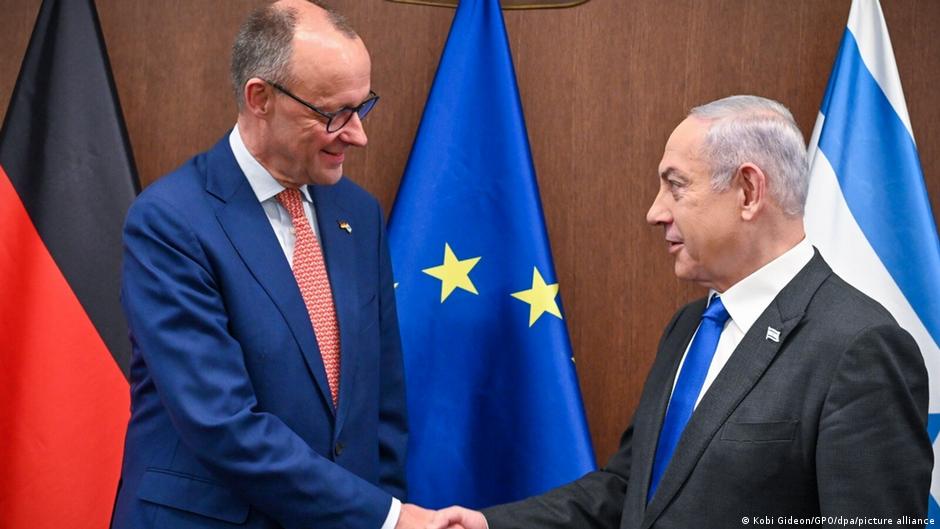
Since taking office seven months ago, centre-right Christian Democrat (CDU) Chancellor Friedrich Merz has been linked to the German-Israeli “special relationship”. There have been several disputes between Berlin and Jerusalem over Israel’s actions in the Gaza Strip in response to the Hamas-led terrorist attack on Israel on October 7, 2023, which took more than 1,200 lives. According to the Gaza Health Ministry, which is considered credible by the United Nations and several rights organizations, at least 70,000 Palestinians have been killed amid Israeli military conduct since October 2023. Several international rights organizations and the United Nations Commission of Inquiry have found Israel’s war in Gaza to be genocide.
Meraz’s inaugural trip to Jerusalem is therefore a difficult mission. Some things speak of continuity, while others speak of change. This is already clear from the statements made by Israeli Ambassador to Germany Ron Prosor in response to the comments made by the Chancellor.
When Merz, only two weeks in office, expressed concern over Israel’s actions in Gaza in late May and spoke of violations of international humanitarian law, Prosser remained calm: “When Friedrich Merz criticizes Israel, we listen very carefully because he is a friend,” the diplomat told the German public broadcaster. ZDF,
Eleven weeks later, the tone was completely different: in early August, given the humanitarian situation in the Gaza Strip, Meraz decided to stop supplying some military equipment to Israel “until further notice”. In particular, these relate to weapons that could also be used in the war in the Gaza Strip. According to the Chancellor, the German government cannot supply weapons to a conflict that could lead to “hundreds of thousands of civilian casualties.”
Prosser’s criticism of the decision was unusually sharp. He told Germany that the Chancellor’s move did not lead to the release of Israeli hostages from Hamas or a ceasefire. World News Channel. According to Prosor, what was being discussed was “Israel’s disarmament”, who also said it was “a celebration for Hamas”. Israeli Prime Minister Benjamin Netanyahu also talked about Merz rewarding Hamas.
By mid-November the German government had not lifted the ban on arms exports that had been in place since 24 November. Government spokesman Stephen Cornelius cited the ceasefire in the Gaza Strip that came into effect on October 10 as the reason.
But the ceasefire has remained stable, with occasional clashes between Hamas fighters and Israeli troops, as well as rocket attacks by Israeli forces on Gaza. The territory’s health ministry reports that more than 300 people, including many children, have been killed by Israeli shelling in the Gaza Strip since the start of the ceasefire.
Regular talks between Merz and Netanyahu
Merz will again be Netanyahu’s guest on Sunday. Compared to her predecessors, the Chancellor often mentions the lengthy phone call with the Israeli Prime Minister in her statements, whether on the overall situation in the Middle East, the humanitarian crisis in Gaza, or the 12-day war between Israel and Iran.
The questions come amid questions over whether Germany will uphold its international obligations, as a party to the statute of the International Criminal Court, to arrest Netanyahu, who is under an ICC arrest warrant through November 2024 for crimes against humanity and war crimes – should he visit Germany, as he would be required to do so under international law. Merz said shortly before taking office in February 2024 that “I have also promised him that we will find ways and means for him to go to Germany and be able to leave again without being arrested in Germany.”
In addition to political talks with Netanyahu and Israeli President Isaac Herzog, the German Chancellor’s visit to the Yad Vashem Holocaust Memorial will certainly be important. The site keeps alive the memory of the 6 million Jews murdered by Nazi Germany in the Holocaust. Israel also noted how Merz appeared to fight back tears during a speech in mid-September marking the reopening of a synagogue in Munich that was destroyed by the Nazis 87 years ago. He also expressed his “embarrassment” at the resurgence of anti-Semitism in Germany.
Merz admits difficulty in ‘state cause’
Following the controversy over arms exports, Merz insisted that German-Israeli “friendship” could withstand disagreements on a specific issue: “Nothing has changed in that regard, and nothing will change,” Merz said.
On the other hand, the German Chancellor admits that he has difficulty with the concept of “reason of state” because “all its consequences have never been made clear,” as he said in a newspaper interview in October. The term was used by Chancellor Angela Merkel (CDU) in 2008, when she became the first foreign head of government to address the Knesset, the Israeli parliament. Merkel said, “Every federal government and every chancellor before me has been committed to Germany’s special historical responsibility for Israel’s security. This historical responsibility of Germany is part of the reason for my country’s statehood.”
Merz also used the term in June, but rarely thereafter. At an event in the fall, Merz spoke immediately after Joseph Schuster, president of the Central Council of Jews in Germany. Schuster used the term “reason of state” several times, but Merz did not use it even once. Instead, the Chancellor said that Germany’s commitment to the survival and security of the State of Israel is “a non-negotiable part of the normative foundation of our country.”
Meraz is now traveling to Jerusalem, seven months after his election. His two predecessors, Olaf Scholz and Angela Merkel, held their first meetings with an Israeli head of government within the first three months of taking office. None of them imposed any further restrictions on their travels. Meraz, on the other hand, is flying to Jordan to meet the Jordanian king in Amman before flying to Israel.
This article was originally written in German.
While you’re here: Every Tuesday, DW editors provide insight into what’s happening in German politics and society. You can sign up for the weekly email newsletter, Berlin Briefing, here.