
Even a few days after the presidential elections in Honduras, a tough competition continues between the two major candidates. At one point, only about 500 votes separated centrist Salvador Nasrallah and conservative Nasri Asfura.
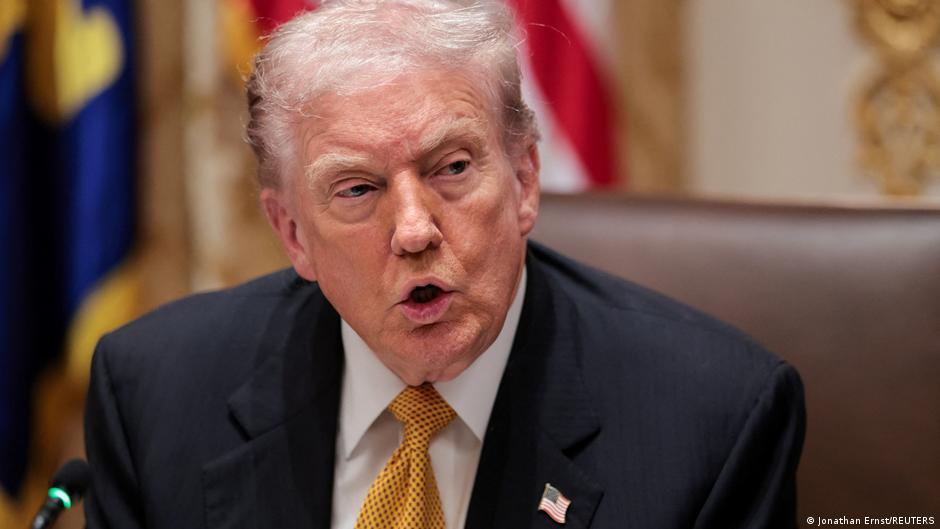
This was reason enough for US President Donald Trump to support his favourite, Asfura. “It appears that Honduras is trying to change the results of their presidential election. If they do, they will pay a heavy price!” He posted on his social media platform Truth Social.
Both parties have been accused of election fraud. This is not unusual in Honduras, where such serious allegations were made in the 2013 and 2017 elections. But since Honduras is a small country with little influence on global politics, why has Trump responded so strongly?
For trans-Atlantic expert Katherine Kluver-Ashbrook of the independent German Bertelsmann Foundation, the US president clearly likes the idea of political spheres of influence.
“He sees himself as almost regal in his role in the White House, and he likes it when the world dances to his tune – especially in the Western Hemisphere. And it should be emphasized that these are His interests, not traditional American foreign policy.”
His “area of interest” appears to be Latin America. “The military operation off the coast of Venezuela, the amount of more than $20 billion that went to Argentinian President (Javier) Miley to save his election, the bullying of the Colombian head of state, the recommendation of elections in Honduras, with threatening postures,” Kluwer-Ashbrook lists.
“There is a new policy emerging here that the United States has not pursued so actively toward its neighbors in Latin and South America for a long time.”
intervention in Europe
But Europe is also a target.
Just a few days ago, America had instructed its diplomats to promote anti-immigration policies in Europe.
The Heritage Foundation, a conservative think tank closely associated with Trump’s Make America Great Again (MAGA) movement, has actively lobbied against the EU’s climate goals. In April, it published “Project 2025”, considered a blueprint for restructuring the US government.
In the first year of his second presidential term, Trump has made radical changes in America’s foreign policy. More radically than almost any of his predecessors, he is breaking the unwritten principle of non-interference in the internal affairs of Allied countries.
Trump sees Europe as ‘parasite’ exploiting America
Celia Belin, author of a study for the European Council on Foreign Relations (ECFR) in May 2025, concluded that in this context, domestic and foreign policy are essentially one and the same for the US president. He argued that American presidents see their foreign policy primarily as an international continuation of the ongoing cultural conflict within America.
He wrote, “Liberals and Democrats are the enemy within; the Europeans are spreading themselves outside.” He further said that Trump sees Europe as “parasites” exploiting the US, just as he accuses Democrats in the US of weakening the country.
Klüver-Ashbrook agreed, saying, “An ideology of US foreign policy can already be found in the core documents of Project 2025.”
This, he added, fits with the attitude of former Trump campaign adviser Steve Bannon, who in a recent interview described Russia as a “devout Christian nation” and a “true ally during World War II.”
He pointed out that the Trump administration is breaking the previous foundations of US foreign policy and making “major ideological shifts” driven by “very strategic ambitions with respect to foreign policy”.
Klüver-Ashbrook pointed out that Europeans were not only in favor of ending the war in Ukraine, but there were many occasions when left-liberal Europeans, in particular, were treated with contempt by representatives of the US government.
He cited Signal chat about a possible US attack on Yemen, which was leaked atlanticEarlier this year, an American magazine was published in which US Vice President JD Vance said that this would benefit Europe more than America. “I would hate to have to bail out Europe again,” he wrote. And in response, US Defense Secretary Pete Hegseth, now calling himself Secretary of War, wrote: “I completely agree with your hatred of European free-loading. It’s pathetic.”
Europe is in the middle of a cultural war
According to Paweł Czerka of the European Council on Foreign Relations (ECFR), Europe is in the midst of a culture war driven by this mentality. He believes that the US government is waging an open ideological battle in Europe over values such as migration, climate change, “vocalism” and freedom of expression.
He says Trump supports new right-wing movements wherever possible, while normalizing his radical stances. He explains that strategies supported by the MAGA ideology include active interference in elections in favor of right-wing and conservative candidates, as well as the creation of conservative networks and the establishment of a kind of “MAGA International” through right-wing media outlets, parties, and conferences such as the annual Conservative Political Action Conference (CPAC).
Europe should form a united front
Europe would be well advised not to allow itself to be pressured by the Trump administration, Zerka says. Instead of seeing itself as dependent on the US, it should represent its interests holistically and with confidence – even in the face of pressure from the White House. After all, most EU states are still led by pro-European politicians, he points out, and this potential should be used to present a united front rather than dividing along national or party lines.
Klüver-Ashbrook sees another threat to Europe: “Particularly well-funded organizations, which were also behind the Heritage Foundation and Project 2025, are now gearing up to increase their influence through, for example, party donations.”
Like the German civil society initiative LobbyControl, they warned that party donation laws in Germany and other European countries were too weak and “provide a gateway for outside influence, particularly through state or neo-state-controlled money from the US.”
This article was translated from German.