

ZK Interop, a complement to the Atlas technical suite, promises to solve liquidity fragmentation.
The update includes Prividiums, a system aimed at the privacy of institutions.
The team behind the Ethereum second layer (L2) network ZKsync presented ZK Interop on December 4, a complementary update to Atlas, the technical package launched in October by that same L2.
ZK Interop enables native interoperability between “ZK Chains,” the sovereign chains of the ZKsync ecosystem built with Atlas, and decentralized finance (DeFi) applications on the Ethereum mainnet.
This new release promises that protocols like Aave can be used from one of those ZK Chains without depending on bridges, without fragmented accounts and without long waiting times, depending on the advertisement.
What problem does ZK Interop want to solve?
The interoperability announced with ZK Interop aims to solve the fragmentation of liquidity in Ethereum, a phenomenon in which funds are distributed across multiple networks that do not communicate directly.
Until now, each L2 and each private chain operated as islands. Users had to change networks, move funds or open separate accounts to use DeFi protocols.
With ZK Interop, interactions no longer require complex bridges. Users operate from the same wallet on their ZK Chain, while transactions are executed on Ethereum under a unified permissions and digital identity scheme.
How does ZK Interop work on Ethereum?
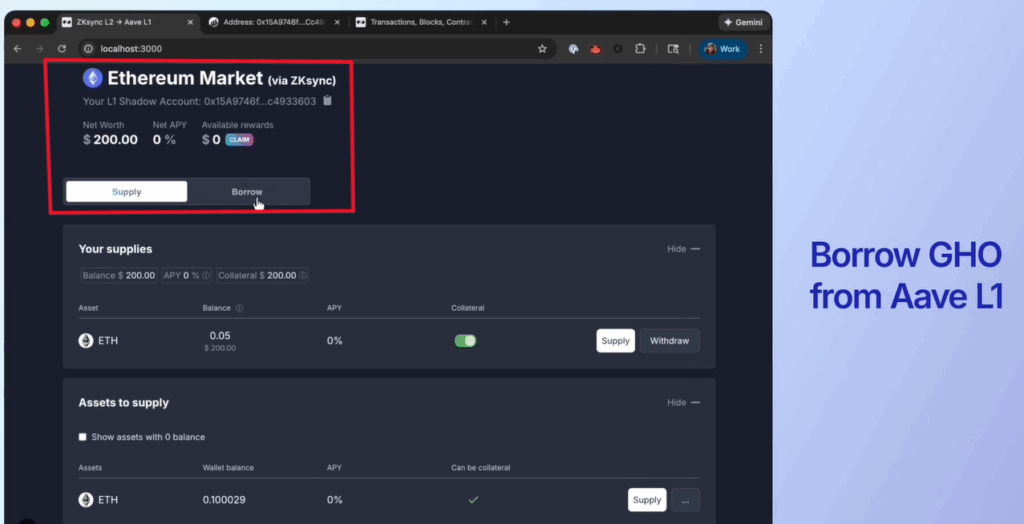
The official announcement describes a concrete example. A user of a ZK Chain makes a deposit in Aave (a platform that allows lending and borrowing of cryptocurrencies) and then requests a credit with the GHO token, Aave’s stablecoin.
The entire process is completed without that user leaving their account on the secondary chain.
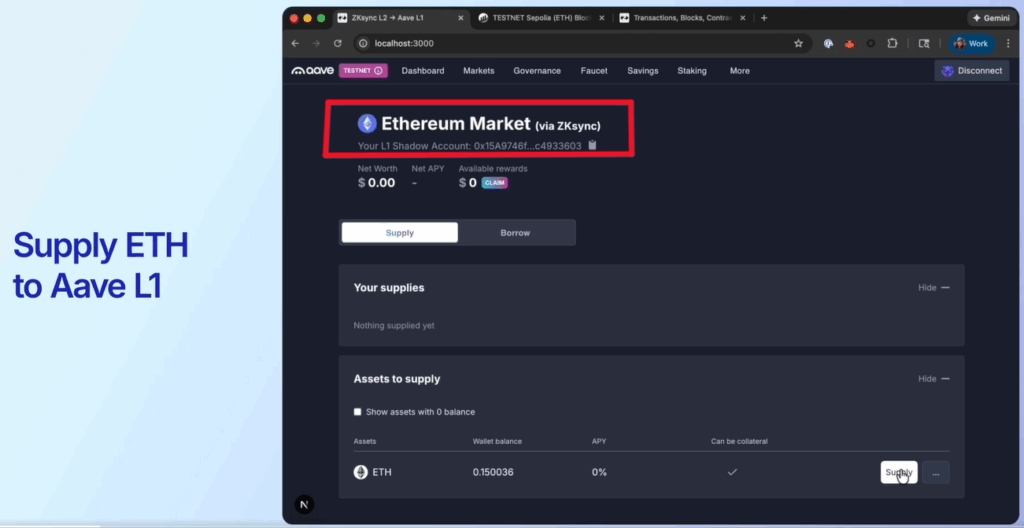
This flow is possible thanks to a mechanism composed of three steps:
- Fast withdrawals to an “alias” account in Ethereum.
Alias accounts are cryptographically controlled representations that allow actions to be executed at the main layer without the user generating a new identity.
These alias accounts are still controlled by the user’s key on the ZK Chain, so they do not require creating an additional identity on Ethereum.
- Preparation and execution of an interoperability “transaction package”.
This package bundles the instructions needed to deposit funds into Aave and then take credit into GHO within Ethereum.
- Possibility of returning the borrowed tokens to the L2.
The user decides if they want to move the GHO back to their ZK Chain. Using a bridge is no longer a requirement to complete the operation, but rather a later option.
Institutional impact: privacy with access to public markets
The new Atlas update also integrates Prividiums, a set of tools that allows companies or financial entities trade on private systems without disconnecting from the open Ethereum market.
Prividiums works as an isolated environment that protects sensitive data, like a private space where sensitive information is not exposed to the public network. This relevant to companies subject to regulatory requirements.
However, thanks to ZK Interop, those institutions gain direct access to liquidity and to the availability of capital in Ethereum.
The ad summarizes the idea in one sentence: “Companies no longer have to choose between private systems and public liquidity.”
With this architecture, they can integrate treasury operations, risk models, financing, and advanced trading strategies within a private framework while executing DeFi transactions without moving critical data.
ZKsync describes this scenario as “the end of fragmented liquidity.” Its vision is to position to Ethereum as the capital center for all ZK Chainsregardless of the degree of privacy, corporate use or scale that each one needs.