
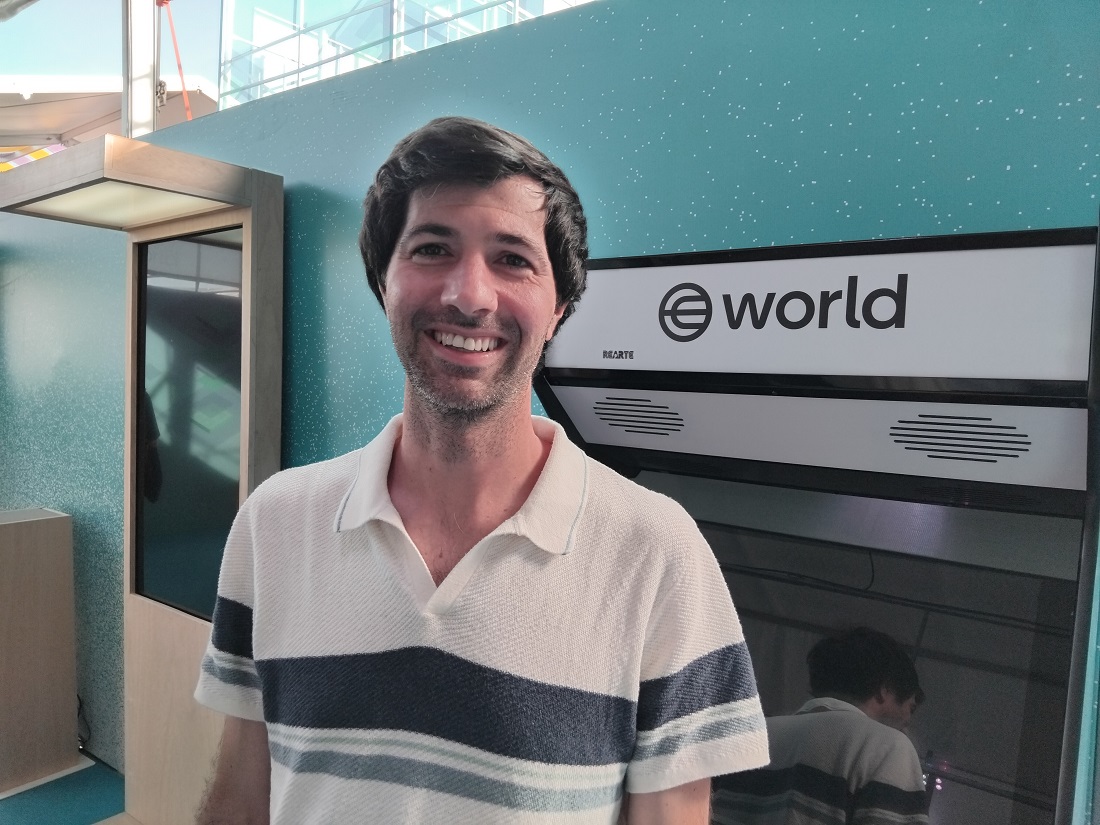
Within the framework of the most recent edition of DevConnect held in Buenos Aires, an event that brought together developers and enthusiasts of the Ethereum ecosystem and decentralized technologies, the debate on digital identity took center stage. CriptoNoticias had the opportunity to speak exclusively with Martín Mazza, regional manager for Latin America at Tools for Humanity, the company behind the technological development of the World protocol (previously known as Worldcoin).
The conversation, which flowed from the manager’s origins in the bitcoiner ecosystem to the challenges of artificial intelligence (AI), left a conclusive fact that highlights the relevance of the region: “Argentina has more than 2 million verified users.”
Throughout the interview, Mazza broke down not just the numbers, but the philosophy behind iris scanning, privacy controversies, and integration plans with governments and large companies.
Martín Mazza: from bitcoin to proof of humanity
To understand the direction of a project, it is vital to understand who is behind the wheel. Mazza is not a newcomer to the world of digital assets. His foray began more than a decade ago, captivated by the value proposition of bitcoin (BTC) and the beginnings of smart contracts on Ethereum.
«More than 10 years ago I began to get involved with what bitcoin was at that time and in the beginnings of Ethereum. (…) I saw that blockchain, as a moldable and technological platform, is very kind and can greatly empower both people and creators,” Mazza said at the beginning of the talk.
His transition to World was driven by entrepreneurial curiosity and the search for “new rails and financial infrastructure.” What caught his attention four years ago, he explained, was the scale of the project’s ambition: create a private and anonymous proof of humanity (World ID) distributed globally.
It is important to make a technical distinction that often confuses the general public and that the executive was responsible for clarifying: Tools for Humanity is the technology company that develops the protocol, while the World Foundation is the entity that governs it. “We believe a lot in decentralization and that tomorrow there will be more ‘Tools for Humanity’, more developers,” he said, stressing that the ultimate goal is for the network not to depend on a single entity.
What problem is World seeking to solve?
During the interview, the focus quickly shifted to the real usefulness of the project beyond market speculation. Why is it necessary to scan the iris? For Mazza, the answer lies in proliferation of artificial intelligence and the current inability to distinguish who is on the other side of the screen.
The manager cited alarming figures: «According to research by MIT Risk Assessment, fraud related to artificial intelligence increased from 6% to 46% in the last 5 years. Fraud in Latin America increased more than 140% in the last year.
In this scenario, World ID is presented as a digital “pipe” that connects applications and users, certifying only that the user is a unique human being, without revealing his or her civil identity. For its part, the Worldcoin token (WLD) acts as “the electricity that runs through that pipe” to facilitate the exchange of value.
World use cases: from Tinder to Ricardo Arjona
One of the most interesting points of the dialogue was the grounding of this technology. Cryptocurrency projects often remain theoretical, but Mazza listed integrations that are already happening or in pilot phase.
He mentioned alliances with giants like Tinder in Japan and the Razer gaming communitywhere the goal is to preserve the integrity of the game by preventing users from competing against bots.
However, the most graphic example and closest to popular culture was the one related to the entertainment industry and the Guatemalan singer Ricardo Arjona.
«Arjona announced a world tour and suffered the problem of bots: he sold out a Madison Square Garden in two hours. (…) World ID can be a solution to that: humans from Guatemala verifying their humanity to access the tickets,” Mazza explained.
This case illustrates how, according to Mazza, World could solve tangible problems such as mass ticket reselling, ensuring that tickets reach real fans and not automated resellers.
Privacy and controversies over World
It is undeniable that World has faced resistance and criticism, both from regulators in various countries and from privacy advocates within the bitcoin ecosystem. Asked about the matter, Mazza pointed to a lack of education about how the underlying technology works.
The executive was emphatic about ensure that the Orb device (used for eye scanning) does not store biometric data once the iris code is generated. “It still needs to be understood that World ID is a tool that preserves our privacy and anonymity,” he said.

To technically support his claim, Mazza alluded to the use of zero-knowledge proofs (Zero Knowledge Proofs) and secure multiparty computing (SMPC) systems. These cryptographic technologies make it possible to prove the veracity of a statement (such as “I am a unique human”) without revealing the information that supports it (the image of the iris). “It achieves thresholds of privacy and anonymity that are a new global standard,” he stated.
Innovation: passports and the World Chain
Looking toward the immediate future, the interview revealed new features that seek to expand the ecosystem. One of them is the Integration with government ID documents that have NFC technologylike the Argentine passport.
This would allow the credential to be “tokenized.” In practice, a user could prove in an application that they are over 18 years of age or that they have Argentine nationality without having to provide a photocopy of their document or expose their address or tax number. “We get used to giving away all our information for simple things,” Mazza reflected, proposing a paradigm shift towards data minimization.
In addition, justified the launch of World Chain, a new second layer network (Layer 2) on Ethereum. In a market saturated with cryptocurrency networks, Mazza argued that this new network is necessary to “prioritize block space for humans.” This means that, in the event of network congestion, Transactions from verified users will have preference over those from arbitrage botsin addition to offering differentiated rate systems.

Argentina as a development hub
The choice of Buenos Aires for World Buildthe Tools for Humanity acceleration program was no accident. Mazza highlighted that the country is an “ideal breeding ground” not only for user adoption, but also for the talent of developers.
The World Build program, which brought 16 finalist teams to the Argentine capital, seeks to incubate applications that use the World ID. «Understanding that Argentina has more than 2 million verified users, it is ideal for these teams to talk to users and partners«he commented.
Additionally, the local ecosystem is moving fast. Mazza advanced the vision towards 2026, where QR payments through the World App could become widespread. He mentioned the recente alliance with the local exchange Ripio to launch the W-ARS (Cryptodollar UXD), a stablecoin tied to the value of the Argentine peso.
“Tomorrow you will be able to have an account in Argentine, Colombian or real pesos in your World App, interoperable with crypto and digital dollars.”
Martín Mazza, regional manager of Tools for Humanity.
Towards 100 million verified humans in World ID
The closing of the interview left a clear perspective on the project ambition: reach between 100 and 200 million users. For Mazza, success lies in integrating this “proof of humanity” into the daily infrastructure of the internet, from social networks to financial systems.
In an increasingly automated digital environment, humanity certification is emerging as a key security component. Nevertheless, World’s global rollout advances under the watchful eye of regulators in several jurisdictionskeeping the debate open in the industry.
With that in mind, a challenge for the project will be gaining the ultimate trust of both state regulators and the cryptocurrency ecosystem.
Meanwhile, World continues to make steady progress with the goal of becoming an identity standard for Web3.