

Kohaku incorporates privacy into wallets through modules that can be activated by developers.
The kit offers private shipping, hidden addresses and consultations without data exposure.
The Ethereum Foundation (EF) is advancing the implementation of Kohaku, a modular toolkit that seeks to incorporate privacy features directly into Ethereum wallets.
These tools would be possible without requiring the user to switch applications or modify your usual way of operating.
The Kohaku project, reported by CriptoNoticias, suggests that privacy should be a basic standard and not an additional feature. Bringing these tools to the wallet level would place identity protection as an integral part of the experience and not an optional add-on.

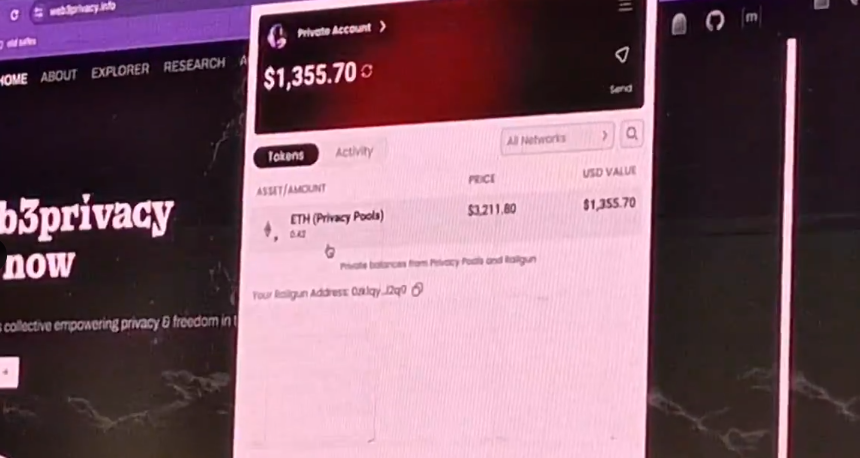
Likewise, EF presented during Devconnect Argentina Kohaku Wallet, a browser extension created solely as a demonstration to showcase the functions of the SDK.
Kohaku will have a public testing period during the next edition of the EthCC event, which will be held between March 30 and April 2, 2026.
Kohaku: a standard to incorporate privacy into any wallet
Kohaku is an SDK (Software Development Kit) that introduces a series of components designed so that any wallet provider add privacy as a native feature.
The SDK groups functions that today are usually distributed in specialized applications and proposes to integrate them through a single module, installable as if it were an add-on. This reduces dependence on external agents.
The Oxbow team, an infrastructure platform focused on privacy and regulatory compliance for decentralized finance (DeFi) on Ethereum, published a thread on X on December 8 along with a explanation about Kohaku.
Kohaku mainly aims to solve two problems: that Ethereum transactions are easy to trace and that a user’s activity is usually tied to a single address.
What privacy features does Kohaku contain for Ethereum wallets?
Among the functions that the Ethereum Foundation included in Kohaku, there are three main ones:
- Private shipping and receiving via privacy pools.
This is a mechanism that groups transactions and hides the link between source and destination.
The privacy pools They function as groups of users who deposit and withdraw funds without leaving direct traces between both operations. In this case, Kohaku provides the necessary integration for the wallet to manage these movements automatically.
- The generation of stealth addresses (hidden addresses).
These addresses are created automatically for each transfer and allow two parties to make movements in the network without the rest of the observers being able to associate both addresses.
The objective is to prevent a public address from becoming a kind of “personal identifier” of the user.
- Accounts per application.
It is a configuration that separates the activity between different services or contracts. This approach prevents the use of a decentralized application (dapp) is linked to the activity carried out in others.
It is a way of compartmentalizing information, similar to using independent profiles within a system.
How does Kohaku address watchpoints on Ethereum?
Kohaku integrates a light client (thin client), software capable of checking the network status without depending on third-party nodes.
Today, many wallets consult the Ethereum network through RPC providers (remote network access points, or in English Remote Procedure Call), which allows These services reconstruct usage patterns: what a user consults, when they do it and from what address.
When operating with a light client internally, the wallet reduces that exposure channel.

Another piece of the SDK is private state reads, based on a combination of TEE (Trusted Execution Environments) Trusted Execution Environment and ORAM (random access mechanisms that hide what data is consulted, called Oblivious RAM).
In practical terms, these tools allow the user to consult information on the Internet without revealing exactly what part of the state you are looking at.
Oxbow anticipates that Kohaku will migrate to a system based on PIR (Private Information Retrieval or private information recovery), which performs the same function without dependencies on specialized hardware.
The SDK also incorporates social recovery options, a mechanism that allows access to an account to be restored using identities verified with zero-knowledge proofing tools (ZK, Zero-Knowledge proofs).
Among the alternatives mentioned are ZKEmail and ZKPassportwhich combine digital identities with cryptographic validations without exposing sensitive data.
The logic is to replace traditional recovery processes (such as passwords or seed phrases stored in plain text) with on-chain auditable methods.
Finally, Kohaku also includes accounts post-quantumdesigned to resist algorithms enabled by quantum computers, as explained.