
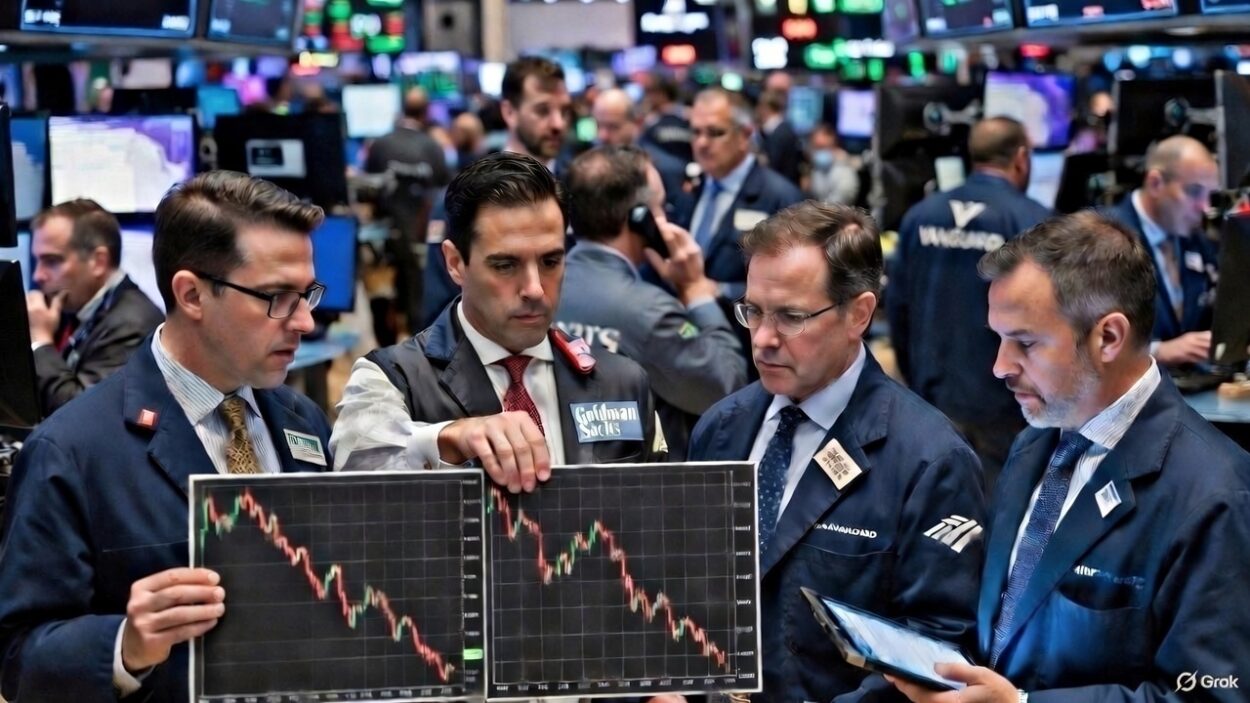
Four financial giants, which manage more than 20 billion dollars, are behind the maneuver.
$1.3 trillion was lost in market capitalization since the October crash.
For over a decade, the Bitcoin (BTC) narrative has been marked by high volatility and cycles of euphoria and pain, driven largely by the psychology of individual investors. However, what we experienced in recent weeks was not an organic retail market correction.
It was a classic Wall Street manual for the transfer of assets: a shakeup calculated to force weak holders (weak hands) to be liquidated, just before the large institutions activated their distribution and access networks.
He timing and the coordination of four top-tier financial institutions—JPMorgan, Goldman Sachs, Vanguard, and Bank of America (BofA)—in the immediate aftermath of a massive liquidation of retailit was not subtle. In fact, it felt like the closing of a chapter in which fear is used as a tool for accumulation.
The appearance of these Four Horsemen of the traditional economy at the point of maximum retail weakness was not a coincidence, but rather the sign that the infrastructure was ready.
The shaking manual: panic and complaint
It all started with a forced liquidation event in November. A dump big enough to purge leverage, trigger bailouts (redemptions) and force the most fragile hands out of the ETF complex. Billions of dollars flowed out at a time when the market was perceived to be most vulnerable.
That was not the goal; It was cleaning the track. Once the market was weakened, the FUD sequence (Fear, Uncertainty, and Doubt) was activated:
The shaking process (shakeout) was consolidated. And while blood was still hot, the institutional response was activated in a surgical sequence orchestrated by the four giants.
Activation of institutional infrastructure
The synchronized movement of these four institutions is the clearest evidence that this dump It was not chaos, but preparation:
- JPMorgan and structured debt
As soon as the market was purged, JPMorgan introduced the first wave of structured notes of leveraged Bitcoin (leveraged Bitcoin structured notes). These are sophisticated financial products that the institution could not launch until the ETF options markets (such as IBIT) had the necessary depth. This move is not speculative; is the construction of debt and risk infrastructure on Bitcoin for very high-level clients.
- Goldman Sachs: Agreed to acquire Innovator Capital Management for approximately $2 billion, adding the defined outcome ETF issuer (defined-outcome) under its asset management.
- Vanguard, the $11 trillion fund manager famous for its uncompromising stance against Bitcoin for 15 years—with its (former) CEO publicly stating that “we are not going to change our mind”—suddenly turned 180 degrees.
Vanguard did not change its stance in the euphoria; it did so immediately after a 30% drop. Retail capitulation was the trigger so that the strength of passive investing finally integrated exposure to Bitcoin.
- Bank of America (BofA): the green light for distribution.
To complete the triangle, Bank of America (BofA) gave the green light to 15,000 advisors who were previously prohibited from recommending Bitcoin. Most importantly, this approval came with a formal allocation guide: exposure to model portfolios of between 1% and 4%.
This is the activation of the massive distribution network. It’s not just that BofA allows Bitcoin; It is integrating it into the standard risk model that its advisors use to move billions of dollars from their wealthy clients. The process is activated only after the shock clears marginal sellers from the market.
The Bottom Line: Wealth Transfer
When viewing the sequence in perspective, the pattern is unmistakable:
- Banks create or amplify fear (exclusion FUD, forced dump).
- The market falls, liquidity is drained.
- He retail capitulate and sell in panic.
- Strong hands (institutions) silently accumulate at discounted prices.
- Legal and product infrastructure (structured notes, ETFs, formal allocation) is activated.
- Distribution networks (thousands of advisors) open access.
We are facing a classic transfer of wealth: from weak and hyper-leveraged hands to institutional balance sheets with long-term mandates.
We must not forget the liquidity context. The big rally that took Bitcoin from $16,000 to $126,000 in the last 2.5 years occurred under the harshest liquidity regime it has ever faced (quantitative tightening or QT). The fact that QT officially ended a few days ago only reinforces the thesis.
The path has been cleared, the Four Horsemen have taken their positions and global liquidity is about to turn. This is not a time to be shaken.
It is the time when Bitcoin leaves retail phase to become global reserve asset allocation. The route to dismantling the USD 100,000 wall now does not depend on viral narratives, but on the constant flow of institutional capital that has just opened its floodgates.
Disclaimer: The views and opinions expressed in this article belong to its author and do not necessarily reflect those of CriptoNoticias. The author’s opinion is for informational purposes and under no circumstances constitutes an investment recommendation or financial advice.