
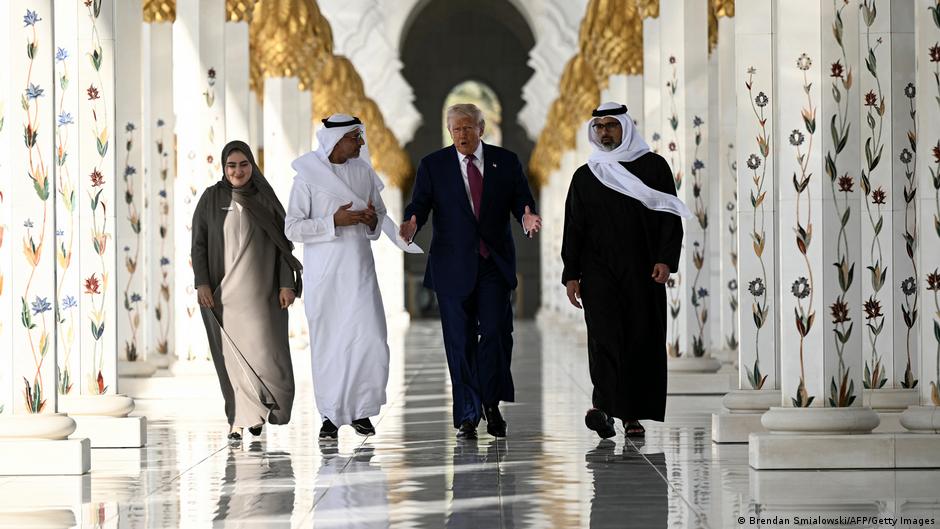
It’s hard to see US President Donald Trump saying a bad word about the “strongmen” and authoritarians of the Middle East.
He called Saudi Arabia’s leader Mohammed bin Salman “brilliant” and “fantastic”, adding, “What he has done is incredible in terms of human rights and everything else.”
This year alone, Saudi Arabia executed more than 240 people, often without due process, human rights organizations report.
As for Turkish President Recep Tayyip Erdogan, the U.S. Ambassador to Turkey recently described Trump’s relationship with the increasingly autocratic Turkish leader as a “bromance.”
“He’s a tough cookie — but he’s my friend,” Trump enthused during an October meeting with Erdogan, who has recently made international headlines for jailing opposition politicians.
“I don’t know why I like the tough guys better than the soft, easy guys,” Trump said at the same meeting.
A New Approach to Middle East Authoritarians
Previous US governments have conditioned military deals and aid on human rights and democratic policies in the Middle East – or at least paid lip service to those ideals. But according to this month’s update of the US national security strategy, that is no longer the case. The document is regularly updated by different administrations and outlines changing priorities.
In 2022 editionPrepared for former President Joe Biden, it says that in the Middle East, the US will “support and strengthen partnerships with countries that subscribe to the rules-based international order” and “demand accountability for human rights violations.”
Trump administration’s Update, published in early December, Makes no mention of human rights and focuses only once on the “rules-based international order.” Regarding the Middle East, it simply says that the US should “stop forcing these countries – especially the Gulf monarchies – to abandon their traditions and historic forms of government.”
In the same document, European “forms of government” are not given equal favour. The Trump administration may intend to stop “bullying” in the Middle East, but in Europe, it apparently plans to dare the European Council on Foreign Relations described last week For example, supporting right-wing, anti-EU political parties, in the form of a “culture war”.
Why does Trump prefer Arab royals to EU leaders?
“Donald Trump’s personal style of decision-making and his authoritarian tendencies make him a far more natural ‘strong man’ than traditional democratically elected leaders,” says Christian Coates Ulrichsen, a Middle East fellow at Rice University’s Baker Institute for Public Policy.
“Trump’s affinity for the leaders of the Middle East, and especially the Gulf, may be rooted in his appreciation of some similarities in their policymaking styles as well as the give-and-take basis of the relationships they have built,” he told DW. “Gulf leaders also have the advantage of being outside the camps of traditional US allies or adversaries, occupying a ‘safe space’ of transactions despite being close partners.”
As Andreas Craig, senior lecturer at the School of Security Studies at King’s College London, notes, wrote some time ago Trump visited the Gulf in May this year, saying, “Trump’s transactionalism has found a natural home in the Gulf. The premise is simple: you get what you pay for. There is no pretense of shared destiny, values or ideals… This is exactly how the Gulf’s tribal monarchies manage their relationships.”
Qatar famously gifted Trump a $400 million airplane, while the United Arab Emirates and Saudi Arabia have made extravagant promises to invest hundreds of billions in the U.S. economy.
Trump seems to like the idea of thinking of himself as king
It may also be that Trump appreciates the lack of constraints on political action from authoritarian leaders in the Middle East, Coates Ulrichsen says, something that “Trump himself has tried to achieve, especially in his second term in office.”
Saudi Arabia, the United Arab Emirates and Qatar are run by royal families who make their own laws, will not tolerate political dissent and, because they do not have democracies, do not rely on the favor of citizens to remain in power.
In February 2025, Trump described himself as a royalist. He ended a Truth Social post detailing how New York had abolished congestion pricing, to which he insisted, “Long live the King!” The official White House Instagram account shared the quote along with an AI drawing of Trump wearing a crown.
‘Neo-royalty’ is changing the international order
A newly published paper in the journal international organizationThe study, written by Stacey Goddard, professor at Wellesley College in Massachusetts, and Abraham Newman at Georgetown University in Washington, supports that opinion. It sees Trump’s affinity towards Middle Eastern “strongmen” as part of an emerging system of “neo-imperialism”.
Academics have defined neo-imperialism as “an international system structured by a small group of ultra-elite who use modern economic and military interdependence to extract material and status resources for themselves.”
They write, “Trump’s vision of absolute sovereignty, his reliance on a cabal composed of family members, staunch loyalists, and elite ultra-capitalists, guides not only US foreign policy, but also his arrangement of international relations.” “Consistent with neo-monarchism, Trump equates some leaders with monarchical sovereignty and has prioritized relations with them [them],
Of course, royalty-based systems are not new, Newman and Goddard point out. They have existed for centuries and the Gulf monarchies have co-existed with democratic nation states for decades.
But what is happening now is “a generational transformation of the international system,” Newman argues.
The paper said other countries, including Türkiye, India, Hungary, China and Russia, are also moving towards a system dominated by elites. But now that the US – with its economic and military might – is also moving in that direction, the idea is spreading, as other world leaders, including Europeans, are forced to play the same game, it says.
“We were very clear in the text that this [neo-royal] The order has not been consolidated yet,” Neumann told DW. He explains that for it to more fully take hold, it must undermine the existing liberal rules-based order. He said that is why the EU – which is seen as the leading representative of that order – is under attack. According to Newman, this is also one of the reasons why Trump favors the Gulf monarchies.
“In this [neo-royal] “Through exceptionalism you legitimize the system,” say political scientists. “That’s why you are the absolute ruler. So whose approval do you want?” he asks. Certainly of other “autocratic rulers.” “And the Middle East is fertile ground for that,” he says.
“What’s important if you’re going to promote it [neo-royal] Alternatively, you have to normalize the behavior, legitimize it,” Newman says. “These actors – Erdogan, the House of Saud, or the UAE, or Qatar – can provide that legitimacy. They offer Trump a way to say, ‘This is normal, what I’m doing is normal.’