
“We are not at war, but we are no longer at peace either,” German Chancellor Friedrich Merz of the conservative Christian Democratic Union (CDU) party summed up the mood in Germany in late September.
Hybrid war has been discussed among German security and political experts since Russia’s attack on Ukraine in February 2022. Germany is being hit hard by a mix of military and intelligence operations, often including disinformation. Classic methods include sabotage, espionage, and disinformation to promote uncertainty among the general population.
What’s wrong with Germany’s early warning system?
The main task of the German domestic intelligence services, or Federal Office for the Protection of the Constitution (BfV), is to quickly identify threats in order to prevent attacks. Given the current level of threats, BfV Director General Sinan Selen said his agency needs more powers.
“We have forms of communication that we are no longer able to decrypt in parts. We have actors who operate under pseudonyms,” Selen said at the annual Constitution Protection Symposium in Berlin. “As an intelligence service, I need to be able to get into these areas.”
Selenium is relying on changes in security laws to achieve this goal. German Interior Minister Alexander Dobrindt has already announced reforms, while support has also been voiced from the Chancellor’s Office, where Philipp Wolff coordinates the country’s three central intelligence agencies: the Federal Office for the Protection of the Constitution, the Federal Intelligence Service and the Military Counter-Intelligence Service.
Wolff emphasizes that increased online surveillance and storage of IP addresses is necessary. He also wants security agencies to exchange personal data more easily.
However, whether this will be possible remains uncertain. Opposition parties and civil society organizations have almost always challenged strict security laws in Germany’s Federal Constitutional Court – and often successfully.
France and the Netherlands as role models?
But Selenium is convincing. Other EU countries such as France and the Netherlands are well ahead, he told the Berlin conference, citing two countries with fewer legal restrictions on surveillance of suspects and less stringent data protection laws.
Following President Donald Trump’s recent national security strategy, it is difficult to tell how the BfV’s future intelligence relationship with the US will evolve. However, Selenium indicated a business as usual outlook. “I would not draw the conclusion from such a strategy that we are breaking ties with America,” he said. “I also don’t believe that our partners are breaking ties with us.”
At the same time, he stressed the importance of constantly reviewing and developing alliances. In his view, Europe should be more independent from America.
Selene is also considering developing its own IT programs of domestic intelligence services to monitor and analyze digital communications.
Many countries use the controversial US software Palantir for this purpose, but German security officials have been debating its use for some time. Selenium expressed support for the national option. “We have industries, we have companies that can do this,” he said, adding that perhaps they need more support.
Critical infrastructure is at risk
For his part, intelligence coordinator Wolff said that the BfV and other German security agencies were already effective. “The Russians know this too; they already take us seriously,” he said, adding that the national debate on how to deal with hybrid threats is being closely followed in Moscow.
Wolfe’s main concern is how to deal with a country that doesn’t follow any rules. Hybrid threats are playing an increasingly important role in this context, he said, adding that the symposium offered no definitive answers to such attempts at influence and destabilization.
Carlo Masala, a military expert at the Bundeswehr University in Munich, described Russia’s strategy toward NATO member states as “increasingly adventurous.”
From a Russian perspective, he said, Germany, in particular, was a target. “We are the center,” Masala said, referring to Germany’s central location in Europe and its strategic importance within NATO.
Experts like Masala suspect Russia to be behind the increasing incidents of sabotage on railways, airports and water and electricity supplies. However, critical infrastructure could also be indirectly paralyzed, Masala warned at the symposium. “There is a substation in Austria, and if it goes down, large parts of Germany will lose power,” he explained.
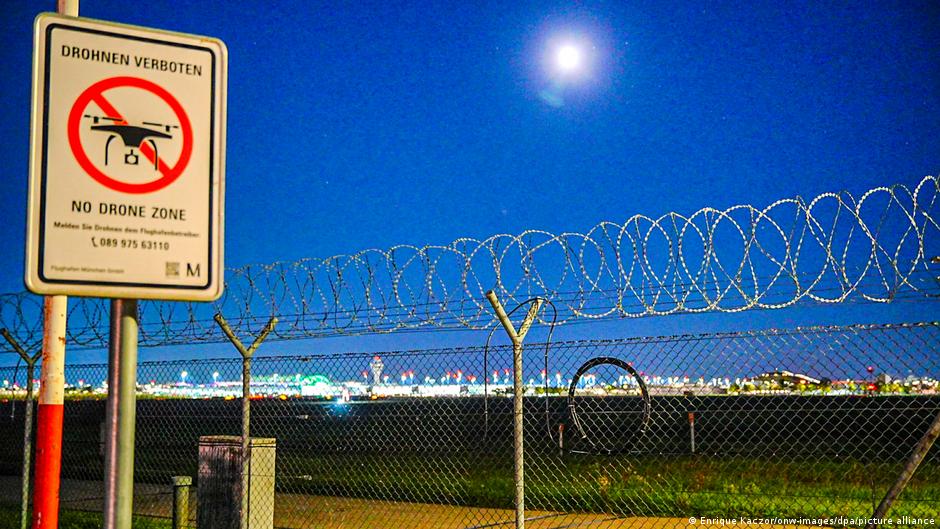
In early October, drones flying near Munich Airport in Bavaria also made headlines when they disrupted operations for a long period of time. According to Masala, its objective was to create fear and panic among the public. However, he suggested that another possible objective was to demonstrate that the Bavarian state government was incapable of taking action against such attacks. The intelligence service can warn about such scenarios, he said, “but it can’t prevent them.”
This article was originally written in German.
While you’re here: Every Tuesday, DW editors provide insight into what’s happening in German politics and society. You can sign up for the weekly email newsletter, Berlin Briefing, here.