
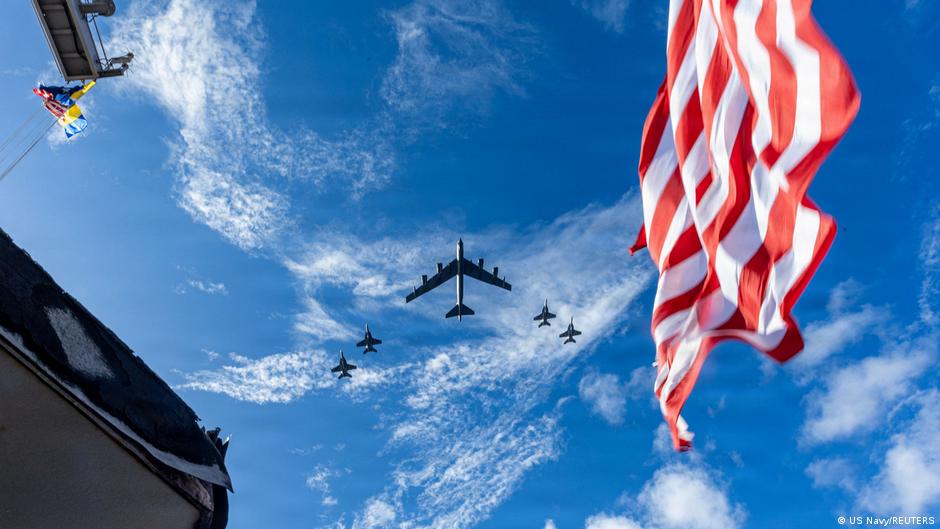
In his first year in office, Donald Trump increased the US military presence in Latin America, personally involved himself in national elections, pressured regional leaders on migration, Drug cartels designated as terrorist groups and disrupted trade relations with an aggressive tariff policy.
The new US national security strategy states that the government will “assert and enforce ‘Trump consequences’ for the Monroe Doctrine” – referring to President James Monroe’s 1823 declaration that the United States should have hegemony over the Western Hemisphere and the American continent.
To better understand relations between the United States and its southern neighbors, here are seven charts that provide context on recent trends on migration, security, geopolitics, and trade.
1. Migration: 50% of migrants to the US are Latin American and more than 90% of those deported
According to annual data published by the U.S. Census Bureau, more than 50 million of the 340 million residents of the United States were born abroad. About 25 million came from Latin America and the Caribbean.
Numbering more than 11 million, Mexicans are the largest group of Latin American immigrants in the United States. Cuba ranks second with about 1.7 million immigrants to the Americas, followed by El Salvador with 1.5 million.
Mass emigration from Latin America began in the 1960s. There has been a significant increase in migration to the United States from around the world since 2020, but the increase has been particularly notable for Latin America. Venezuela and Colombia are among the places of origin for this recent group of migrants, according to the Pew Research Center, which based its estimates on monthly survey data.
Trump began his 2015 presidential campaign by linking immigration from Mexico to drugs, rape and other crimes. For example, ten years later, he made the same rhetoric, saying that the Venezuelan government knowingly released criminals from prison and deported them to the United States – a claim for which there is no evidence.
While continuing to use inflammatory language, Trump has taken steps to carry out his stated plans for mass deportation. For example, he removed temporary protections from 600,000 Venezuelans who previously were allowed to live and work in the United States.
Even before Trump took office, people from Latin America were the overwhelming majority of immigrants removed from the United States by Immigration and Customs Enforcement.
2. Security: Trump is officially designating Latin American cartels as terrorist organizations
Trump’s engagement with Latin American countries characterized by drug trafficking and criminality has extended to broader geopolitical stances. To justify air strikes on boats allegedly carrying drugs in Latin American waters, Trump has claimed that the United States is at war with terrorist groups.
In 2025 alone, the United States has designated 24 new groups as foreign terrorist organizations (FTOs) – a legal classification that allows the US to freeze assets and prosecute people alleged to have ties to them. 14 of them are Latin American drug cartels and criminal gangs such as the Cartel de Sinaloa from Mexico and the Tren de Aragua from Venezuela.
Before Trump, only eight organizations in Latin America were so designated. They were all leftist guerrilla groups, such as Peru’s Sendero Luminoso and Colombia’s Ejército de Liberación Nacional.
The shift toward listing cartels and crime syndicates as terrorist organizations is unprecedented. None of the previous State Department reports reviewed by DW since 1997 have mentioned drug trafficking and criminal activities as justification for inclusion on the FTO list. Most of the designations before Trump were for terrorist groups in Africa, the Middle East and other parts of Asia.
In An analysis published in Foreign Policy magazineTricia Bacon and Daniel Byman, professors at American University and Georgetown University, respectively, write that these designations could increase tensions with the governments of the countries where the cartels operate. They write, “Switching the narrative from crime to terrorism creates the implication that these governments are knowingly harboring terrorists, which is a far more serious accusation than simply having ties to criminal organizations.”
Designations do not legally authorize the use of military force. He says, “Politically, labeling a group ‘terrorist’ may help justify military action and perform better to American audiences, but the FTO designation, in itself, does not confer expanded authority.”
3. Geopolitics: Trump is continuing the US tradition of interfering in Latin American politics. His openness about this may be new, but the trend is not new.
Trump began his presidency by vowing to recapture the Panama Canal and rename the Gulf of Mexico within the United States as “America’s Gulf”. In August 2025, he increased tariffs on Brazilian imports in an unsuccessful attempt to prevent the Brazilian Supreme Court from convicting far-right former President Jair Bolsonaro on charges including plotting a coup and attempting to subvert the democratic rule of law.
As Argentina prepared to vote in legislative elections in October, Trump pledged a $20 billion (€17.2 billion) loan to the success of President Javier Meili’s far-right coalition – which some have credited with helping the bloc win the most votes. He even sent the world’s largest aircraft carrier to the Caribbean Sea, threatening Venezuela’s strong leader Nicolas Maduro and has not completely ruled out attacking the country.
For many, these actions are reminiscent of US Cold War-era interventions in Latin America, either with direct, overt military action or with covert schemes such as supporting allied groups, attempting assassinations, and influencing elections.
In his book, “Secret Regime Change: America’s Secret Cold War”, Lindsay O’Rourke, professor of political science at Boston College, identifies 23 instances in which the United States tried to topple governments in Latin America from 1949 to 1989. They include secretly supporting coups against elected leaders in Chile and Brazil, repeatedly attempting to assassinate Cuba’s Fidel Castro, and invading Panama to remove the dictator (and former). Collaborator) Manuel Noriega.
According to O’Rourke’s work, those actions were not exclusive to the Cold War, but were part of a century-old geopolitical strategy to establish dominance in the Western Hemisphere. These often result in increased political instability in the targeted countries.
Trump’s Secretary of State Marco Rubio claims that US foreign policy has neglected its neighbors in recent years. Now, he says, the United States will focus on working with Latin American governments to secure borders and stem what he describes as migrant invasion. “Some countries are enthusiastically cooperating with us — others, less so. The first will be rewarded,” he wrote in an op-ed for the Wall Street Journal in January, shortly before beginning his first official visit to Central America in February. “As far as the latter is concerned, Mr. Trump has already shown that he is willing to use America’s significant leverage to protect our interests.”
4. Trade: America is no longer the undisputed trade leader in the US
The latest data from UN Comtrade, the United Nations platform that tracks global commerce flows, shows that the United States is still Latin American countries’ largest trading partner, but no longer as dominant as before.
In 2024, the United States was the source of about 29% of total imports for countries in Latin America – down from about 50% in 2000. Currently, the United States is the destination of 45% of Latin American exports, down from 49% in 2000.
Latin America’s dependence on US markets varies from country to country. Although some countries, such as Mexico, still rely heavily on the United States as their main commercial partner, many countries are looking elsewhere.
Additionally, trade relations with China increased throughout Latin America. By 2024, the Asian superpower was the main trading partner of Brazil, Peru, Chile and Bolivia.
Trump’s tariff policy has had a direct impact on some countries. For example, Brazil faces a 50% levy on its exports to the United States, although many products are exempt. Mexico is currently negotiating to avoid imposing a 25% tariff. Additional tariffs on commodities like copper and steel could hit other economies as well.
“We have to look for other partners to buy our products,” Brazilian President Lula da Silva said when the tariffs were first announced in July. “It’s not that we can’t survive without the United States. If the United States doesn’t want to buy, we’ll find someone who wants to buy.”
Edited by: Milan Gagnon and Gianna Gruen