
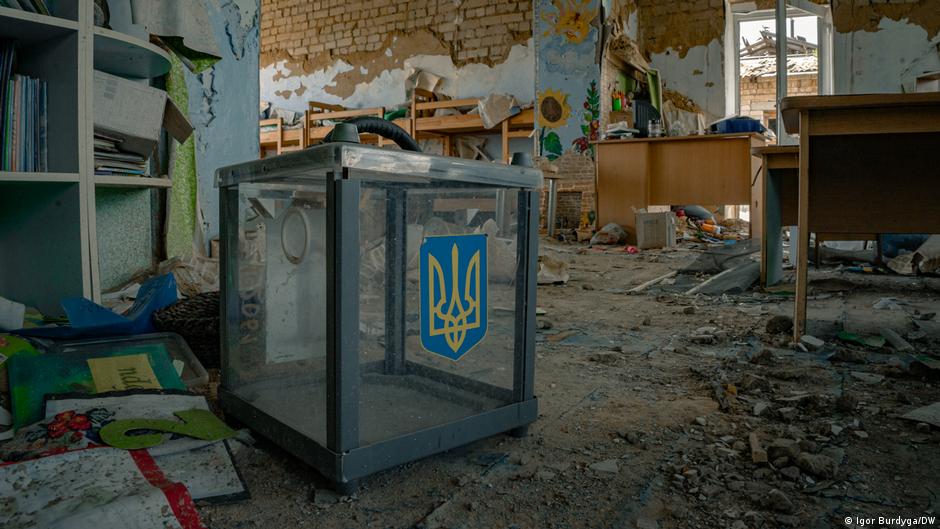
The presidential election in Ukraine has once again become a hotly debated topic as US President Donald Trump slammed his Ukrainian counterpart Volodymyr Zelensky for abstaining from voting.
“They’re using the war to not hold an election, but I think the Ukrainian people should … hold an election. And maybe Zelensky will win,” Trump said in a recent interview with media outlet Politico. He said it was “getting to the point where it is no longer a democracy.”
Zelensky: If conditions remain safe, elections will be held in Ukraine
Zelensky responded to Trump’s comments by saying that the question of elections in Ukraine depends primarily on the Ukrainian people.
“This is an issue for the people of Ukraine, not for the people of other countries. With all due respect to our partners,” the Ukrainian president said in response to a journalist’s question during an online briefing.
At the same time, he said that he would be ready to run for president if international partners could ensure safe conditions.
“I am now asking the United States, if necessary with European allies, to help me ensure security for holding elections, and then within the next 60 to 90 days Ukraine will be ready to hold elections. I personally have the will and readiness for this.”
He said some issues must be resolved in order to hold elections – such as protection from Russia’s ongoing shelling and ensuring Ukrainian troops can participate in the voting.
Another problem, Zelenskyy said, was the legal basis needed to ensure the legitimacy of the vote. He said he would ask members of the Verkhovna Rada, Ukraine’s parliament, to prepare a proposal for changes to the electoral law to allow elections during martial law.
‘First peace, then elections’
Political reactions came swiftly.
“First peace, then elections,” Oleksiy Honcharenko, an opposition lawmaker from the European Solidarity party, wrote on Telegram.
The Ukrainian parliament has long made clear its position that elections are impossible during the war, said Yevheniya Kravchuk, deputy chairman of the parliamentary faction of the Servant of the People party, which holds a majority in the Verkhovna Rada. He said a ceasefire and stable peace were prerequisites for holding new elections.
Kravchuk said on Ukrainian national television, “The elections are not just the day of voting, when everyone comes and everything magically happens. Needless to mention that every day and every night hundreds of drones and missiles are flying over Ukraine, destroying the infrastructure, including the places where elections can be held. There is a threat to life, there are power outages and a million people at the front – obviously they will not leave their posts to campaign or vote.”
Validity of elections without ceasefire
Oleksiy Koshel, head of the Voters’ Committee of Ukraine, an NGO, said there were unresolved issues such as organizing voting abroad, updating the voter registry and enabling internally displaced persons to vote. The most important question, he said, is how to ensure voting rights for military service personnel and the opportunity to contest elections for office.
He argued that raising the topic of elections before the end of hostilities and the signing of a peace agreement became an additional lever of pressure on Ukraine – by Russia and some international partners, warning that if elections became part of the negotiations, Russia would try as hard as possible to disrupt them or suppress turnout.
,Elections require real steps and time,“Big issues take years to resolve,” Koshel told DW. Involving elections in peace talks is a serious threat that plays directly into Russia’s hands. There is a real risk of large-scale fake bomb threats, cyber attacks and interference at polling stations. It’s hard to disrupt elections, but to reduce turnout later to claim the government is illegitimate – Russia is very good at that.”
Ukraine’s constitution prohibits elections during martial law.
Andriy Mahera, a constitutional law expert at the Ukrainian think tank Center of Policy and Legal Reform and former deputy chairman of the Central Election Commission of Ukraine, emphasized that elections cannot be held during martial law because the Constitution explicitly forbids it, and moreover it cannot be amended during martial law. Therefore, elections will be possible only after a peace agreement is signed, the war ends and martial law is lifted.
He said elections would only be considered legitimate if they followed international democratic standards – when voters could form their opinions without fear or pressure, including fear caused by war, and express their will at the polling stations.
Mahera said, “If the elections in Ukraine are not held up to international standards, their recognition will be questioned both at home and abroad. That’s what Putin wants. He will be the first to claim that he does not recognize the elections because they were not properly conducted – even though he will be the one firing missiles at polling stations.”
Russia’s pressure on Trump?
Ukrainian experts believe Russia is pressuring Trump to hold elections before the end of the war on Ukraine, in hopes of destabilizing the country and potentially securing a peace deal with a more accommodating president.
Political analyst Mykola Davidyuk argued that Trump’s demand for elections in Ukraine ignored real circumstances and constitutional constraints. He stressed that the elections are purely a domestic issue and cannot be dictated from abroad.
In a comment to DW, Davidiuk also pointed to double standards regarding democracy:
“If Trump demands elections from Ukraine, why isn’t he demanding the same from Russia? Why not make sure people like that.” [opposition politician and chess grandmaster Garry] Kasparov and other opposition figures could run in Russian elections? Why only Putin? Why should we be accused of not holding elections for six years, when Russia has not had real elections for the last 20 years – and that seems fine?”
For them, demanding elections during the war is an attempt to increase pressure and a way to weaken Ukraine before peace talks.
This article was originally written in Ukrainian