
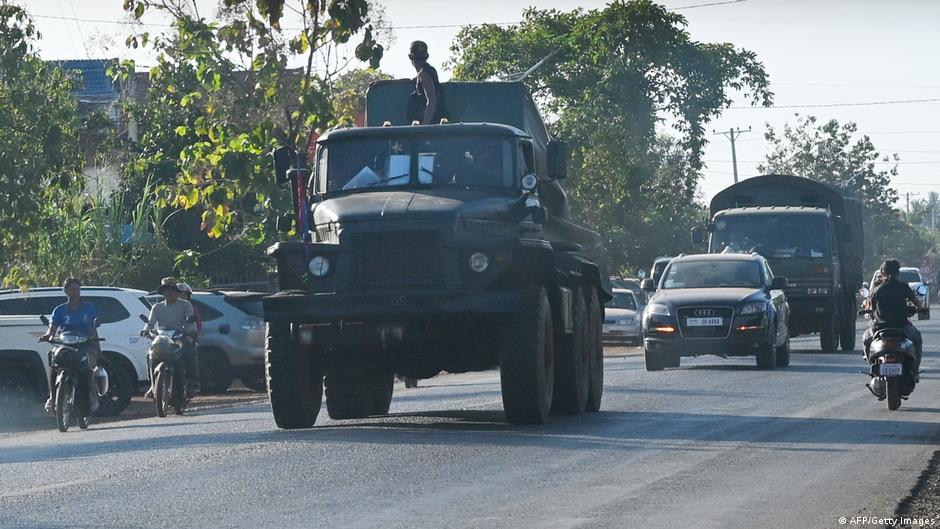
Cambodia closed all its border crossings with Thailand on Saturday until further notice as border hostilities continued.
The move comes as border clashes between the Southeast Asian countries continue despite US President Donald Trump saying on Friday that they have agreed to a ceasefire.
“The Royal Government of Cambodia has decided to immediately and completely suspend all entry and exit activities at all Cambodia-Thailand border crossings immediately and until further notice,” Cambodia’s Interior Ministry said in a statement.
The announcement comes after Thai Prime Minister Anutin Charnvirakul said his country would continue military attacks on Cambodia until it feels threatened by its neighbor, telling local media there is no ceasefire there.
Anutin wrote on Facebook that Thailand would “continue military action until we feel no harm and threat to our land and people,” and told reporters that Cambodia should be the first to end its attacks.
“I want to make this clear. Our actions this morning have already shown that,” he said.
thai newspaper Khaosod “There are no ceasefire talks, and the time has not come yet,” Anutin was quoted as saying. At the same time, the newspaper reported Anutin as saying “a lot of communication is going on.”
Several deaths amid flare-up regional dispute
Authorities say more than 500,000 people have been displaced and more than 20 have been killed, including many civilians, while hundreds of others have been injured in the latest cross-border clashes since the rekindling of a long-running territorial dispute this year.
Anutin’s statement came a day after Trump said the two countries had agreed to stop fighting after several days of clashes along their shared 800 kilometer (about 550 mile) border. Trump has been mediating this conflict.
Thailand says four more of its soldiers were killed in renewed border clashes on Saturday, the defense ministry said, bringing the death toll of Thai troops to 14 since fighting began on Monday.
Cambodia confirms attacks
Cambodia’s Defense Ministry also said in a post on Facebook that “Thai forces have not stopped the bombardment and are still continuing the bombardment.”
Its information minister, Neth Phektra, said Thai forces had “expanded their attacks to include civilian infrastructure and Cambodian civilians”, a claim Thailand denied.
Royal Thai Air Force spokesman Chakrit Thammavichai said the Thai military was “using high-precision weapons to prevent harm to innocent civilians.”
Malaysia’s Prime Minister is demanding a new ceasefire
Malaysian Prime Minister Anwar Ibrahim said in a post on Ibrahim that he spoke to both Thai Prime Minister Anutin and Cambodian Prime Minister Hun Manet.
“To support de-escalation and promote transparency, I have requested the deployment of an ASEAN Observer Team (AOT) led by the Chief of the Malaysian Defense Forces to monitor developments on the ground,” Anwar said, referring to the Association of Southeast Asian Nations. “This mission will be complemented by satellite surveillance capabilities provided by the United States government beginning at the same time.”
Cambodia’s official state news agency, Agence Kampuchea Presse, reported that PM Hun welcomed Anwar’s proposal for a ceasefire starting on Saturday evening.
Long-running Thai-Cambodian border dispute
A ceasefire was last reached in July by the US, China and Malaysia following five days of clashes, after which the warring parties announced the extension of the ceasefire.
However, the agreement was suspended in November after Thai soldiers were injured by landmines along the border.
The border dispute dates back to the 1950s, when Cambodia gained independence from France, and first centered on the disputed ownership of the ancient Hindu Preah Vihear temple before expanding to include other border areas.
Edited by: Wesley Rahn, Carl Sexton