
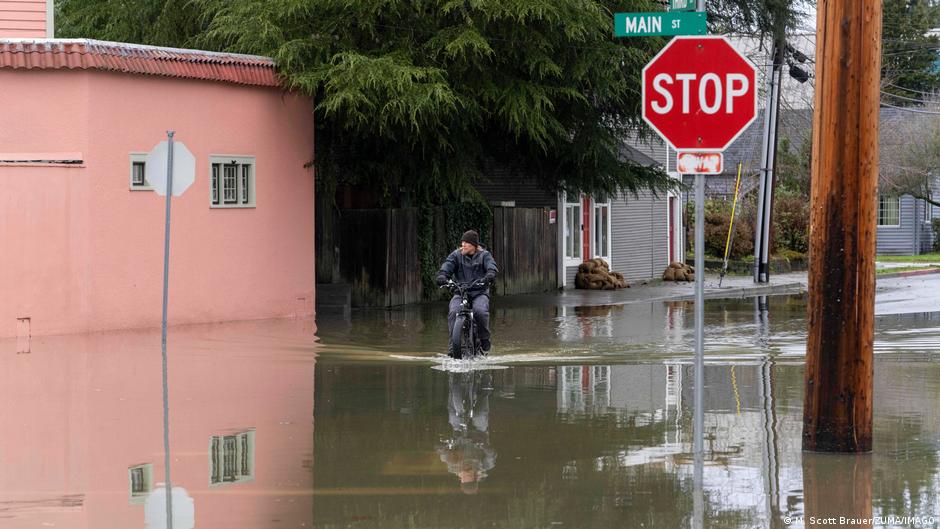
Days of relentless rain have been lashing western Washington state, forcing officials to order the evacuation of thousands of residents due to devastating flooding.
As rivers approached historic levels, state Governor Bob Ferguson declared a statewide emergency. “Lives will be in danger in the coming days,” he said.
Meteorologists say the extreme rainfall was caused by an “atmospheric river” soaking the area along the coast of Oregon and Washington.
Former National Oceanic and Atmospheric Administration chief scientist Ryan Mau, now a private meteorologist, said between 20 to 30 inches (51 to 76 centimeters) of precipitation could fall over a three-week period, which is “pretty extreme.”
What is the science behind extreme floods?
Rainfall is becoming more frequent and severe in much of the world due to rising global temperatures caused by burning fossil fuels.
Tropical storms and intense monsoon systems have caused devastating floods and landslides in Sri Lanka, Indonesia, Thailand, Malaysia and Vietnam since mid-November.,
,A warming climate threatens densely populated areas in Sri Lanka and the Strait of Malacca due to increased heavy rainfall and extreme flooding, according to a study this week by World Weather Attribution, a UK-based academic institute.
While modeling precipitation patterns is complex, a clear guiding principle is that when air becomes warmer it holds more moisture.
Greenhouse gases released into the atmosphere work to insulate the Earth, trapping heat and increasing temperatures. One consequence of this is that water evaporates from land and sea faster, so more water runs off when it rains, which can result in flooding.
The moisture holding capacity of the air increases by 7% for every 1 °C (1.8 °F) increase in temperature. Global air temperatures in 2024 could rise 1.55 C above pre-industrial levels, the hottest on record, according to the World Meteorological Organization.
Rising temperatures result in more precipitation as rain rather than snowfall, which could make high-altitude areas vulnerable to floods and landslides. A 2022 study published in the journal Science Nature found that in snowy, high-altitude parts of the Northern Hemisphere, precipitation extremes increased by an average of 15% for every 1 °C temperature increase.
How are warmer temperatures affecting rainfall?
Climate change is altering the frequency of heavy rainfall during storms and sudden bursts through its effects on complex atmospheric and weather patterns.
Advances in attribution science are allowing experts to more accurately pinpoint the causal relationship between climate change and extreme weather events. According to one estimate, an average of one in four recorded rainfall events over the past decade can be attributed to climate change.
Experts say severe flooding in the US state of Texas in July, which killed more than 100 people, was made worse by the climate.
Edward Grispeart, a research fellow in the Department of Physics at Imperial College London in the UK, concluded that “the flooding in Texas was caused by record amounts of atmospheric moisture in a region that is known for flash flooding.”
He warned that as the atmosphere warms due to climate change, such extreme rainfall events are likely to get worse.
“Climate models project that Texas may become slightly drier on average due to climate change, with precipitation intensity likely to increase, which suggests these types of storms will become more common in the future.”
Will floods increase in future?
Climate science shows that the risk of extreme floods will increase if the world fails to limit global warming.
According to the UN International Panel on Climate Change (IPCC), if the 1.5 °C temperature rise limit set at the Paris Climate Summit is breached, extreme rainfall is considered a once-in-a-decade rainfall event, which will occur 1.5 times every 10 years and will occur in more than 10% of the seasons.
According to the IPCC, at temperatures 2 °C above pre-industrial levels, such events would be 1.7 times per decade and 14% more likely to occur as extreme weather events.
And if the world warms by 4°C, heavy rainfall could be almost three times more likely and rainfall could be 30% more frequent.
Edited by: Tamsin Walker, Sarah Stephan