
The film is shocking. In it, high-ranking prosecutors and judges explain how Romania’s judiciary is politically controlled.
They detail how major corruption cases disappear into drawers, conscientious prosecutors and judges are thwarted and punished by their superiors, and politicians and civil servants embezzle millions with impunity. The court system is becoming weak, a high-ranking justice official says at one stage in the two-hour documentary.
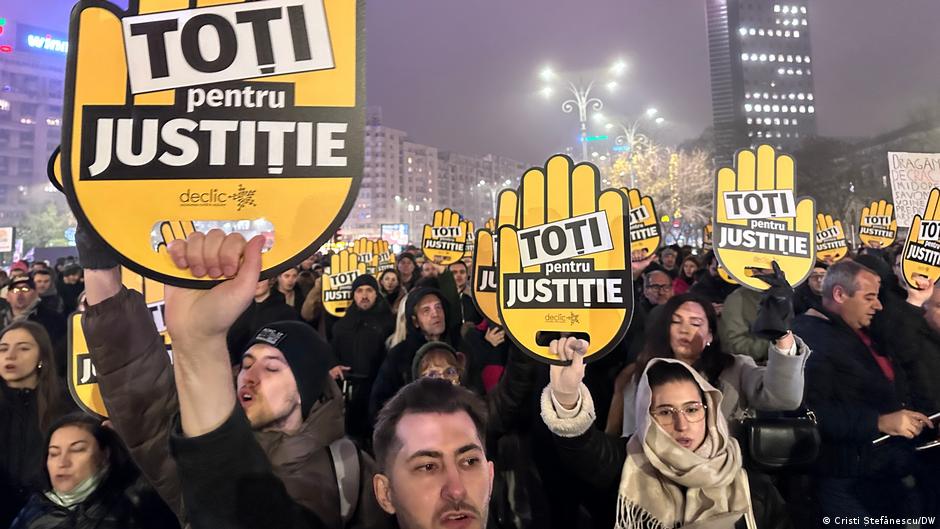
Since “Captured Justice” was released by the Romanian Investigative News Platform on December 9 recorder, It has been viewed nearly 4 million times on YouTube. It is now the number one topic in the media throughout the south-eastern European country, troubling both politicians and the public. Angry citizens have been demonstrating every evening in the capital Bucharest and several other cities since last Wednesday.
Romanian President Nicăor Dan expressed his support for the report on his Facebook page, and called for more coherent judicial reform. The post recorded 10,000 likes, but also thousands of angry comments, calling on him to take action with his words.
Prime Minister Elie Bologen told media that he understood citizens’ frustration, promising that “serious problems in the system” would be fixed.
New speed, old problem
Romania’s rigged judicial system and delays in fighting corruption have been an issue for decades, and have repeatedly been the focus of protests, state crises and changes in government. Many reform efforts have failed to have a lasting impact.
Some people have faced these failures in the past, but a number of high-ranking prosecutors and judges are willing to speak out for them. recorder The report is new, apart from the level of detail it provides about the influence of politicians and senior officials.
Those featured include Liviu Lascu, a prosecutor and former head of the military department at the National Anti-Corruption Directorate (DNA), Romania’s most important authority in the fight against widespread political abuses. Lascu describes how he was prevented from pursuing carefully documented cases of corruption within the security and military apparatus and forced out of his position.
Former DNA chief prosecutor Krin Bologa, who served until March 2023, also appears in the film, saying that he had the impression that the DNA had been cleared of unwanted prosecutors under his successor Marius Voynig. This would explain why hardly anyone has been found guilty in corruption cases in recent times.
The two high-ranking judges also discuss how judges were replaced in political corruption cases when the defendants faced prison sentences. The charges are primarily leveled against Lia Savonia, the former head of the Superior Council of Magistrates (CSM), the watchdog body that guarantees judicial independence in Romania.
The CSM manages appointments, promotions and transfers for judges, and has the power to change the composition of court chambers and impose disciplinary penalties. Savonia and its loyal CSM members are said to have made extensive use of these powers to influence corruption proceedings in favor of the defendants. The Romanian public sees Savonia as “the face of the captured judiciary”.
‘We are just being terrorized’
A prominent case covered extensively in the report is that of Marian Vangeli, the former mayor of a Bucharest district, who stood trial for years on charges of abuse of office, bribery and money laundering. After an initial prison sentence of more than 11 years, a judicial process began and all proceedings against him were canceled in March 2025 because the statute of limitations had expired. Commentators describe his case as “an exemplary failure of the judicial system”.
The report caused rapid political upheaval in Romania. On Thursday, the Bucharest Court of Appeal (CAB) – the court responsible for the Vangli case – held its first press conference.
Presiding Judge Liana Arseni wanted to defend herself against the allegations in the report, but the press conference ended in public embarrassment when another CAB judge, Raluca Morosanu, confirmed her. Speaking on behalf of his coworkers, he said, “We are being terrorized with disciplinary proceedings and everything else that is happening to us.”
Inflated pension amid economic stress
The release of the report comes at a delicate moment for Romania economically. In 2024, the country’s budget deficit was the largest in the EU at 9.3%. This year’s target is 7%, which would still be a record.
After a tumultuous period of domestic politics in which a right-wing extremist almost became president, pro-European, liberal-conservative, former anti-corruption activist Nikosor Dan took office in May 2025. The following month, a four-party coalition was formed with some difficulty under Prime Minister Bolojan of the National Liberal Party.
One of his toughest tasks is to reform the budget, including so-called special pensions for civil servants, some of whom can retire as young as 48 and who receive up to €14,000 ($16,000) a month. In contrast, the average pension receives approximately €540 per month and thousands of former agricultural workers receive an average pension of only €120 per month.
In view of the fact that former judicial officers often receive special pension recorder The film has increased public pressure on the government to implement the reforms, which had been planned since August but blocked several times by the judiciary.
The Constitutional Court will now have to decide on legislation to end the special pension, although it is unclear when that might happen.
But a date has been set: On Facebook, President Dan invited prosecutors and judges to an “open discussion” on December 22. The date has great symbolic significance as it marks the anniversary of the end of dictator Nicolae Ceausescu’s rule in 1989.
This article was originally written in German.