

There is a fact revealed by the Organization for Economic Cooperation and Development that should set off all educational alarms: according to the most recent PISA evaluation, almost 1 in 5 15-year-old students (18%) in the organization’s member countries does not reach basic levels of competence in financial literacy.
Although the report indicates that more than two-thirds of these young people regularly use digital products and services, such as mobile payments or online shopping, a significant gap remains between their daily practice and formal knowledge about finances.
The situation shows that many educational programs do not reflect the digital reality of the 21st century. As a result, students lack the skills necessary to navigate a society dominated by debt, digital transactions, and technologies such as bitcoin (BTC) and cryptocurrencies.
Likewise, the researchers found that only 2 out of 3 students have learned at school the difference between needs and desires financial. In addition, students from disadvantaged socioeconomic backgrounds perform worse, so they have fewer opportunities to learn about money at home or at school.
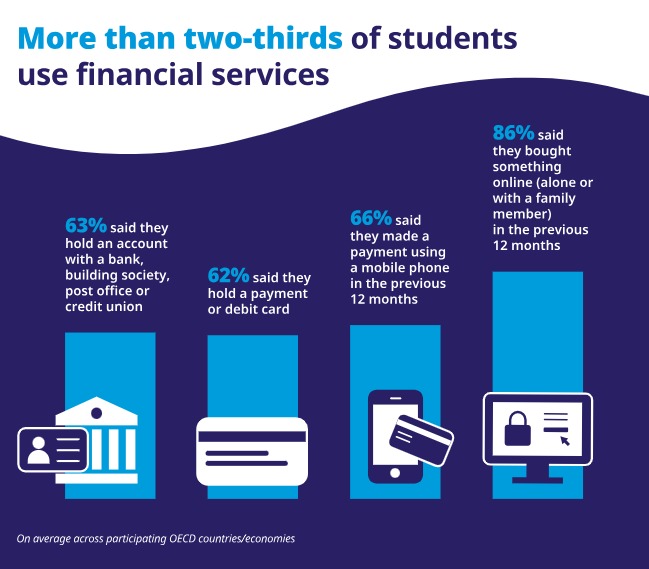
These results, together with the increasing incidence, complexity and potential impact of financial fraud and scams, highlight the urgent need to better equip our young people with the knowledge and skills necessary to make safe and informed financial decisions.
Mathias Cormann, Secretary General of the OECD.
Inequality in financial literacy
All of this occurs in a scenario where teenagers are already coming into contact with forms of investment in assets such as bitcoin, which makes it even more urgent to provide the majority with current and solid economic learning.
It is worth noting that the financial knowledge gap does not affect all countries equally. In Spain, just over 17% of 15-year-old students do not reach the basic level of financial literacy according to PISA, while in Peru and Costa Rica the figure exceeds 25%.
Data from the assessment, PISA 2022 (Volume IV) published in June 2024, demonstrate that young people in several Latin countries face a significant lag compared to jurisdictions such as Denmark, Belgium, Canada, Poland and the Czech Republic, which are among the highest-rated nations.
At this point an additional problem arises: even when money concepts are addressed in school, they often focus solely on fiat money. This perspective does not hold in 2025, as teenagers already interact with financial instruments such as BTC or even memecoins.
This limited vision disconnects young people from global financial reality and leaves them ill-prepared to understand and confront contemporary economic challenges.
Therefore, it is essential to introduce new concepts that reflect financial reality. Among them, bitcoin is presented as the asset that came to end the idea that money should be managed by the State.
The importance of bitcoin
Incorporating bitcoin and cryptocurrencies from early stages does not mean turning classrooms into trading courses. This is about understanding inflation, the difference between controlling your private keys or leaving your savings in centralized platforms, and distinguishing productive debt from debt that can affect future generations, among others.
If we do not update financial education, We will be graduating entire generations ready to be easy prey in a world that does not forgive economic ignorance.
This reality is alarmingly reflected in the progressive collapse of the middle classes in several countries, evidencing how the lack of financial education deepens structural inequalities.
In the United States, despite being an economic power, the participation of the middle class in total national income has diminished since 1970, going from 62% to 42% in 2020.
Furthermore, according to surveys Recently, more than 55% of middle-class American households express concern about significant financial deterioration. In large cities, at least 20% can no longer afford to live in their own locality.
Behind this decline lies a risk inherent to the current financial system: the discretionary issuance of money by governments. When the State has the absolute power to print fiat currency without limits, economic policies end up benefiting elites and eroding purchasing power of the majority of the population.
Precisely here lies the importance of including bitcoin in school financial education. The asset has established itself as a decentralized alternative that challenges state control of money and provides tools for individual sovereignty.
Unlike paper money, Satoshi’s creation operates on a network without intermediaries and has a supply limited to 21 million units. This protects it against arbitrary inflation caused by political decisions.
Studies show that those who understand about bitcoin and cryptocurrencies usually have a higher level of financial literacy in general. Thanks to this, they can face risks such as scams or volatility and, at the same time, obtain opportunities to develop careers in the fintech sector.
Incorporating the digital economy in the classrooms
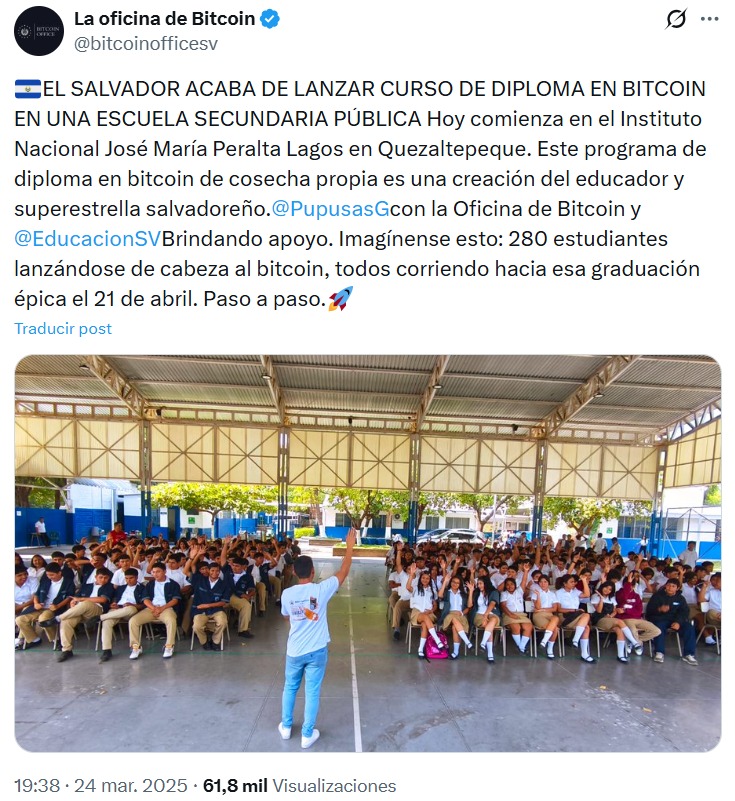
Meanwhile, some countries have already understood that there is no time to waste and they are incorporating these contents into their educational aspect. Since 2021, thousands of students in different areas of El Salvador receive formal classes on bitcoin and digital money as part of the school curriculum. They are not optional experiences, but rather proposals that recognize that the money of the 21st century is no longer the same as what was taught thirty years ago.
Beyond the Salvadoran case, the progress of Argentina stands out, which since 2022 has been taking firm steps to incorporate the digital economy in classrooms. In January of that year, it was announced that high school students in the City of Buenos Aires would participate in a mandatory cycle of financial education. This with content about bitcoin, cryptocurrencies, digital wallets and online transfers.
In addition to institutional progress, Civil society also plays an important role in this evolution. Such is the case of the NGO Bitcoin Argentina, which has been promoting the “Schools and Bitcoin” program for several years now. This initiative brings training on digital money and decentralized technologies to schools across the country.
Then, in 2024, the Buenos Aires Ministry of Education approved the incorporation of content on Ethereum for public and private institutions, along with internships in related projects and training in Solidity for young people and teachers.
Updating financial education is not just a matter of technological innovation. It is a social responsibility that directly impacts the ability of young people to make informed economic decisions.
Integrating bitcoin, cryptocurrencies and digital finance concepts in the classrooms allows the new generations to be empowered in the face of a financial system that has historically favored a few, it’s that simple.
Disclaimer: The views and opinions expressed in this article belong to its author and do not necessarily reflect those of CriptoNoticias. The author’s opinion is for informational purposes and under no circumstances constitutes an investment recommendation or financial advice.