
There is a slowdown in the movement of capital between platforms.
“The blood flow of the market is weakening,” explains the analysis company.
The price of bitcoin (BTC) does not reflect major movements in recent hours, but beneath the surface there is a signal that deserves attention.
And it is that he internal market behaviorknown as the exchange flow pulse (IFP), is in red, reflecting a slowdown in the circulation of capital between exchanges. For analysts at Xwin Finance, a Japanese analysis firm on-chainthis represents “an underlying structural risk in bitcoin.”
In the following CriptoQuant graph, the evolution of the bitcoin exchange flow pulse is observed:
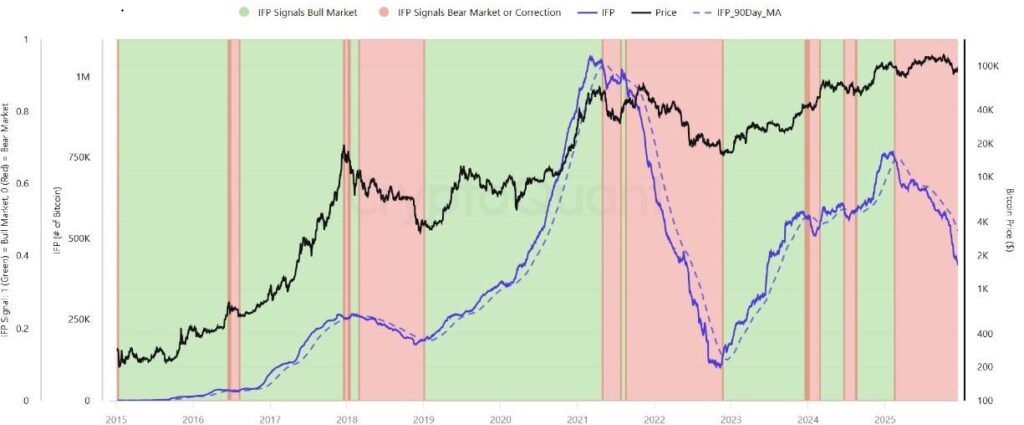
The black line represents the price of BTC, while the blue line corresponds to the IFP, with its 90-day moving average in dotted blue.
Green zones mark periods historically associated with bull markets, when flows between exchanges favor accumulation, and red zones indicate bear markets or correction phaseswhere the flow pulse anticipates selling pressure, as CriptoNoticias had reported.
The IFP reflects the intensity with which BTC circulates between exchanges and allows the health of market liquidity to be assessed.
High levels are usually associated with a more balanced environment, with active arbitrage, good order book depth, and more stable prices.
In this regard, Xwin Finance analysts stand out that, when the indicator weakens, the “blood flow” of the market loses strength and The price is exposed to sharper movements in lower volume operations.
This signal suggests that the “blood” that keeps the market alive is beginning to flow with less force, a scenario that can become a structural risk if it continues over time.
“The key risk today is not aggressive selling, but the structural fragility of the market. Until liquidity recovers, abrupt movements are more likely to occur, making leveraged positioning especially vulnerable in the current context,” the analysts indicated.
That is, the market is more fragile: with less liquidity, small movements can generate sudden price changeswhich makes trading with leverage especially risky.