
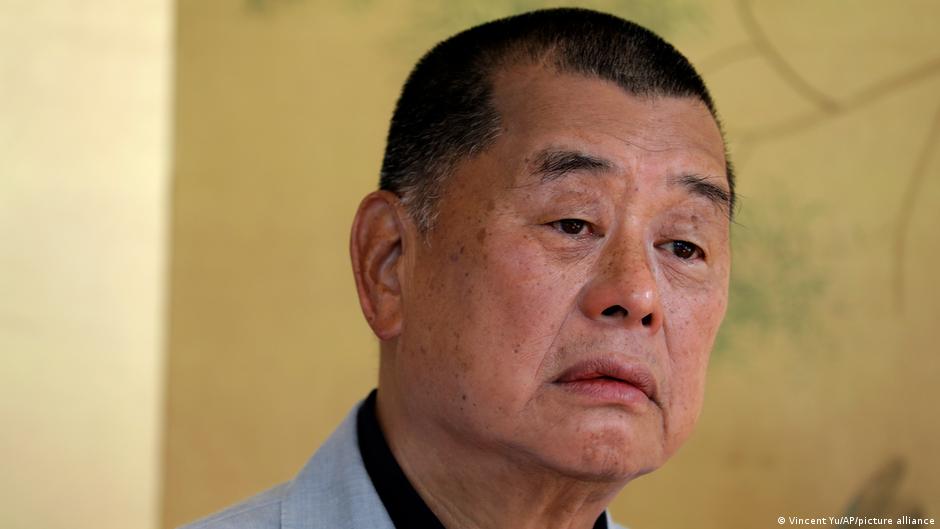
Pro-democracy media tycoon Jimmy Lai was found guilty on Monday of conspiring to collude with foreign forces and publishing seditious material under a national security law imposed by Beijing.
Lai could face life in prison in the ruling by a three-judge panel in Hong Kong’s High Court.
During the hearing, one of the three judges, Esther Toh, said the court had no doubt that Lai had “never wavered” in his intention to “destabilize” China, and that he harbored “hatred and resentment” towards the country.
Lai, one of the most prominent critics of the Chinese Communist Party (CCP) leadership, reportedly sat quietly with folded hands as he heard the verdict along with several security officials.
The 78-year-old defendant has been held in custody for five years and had previously pleaded not guilty to all charges. A mitigation hearing is scheduled for January 12. His lawyer said that Lai would decide after the sentencing whether to appeal or not.
What was Jimmy Lai found guilty of?
At Monday’s hearing before the verdict, Judge Toh said the written verdict ran into 855 pages, with only selected portions read out in court.
He said that “even before the implementation of the National Security Act… [Lai] The report sought to use the United States to counter China, citing messages between Lai and his assistant Mark Simon on the messaging app WhatsApp.
The messages indicate that Simon had arranged meetings between Lai and US officials and lobbied on Lai’s behalf.
Lai, founder of now-shuttered apple daily Mukhtasar, Also found guilty of using the newspaper to publish “seditious material”.
Lai Ki, during the 2019 pro-democracy protests in Hong Kong apple daily Served as a major source of news for local and international audiences.
What does the long-awaited decision indicate?
Lai was first arrested in 2020, the same year Beijing imposed a sweeping national security law in Hong Kong to tighten its control over the former British colony despite being promised a high level of autonomy before the 1997 handover.
His national security trial began only in December 2023, which was initially expected to last about a month but ultimately extended to about 156 hearing days.
“The length of the verdict says nothing about the quality of the verdict,” Eric Lai, a senior fellow at the Georgetown Center for Asian Law (GCAL), told DW. “The outcome of the trial is very certain: The court has little room to make decisions that deviate from Beijing’s wishes,” he said.
Both Hong Kong and Beijing officials reject growing criticism of the city’s erosion of judicial independence.
While Hong Kong leader John Lee said Lai had harmed the country’s fundamental interests, Chief Superintendent Steve Lee of the National Security Department of the Hong Kong Police said: “Lai’s conviction is the fulfillment of justice.”
But GCAL legal expert Eric Lai said the approach in Jimmy Lai’s case “is a common strategy for authoritarian governments.”
In 2022, before the national security trial began, the media tycoon was sentenced to five years and nine months in prison on separate fraud charges.
The strategy, the expert said, was to “discourage political dissent with non-political crimes, then punish them with harsh security crimes to convict them as enemies of the state.”
Press freedom is in danger in Hong Kong
Jimmy Lai’s case is believed to be the first trial for the crime of conspiracy to collude with foreign forces since the implementation of the national security law in Hong Kong.
Experts warned that it highlighted the erosion of press freedom in the city.
GCAL’s Eric Lai said the latest convictions indicate that “providing and disseminating critical and sharp opinions and exchanging information with foreign actors is considered criminal.”
Elaine Pearson, Asia director at Human Rights Watch, said the decision would have “an even worse impact” on media freedom in Hong Kong.
“Since the passage of the national security law, Hong Kong has gone from being a bastion of media freedom in Asia to a place where journalists face harassment and arrest,” he told DW. He added, “Many journalists have been forced into exile and some have been jailed.”
Since 2020, 14 media outlets have been closed, including in Hong Kong stand news and jimmy ly’s apple dailyWhile those who are still working in the industry remain cautious in their reporting.
“Just recently after the Tai Po fire, international media were called in by the Office of National Security and warned that there would be no tolerance for ‘causing trouble,'” Pearson said, referring to a deadly fire in Hong Kong in November.
In the days following the fire, Hong Kong authorities increased police presence at mourning events and made several arrests, accusing unnamed actors of “using the disaster to spread chaos”.
More international support is needed
Several international human rights groups on Monday condemned Jimmy Lai’s sentencing and called on governments to step up pressure on China to secure his release.
Pearson said, “The governments concerned should at least push for the release of Jimmy Lai on humanitarian grounds. He is a 78-year-old man who has already spent five years in solitary confinement.”
The UK government has expressed concern over the verdict against British national Lai, condemning it as “politically motivated persecution” and calling for the national security law to be repealed.
Jimmy Lai’s son Sebastian Lai urged the UK government to “do more” to help secure his father’s release.
“Now is the time to put action behind words and make my father’s release a precondition for closer ties with China,” Sebastian Lai said at a news conference in London.
His family also pointed to Lai’s deteriorating health, saying he suffered from diabetes and high blood pressure, among other problems.
The US did not immediately react to Lai’s latest sentencing, but President Donald Trump raised Lai’s case with Chinese President Xi Jinping at a meeting in October and has vowed to “do everything possible” to secure his release.
Meanwhile, China’s Foreign Ministry urged other countries not to “make irresponsible comments on the hearing of judicial cases in Hong Kong and not interfere in the Hong Kong judiciary or China’s internal affairs in any form.”
GCAL’s Eric Lai said, “It is too early to judge whether external pressure is helpful or counterproductive,” noting that foreign governments are more likely to respond after a sentence is announced. For now, since the media mogul has the legal right to appeal both his conviction and sentence, he underlined, “[only] Time will tell how the legal battle plays out.”
DW correspondent Chia-Chun Yeh contributed to the report.
Edited by: Srinivas Majumdaru