
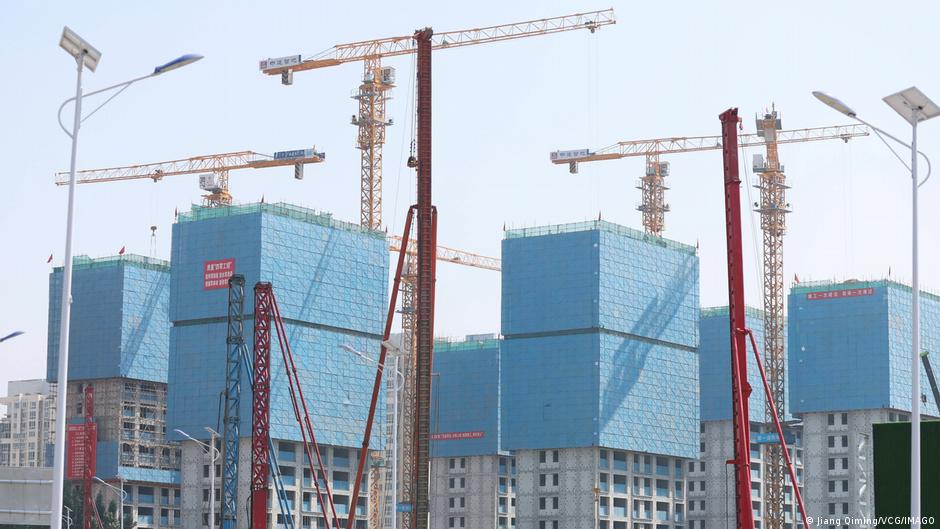
The larger the bounce, the deeper and longer the movement. After two decades of wild growth, by 2020, China’s real estate bubble had pushed home prices to 17 times the average wage.
Reforms in 1998 that shifted housing from state provision to private ownership, combined with the migration of nearly half a billion Chinese people from rural areas to cities and abundant credit from state banks, precipitated a perfect storm.
A construction frenzy transformed China’s skyline, families poured their savings into apartments and property speculation became commonplace, helping millions of middle-class families feel richer and spend more.
The turning point came during the first wave of COVID-19 lockdowns in the country when President Xi Jinping’s government imposed sweeping new rules on how much loan property developers can take. The outcome of the “Three Red Lines” reforms was brutal. Real estate giants like Evergrande, Country Garden and dozens of smaller companies defaulted, with more than 70 developers either going bankrupt or needing state-backed bailouts to survive.
More than five years later, the upcoming hustle shows no signs of slowing down. According to Barclays, a British bank, more than $18 trillion (€15.38 trillion) of household wealth has vanished due to falling home values. Meanwhile, construction activity – once a key driver of gross domestic product (GDP) – has fallen so badly that it is now dragging overall growth below Beijing’s target.
Beijing censors private property data
In a sign of how vulnerable the recession has become, Chinese authorities last month told private data providers to stop publishing home sales figures, cutting off one of the few independent windows into the ongoing crisis in the real estate market.
The move came after new home sales by the top 100 builders fell 42% year-on-year in October, the biggest monthly decline in 18 months, according to China Real Estate Information.
Anne Stevenson-Yang, founder and research director of Taipei-based J Capital Research, believes the move helps mask the real price decline.
“You’ll probably have a 50% drop in the market, maybe 85% before it balances out,” he told DW.
Citing the example of a colleague in the central city of Xi’an who was offered three homes for the price of one by a developer, Stevenson-Yang said this was the equivalent of a two-thirds down on each property.
Oxford Economics wrote in September that in tier-1 cities such as Beijing and Shanghai, average home prices have fallen by about 10% from their peak, with the decline further driven by reduced demand for luxury units. However, the worst impact has been felt in tier‑2 and tier‑3 cities, including Chengdu and Dongguan, where values have fallen by up to 30%.
Half-built and empty apartments litter the horizon
Across China, the crash has left half-built projects, ghost cities and millions of homes stuck in negative equity, sparking public anger and sporadic protests as buyers hope Beijing will step in with stimulus measures to boost demand.
“There is still a lot of supply — 3-5 years of unsold apartments and housing, mostly in smaller cities,” George Magnus, a research fellow at the UK’s University of Oxford China Center, told DW. “This will take a long time to clear, especially because the pool of first-time buyers – 20-35 year olds – is now declining.”
After peaking at 1.41 billion, China’s population is now sliding backwards, marking the end of decades of growth.
China’s key economic growth driver vanishes
Real estate once accounted for a quarter of China’s GDP, leading to double-digit growth rates for more than a decade between the 2000s and early 2010s. The recession caused economic growth to peak at around 5% last year – still impressive, but down sharply compared to the boom years due to its impact on the rest of the country.
,[Chinese] Steel and cement prices and production are falling, employment and [business] Investments are weak – they’re all collateral damage [from the property crash],” Stevenson-Yang told DW.
China was the world’s largest consumer of iron ore, copper, steel and cement, much of it in construction. Exporters Australia, Brazil and Chile are among the global players suffering from the decline in sugar demand. As homeowners are feeling the pinch, the recession has weakened domestic consumption, leading to reduced imports of foreign luxury brands and cars.
Targeted incentives, no blanket rescue
Beijing is keen to avoid another speculative bubble, so stimulus measures to boost the real estate market have not been as generous as in previous recessions. The Chinese government took action during the 2008 global financial crisis, the 2015 stock market crash, and the pandemic.
Instead of coming to the rescue this time, many China watchers believe the government is allowing house prices to decline gradually so that policymakers can prioritize stability and long-term restructuring over short-term stimulus.
“You reach a point you can’t keep stimulating because the amount of money required would be too great – it would be inflationary,” Stevenson-Yang said.
Bloomberg reported last month that Beijing, however, is considering subsidizing mortgage interest payments, reducing transaction fees and offering larger income tax breaks for borrowers.
Prices may fall for the next several years
Property accidents usually take about five years to manifest. In the United States, it took until 2012 for prices to stabilize due to the housing recession that began in 2007. In Spain, the post-2008 collapse delayed nearly five years before signs of recovery appeared.
Japan’s post-bubble collapse from 1991 to 2000 is often cited as the longest-running real estate crisis, with home values stagnating for more than a decade and never fully regaining their pre-bubble highs.
Stevenson-Yang believes the Chinese property sector is headed for the next “10 years of negative or flat growth”, while analysts at S&P Global Ratings believe the recession could last until the end of the 2020s. Some forecasts indicate a recovery next year or in 2027.
This is difficult for ordinary Chinese families to digest. Many of them invested their savings in apartments that have lost value, leaving them trapped in mortgages they can’t escape and homes they can’t sell. Worse, asset values may remain well below 2020 highs for the foreseeable future.
According to Magnus, the story is the same around the world, where homeowners often assume prices will always rise.
“When the party ends and the cycle reverses … the consequences can be very serious,” he told DW.
Edited by: Rob Mudge