
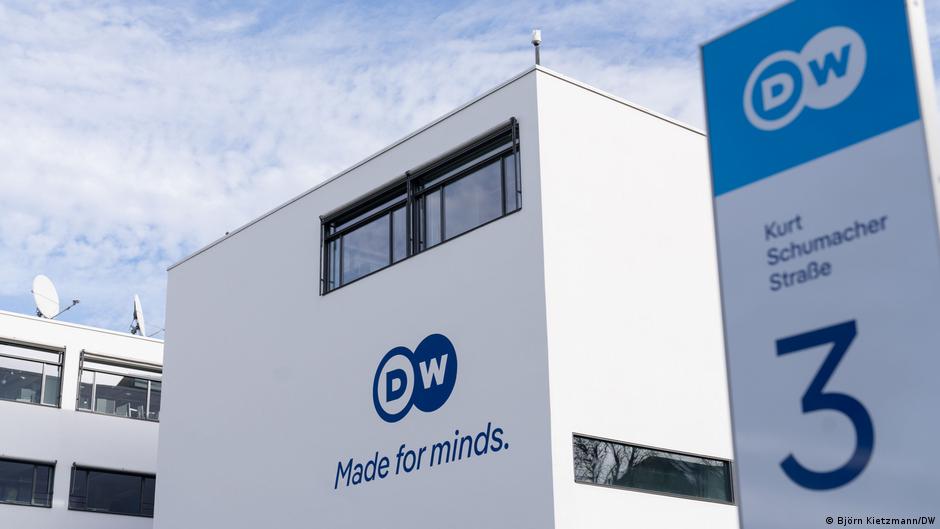
German politicians specializing in culture in the Bundestag criticized Russia on Tuesday as its Justice Ministry formally added public broadcaster Deutsche Welle to a growing list of outlawed “undesirable organizations”.
Culture and Media Commissioner Wolfram Weimer told DW that Russian officials in Moscow “are afraid that people will hear and see the truth.”
Weimer said, “They don’t want the truth to come out about their aggressive war in Ukraine. And they fear that reports about repression within Russia will come out.” “That’s why they’re doing everything they can to suppress independent voices like Deutsche Welle.”
Martin Rabanus, a center-left Social Democrat politician who sits on the Bundestag culture select committee and DW’s supervisory board, called Russia’s move “the next step in undermining freedom of opinion and the press.”
He said similar sanctions on groups such as Reporters Without Borders and Radio Free Europe point to the “systematic curtailment and restriction of organizations and institutions that provide objective information” inside Russia.
Concerns for employees and their loved ones
Environmentalist Claudia Roth of the Greens, previous commissioner for culture and media during the previous legislative term from 2021 to 2025, expressed concern for DW staff and contacts in the sector.
“I am deeply concerned about the journalists and their families,” he said. “Because it is dangerous to report independently against a dictatorial, authoritarian ruler in Russia.”
David Schlissing of the Socialist Left Party said that “independent journalism is never a crime,” but also said he believed Russia could respond with sanctions on Russian state-controlled broadcaster RT (formally Russia Today) inside the EU.
“It’s actually a logical consequence of the war, if you like, that if the European Commission bans Russia Today from broadcasting in our region, the Russians naturally retaliate. I think that’s absolutely logical,” Schlesing said, arguing that it showed how urgent it was to end the fighting and return to a less hostile environment.
Changed from ‘foreign agent’ to ‘undesirable organization’
Russia’s Justice Ministry on Tuesday published an updated list of “undesirable organizations” that now includes Deutsche Welle, confirming a development that Russian media first reported over the weekend.
Russia’s Duma parliament first requested the changed designation in August 2024.
Among the first news of the impending change, a Russian government statement posted on Telegram over the weekend said the Prosecutor General’s Office considered DW “at the forefront of hostile anti-Russian propaganda.”
The new designation not only tightens restrictions on DW’s activity in Russia, which Moscow effectively shut down years ago, but also bans collaborating with or working for the organization.
People found supporting or working for “undesirable organizations” in Russia can face fines or even prison terms. Even sharing content from such groups can lead to prosecution.
Director general says new designation ‘will not stop us’
DW Director General Barbara Massing said the new designation would particularly affect employees of DW’s Russian-language service, many of whom have close ties to the country.
But he also said Moscow’s efforts to sideline DW and other important media outlets are proving counterproductive.
“Despite censorship and blocking of our services by the Russian government, DW’s Russian-language service now reaches more people than ever before,” Massing said.
“We will continue to report independently – On the war of aggression against Ukraine and other topics about which little information is available in Russia. “So people can form their own opinion,” he said.
Moscow shut down days before invasion of Ukraine
Russia designated DW as a “foreign agent” in early 2022, shortly after its full-scale invasion of Ukraine.
Just weeks before the February 24 invasion, DW’s accreditation was withdrawn, leading to the closure of its Moscow bureau in what Russia described as a response to sanctions on RT Deutsche, the state broadcaster in Germany.
DW’s Moscow bureau later relocated to Riga, Latvia, and DW’s website has been banned in all languages in Russia – at least for those unable to circumvent the restrictions.
Nevertheless, DW’s Russian service reached the region of 10 million weekly users in 2025, mostly with video content, making it one of DW’s top 10 languages by volume.
Founded in 1953, DW is an independent media outlet funded by the German government and reporting around the world in 32 languages.
Russia’s list of “undesirable organizations” includes more than 275 entities, including news outlets such as Radio Free Europe/Radio Liberty, think tanks such as Chatham House, anti-corruption NGO Transparency International, and environmental advocacy organization WWF.
It also blacklists several major German political think tanks: the Heinrich Böll Foundation, the Friedrich Ebert Foundation and the Konrad Adenauer Foundation, as well as the German Council on Foreign Relations.