
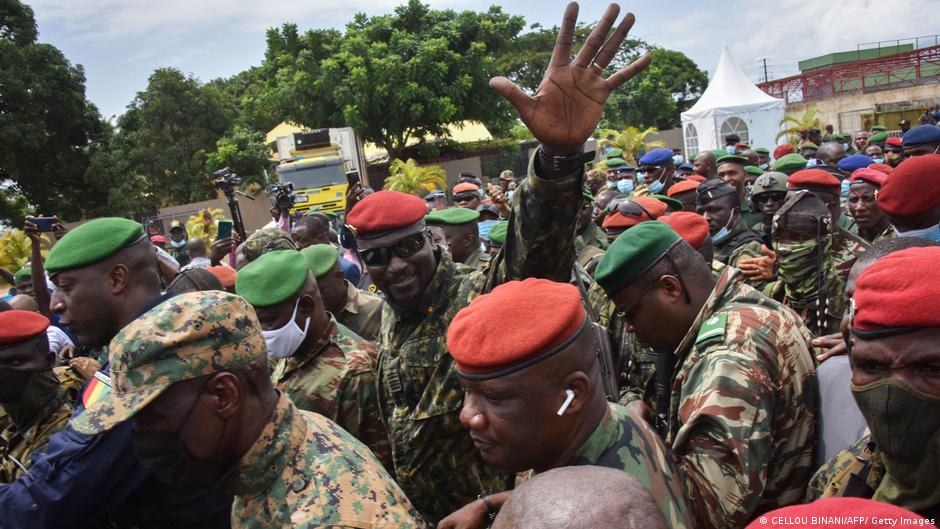
Two coups and one failed coup within eight weeks is also a new dimension for the recent history of Africa. In October, the military in Madagascar ousted the president after weeks of protests. Then in November, troops in Guinea-Bissau ousted the head of state shortly after a rigged election.
In early December, a group of soldiers calling themselves the “Military Committee for Renewal” announced the occupation of Benin. He was eventually arrested after the intervention of the Presidential Guard and regional partners.
Eight African countries are currently under military rule; A “coup belt” extends across the continent, particularly in the predominantly French-speaking Sahel region.
According to Jackie Cilliers, founder and former executive director of the Institute for Security Studies (ISS), Africa is no different from other continents. “The challenge in West Africa and the Sahel is that the population there is growing very rapidly,” Cilliers told DW.
He said, “Many young people, especially young men, who are primarily responsible for instability, are increasingly well educated, but there are no jobs and no opportunities. And it is a very unstable situation.”
Cilliers compared socio-economic conditions to gasoline soaking clothes. The more gasoline there is, the more dangerous the spark becomes – or in other words, the greater the chance of a potential coup. A successful coup elsewhere could also create momentum that propels rebel military personnel to take action at home.
There are three structural drivers of coups: economic pressures (for example, which also gave rise to the so-called Arab Spring in 2011), security crises (such as in the Sahel), and tensions around elections.
“Because elections raise the stakes, especially when incumbents try to increase power or where institutions are weak,” Cilliers said.
Which countries are particularly at risk?
Beverly Ochieng, a researcher with the Africa Program at the US-based Center for Strategic and International Studies (CSIS) in Dakar, said there is a need to address the root causes that fueled the coup.
“It’s important to always pay attention to all these different triggers,” Ochieng told DW. “Are there high levels of socio-economic grievances? Are there doubts within the military about their treatment or whether they are being paid adequately or that their working conditions are right? Are there external instigators who want to take advantage of dissatisfaction with the government to try to organize collectively and disrupt the cohesion of the institutions?” He said.
To that end, some countries display weaknesses; Even if a coup is not happening, they may succeed if they do happen.
The planning of every coup begins with strict secrecy. Otherwise the people involved will be immediately arrested. In this regard, it is difficult, if not impossible, to predict whether other countries might follow the current wave of coups – and if so, which ones.
Ochieng noted the particular risk of new coups in the Sahel states of Mali, Burkina Faso and Niger, all of which are already under military rule. Chad should also be considered given the divisions within the military.
Additionally, the security expert mentioned Côte d’Ivoire, where President Alassane Ouattara has just begun his fourth term in office. “It was very controversial among the opposition and the country has a history of military intervention,” he said.
Guinea is another vulnerable state. The elections, scheduled for December 28, are expected to end the transition period following the September 2021 coup.
“But it is still a matter of concern, especially given the fact that the opposition is unlikely to participate in this election or in consecutive elections,” Ochieng said. He said there were some differences of opinion over how junta members managed rivals within the military. “It’s another country worth visiting.”
how to stop a coup
Even when rebels find suitable conditions for a coup and formulate a plan, it is not too late to avert it. In Benin, the government of President Patrice Talon regained the lead within hours.
Troops from the West African Economic Community ECOWAS task force and Nigeria, which has an interest in keeping its western neighbor, former colonial power France, stable, all supported the suppression of the coup with intelligence and logistics.
For Beverly Ochieng, Benin exemplifies what is possible when governments and regional communities act quickly and decisively.
“It’s really about how well both the government and the regional community are able to take measures and even just be proactive, because this is probably the first coup that has been successfully neutralized, right at the point when it was happening.”
He believes this could also be possible in Niger in July 2023. “Unlike other Niger, I have always felt that it could potentially have been defused, but the concern was the standoff between the Sahelians and the ECOWAS standby force, which should have been deployed, and this delayed the decision.”
In the case of coups carried out in recent years, ECOWAS and the African Union (AU) have no choice but to suspend membership and impose sanctions.
Does the example of Benin show that organizations are now better equipped to deal with post-coup crises? Jackie Cilliers said, “We have seen recently that ECOWAS and the African Union have taken a more forward-looking, stronger approach to what has happened recently.” He cautioned that he was not sure it would have much of a deterrent effect.
However, the ISS founder stressed that the new coup was unlikely to easily win the favor of the population.
Cilliers said, “The promised coup in West Africa has not exactly happened what we all expected. These problems are deep, they are structural and there are no short-term solutions.”
He explains that this also means that coup risks can only be reduced in the long term through solid development that benefits a country’s entire population economically and through access to education, basic goods and rights.
This article was translated from German.