
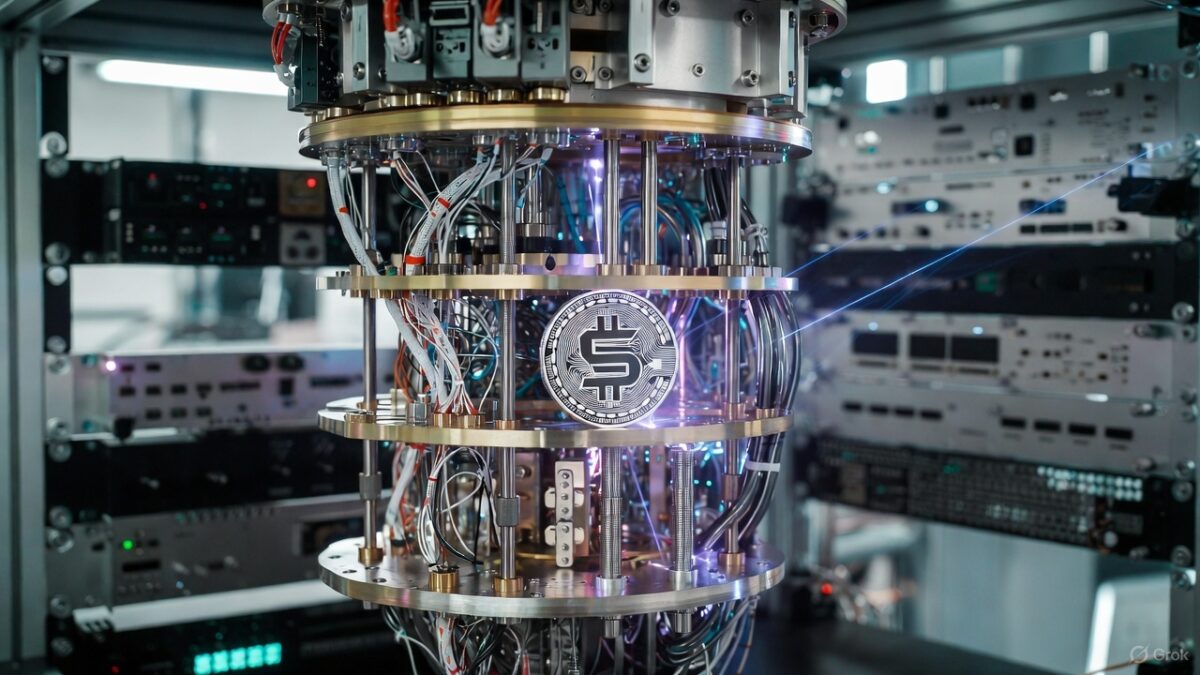
The Solana Foundation announced on December 16 a collaboration with the company Project Eleven to prepare the network against the risks that quantum computing could introduce in the future.
Project Eleven is a company and laboratory specialized in the intersection between quantum computing and cryptography, with a primary focus on security for digital assets.
As part of the work with the Solana Foundation, Project Eleven deployed a post-quantum signature system on a test network (testnet) from Solana“demonstrating that end-to-end quantum-resistant transactions are practical and scalable.”
This means that Project Eleven adapted the entire process of a transaction (from the signature made by the user to its validation on the network) to use cryptographic algorithms designed to resist quantum computer attacks.
By doing it in a testnetdemonstrated that these firms can integrate without slowing down the speed, confirmation or ability to scale the network.
Additionally, the Project Eleven team reported that same day he led a comprehensive risk assessment on how advances in quantum computing could impact Solana’s core infrastructure.
That evaluation involved user wallets, the security of the validators, and the long-term cryptographic assumptions that support the network.
Our mission is to protect the world’s digital assets from quantum risk.
Alex Pruden, CEO of Project Eleven.
Why does quantum computing pose a risk to Solana and other networks?
Solana, like other networks such as Bitcoin or Ethereum, uses elliptic curve cryptography in its network (ECC).
In that sense, CriptoNoticias reported that, given the levels of Bitcoin and Ethereum structures, the latter has more complexities when it comes to defending yourself of an alleged quantum attack.
In the specific case of Solana, it uses the ECC variant known as Ed25519 in the digital signatures of transactions. This cryptographic scheme is a mathematical method that allows verify the authenticity of a transaction without revealing the user’s private key.
In a theoretical scenario and with sufficiently advanced quantum computers, algorithms such as Shor they could break this type of cryptography.
In practical terms, a quantum attacker could derive a private key from a public key already exposed on the network. With that private key, it would be possible to sign fake transactions and transfer funds without authorization from the rightful owner.
However, that circumstance still seems distant.
Finally, this initiative joins another already existing one, which proposes in Solana to use a signature system with hash functions for transactions, which would be resistant to quantum attacks, as reported by CriptoNoticias.