
If the analysis is correct, it could be a good entry point into SOL.
Persistent sunny outings slowed down.
Solana (SOL) has fallen back below $150 from the peak of $250 reached in September.
Although this decline may raise concerns among investors, technical analysis—or, at least, some of its interpretations—points to a period of consolidation rather than a trend reversal, according to the vision of financial markets analyst, Parshwa Turakhiya.
“The current price structure is consistent with a consolidation phase, in which the market digests previous declines without clear signs of a bearish breakout,” he points out.
This reading is supported by the slowdown in sustained sales and greater price stability in the $130 area. This level begins to function as a support after the strong correction recorded from the September highs.
“The reduction in persistent outflows is consistent with a market that is beginning to stabilize after a deep correction,” duck Turakhiya.
To argue his analysis, Turakhiya explains that solana price remains firmly below its main moving averages (EMA).
At this point, it is worth clarifying that The moving average is a technical indicator that follows the market trend. It is built from historical prices, calculating an average value, as explained in the Criptopedia, educational section of CriptoNoticias.
For example, in a 10-day moving average, each point on the curve represents the average price the asset recorded during that period.
The following graph shows the 20, 50, 100 and 200 day moving averages, which the analyst rates as the main ones.
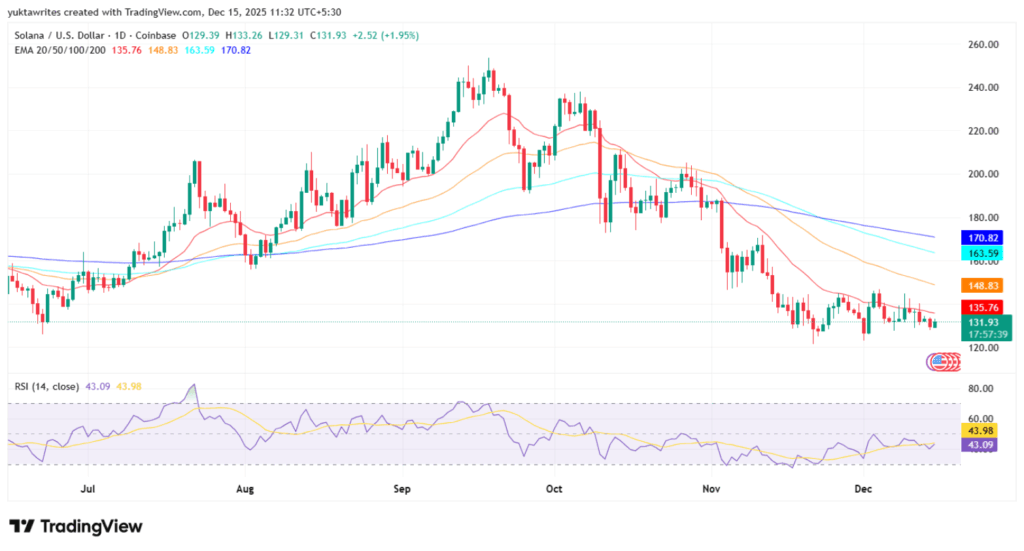
As could be seen, there was a progressive loss of the bullish trend and a clearly bearish structure in recent months.
What does solana technical analysis say?
The price is below the aforementioned exponential moving averages, which reinforces the reading of technical weakness.
«The 20-day EMA, near $136, and the 50-day EMA, near $149, continue to decline, reinforcing the dominant bearish trend. Above these, the 100-day EMA, near $164, and the 200-day EMA, near $171, define the upper limit of the medium-term bearish trend,” explains Turakhiya.
He further adds: “As long as SOL remains below the 20-day and 50-day EMAs, bullish moves should be considered corrective. “No trend changes.”
At the bottom, the relative strength index (RSI) in purple, accompanied by its average in yellow, moves in the medium-low zone, without reaching overshoot levels. This suggests that it is a market without buying force and with sustained selling pressure.
In this regard, Turakhiya highlights that “as a whole, the graph reflects a market pressured by supply, with a bearish bias and without technical confirmations of reversal in the short term.”
But still, “the current stabilization suggests that selling pressure is no longer intensifying, even if buyers have not yet taken control. “This supports a narrative of consolidation rather than an immediate continuation of the decline,” he completes.
If this technical analysis is confirmed, the current level could represent an entry point for those seeking SOL exposure. To do this, it will be key that the price manages to stay in the support zone and the selling pressure does not return.
In addition to technical analysis, it is important to take into account fundamental analysis, that is, what is happening at a technical and adoption level with this cryptocurrency. For example, CriptoNoticias reported yesterday that Solana recently experienced the fourth largest denial of service (DDoS) attack in history, but was able to resist without altering its operation. This behavior can be considered potentially bullish news for SOL.