
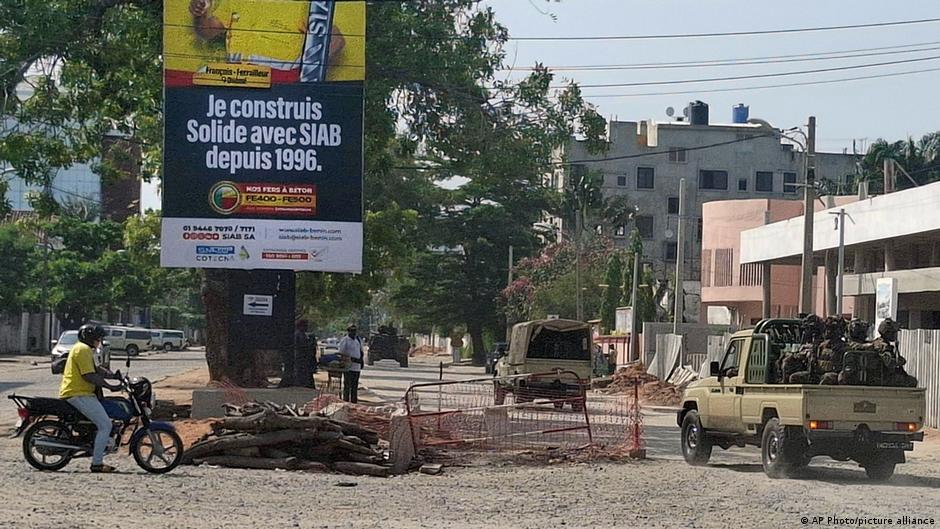
On a Sunday morning in early December a small group of soldiers appeared on Benin’s state television station and announced that President Patrice Talon had been “removed from office as President of the Republic.”
The rebels cited poor management of the deteriorating security situation in northern Benin as well as neglect and disregard of our fallen brothers – a reference to Beninese soldiers killed in clashes with militants near the borders with Burkina Faso and Niger.
Within moments, a familiar fear spread across West Africa, a region that has recently seen a resurgence of coups amid widespread insecurity and economic crises.
However, the coup was quickly foiled following a quick response by loyalist forces, including air strikes and troops deployed from neighboring Nigeria.
Why does West Africa face frequent coups?
Countries such as Chad, Mali, Niger, Burkina Faso and most recently Guinea Bissau have been overrun by military juntas in recent years.
For decades, Nigeria was the region’s de facto “big brother” making the continent the center of its foreign policy.
From intervening in deadly conflicts in Liberia and Sierra Leone to its influence on the West African bloc ECOWAS, Nigeria has played a central role in maintaining peace, promoting democracy and supporting rapid economic growth in the region.
In 2003, it was instrumental in restoring democracy in Sao Tome and Principe, the continent’s most populous country, and reinstated President Frederic de Menezes, who was ousted in a military coup.
Even as its influence waned, Nigeria took a strong stance against the unconstitutional change of government in The Gambia by ECOWAS in early 2017.
Abuja helped oust Gambia’s longtime strongman leader Yahya Jammeh from power after he initially refused to concede defeat to businessman and political newcomer Adama Barrow.
Nigeria’s domestic crisis has weakened its regional role.
Today, bedeviled by insecurity and economic crisis, Nigeria’s efforts to prevent regional instability have fallen short, analysts told DW.
In 2013, Nigeria withdrew some of its 1,200 troops from the United Nations peacekeeping mission in Mali to increase security in its crisis-hit northern region.
For more than a decade now, Nigeria has been facing a complex security crisis, with Islamist groups waging a bloody insurgency in the north-east, while criminal gangs known as bandits among locals roam its north-west.
“Nigeria’s economic and security challenges have left it isolated and absent from regional power projections as it has had to commit troops to fighting domestic terror threats in the form of multiple Islamist insurgencies and banditry,” said Confidence McHarry, a senior analyst at Lagos-based consultancy firm SBM Intelligence.
“And all of this has taken a huge toll on the country’s economy, significantly impacting its ability to meet its regional commitments.”
Nigeria’s declining role in ECOWAS security
Nigeria has long invested heavily in ECOWAS, relying on the country for funding, military strength and political leadership, as it accounts for half of West Africa’s population and its largest economy.
Abuja often uses this military and economic muscle to lead security cooperation and promote democratic norms.
A less vocal Nigeria means the group is struggling to effectively implement its security and democratic mandates.
In 2023, following a coup in Niger, the bloc imposed multiple sanctions on Niamey and even threatened military intervention. But could not overcome the threats.
This led to further division with the creation of the Alliance of Sahel States (AES), a union formed by the junta-led countries of Mali, Niger and Burkina Faso.
“Internal security challenges have become so significant that Nigeria cannot afford to have significant or sustained military intervention outside its borders,” security expert James Barnett told DW.
“The military is overextended. That’s one reason ECOWAS’s 2023 ultimatum to Niger’s junta was adamant.”
Barnett said Nigerian forces would have struggled to reach Niamey because “much of the surrounding rural areas are controlled by armed groups.”
Foreign mercenaries fill the power vacuum
McHarry said the absence of confident Nigerian leadership has not only weakened the regional bloc but also enabled other actors to fill the void.
The void is being filled in terms of defense cooperation, particularly with foreign mercenaries such as the Wagner Group, now rebranded as Afrika Korps. In Mali, CORE has established itself and expanded to neighboring Niger and Burkina Faso.
Many of these interventions have proven counterproductive to Nigeria’s foreign policy which has been largely pro-West “and to the region because these actors are stepping into the void to seriously undermine Nigeria’s credibility and leadership in the region. So that means less cohesion and less integration,” McHarry concluded.
Democratic backsliding and ECOWAS credibility
Nigeria’s recent general elections were plagued with irregularities, with observers raising concerns about transparency and voter confidence.
The vote deeply polarized the country and complicated its or ECOWAS’s ability to implement constitutional arrangements elsewhere.
“Nigeria has certainly been a major force in ECOWAS over the years, but it is not the only one, and the challenges ECOWAS has faced are not solely linked to Nigeria’s growing domestic troubles,” Barnett said.
“The fact that some West African leaders have adopted questionable or clearly undemocratic measures to remain in power has undermined the group’s credibility and helped fuel AES-aligned propaganda,” Barnett said.
changing internal dynamics
The consequences of Nigeria’s retreat always impact its internal dynamics.
Instability in neighboring Niger and expansion into Mali and Burkina Faso have increased the risk of an outbreak, including cross-border arms smuggling and the movement of armed groups from the Sahel region.
The country shares a 1,600 kilometers (994 mi) long border with Niger alone.
More than two years after Nigeria, along with several other ECOWAS members, tried to reverse a coup in Niger despite threats of military action, relations between the two countries have deteriorated amid growing security threats along the Nigeria-Niger border, James Barnett said.
Barnett argued that this probably influenced Nigeria’s decision to take prompt action in Benin while the coup attempt was still in process.
“There was a narrow window of opportunity for Nigeria to potentially help stop the coup attempt in Cotonou, whereas if it had [Tinubu] Had the rebellion occurred and the coup succeeded, Nigeria would have faced another hostile military regime next door, at a time when jihadists were spreading across the Benin-Nigeria border.”
Edited by: Keith Walker