

Charles Edwards, founder of Capriole, believes that Bitcoin has “the weakest financial encryption.”
Adam Back distinguishes encryption or encryption from digital signatures.
A new debate about the potential impact of quantum computing on Bitcoin has opened in recent hours between developers and ecosystem analysts. The exchange revolved around cryptography that protects the network.
The discussion gained momentum after a statement by Charles Edwards, founder of the analysis firm Capriole Investments, who raised that quantum risk is not being treated with the necessary seriousness within the Bitcoin ecosystem.
If we have not deployed a fix by 2028, I expect Bitcoin to be below $50,000 and continue to fall until it is fixed.
Charles Edwards, founder of Capriole.
Technical X Crosses on Bitcoin Crypto
One of the exchanges occurred on December 17 between Edwards and Adam Back, founder of Blockstream. Back responded bluntly to Edwards’ proposal: “absurd.”
Given this, Edwards deepened his position and maintained that Bitcoin represents “the largest honeypot in the world”, by concentrating enormous sums of value protected by what he described as “the weakest financial encryption”.
CriptoNoticias reported at the end of September that the founder of Capriole considers that “Bitcoin is embarrassingly weak in the face of quantum computing.”
Back objected to the technical approach to the argument noting that “Bitcoin does not use encryption” and that statement opened a semantic and conceptual discussion about cryptography and encryption.
Edwards replied that elliptic curve cryptography (ECC) Yes, it is a form of encryption. (equals encryption), and that when that technology is compromised, so will wallets with exposed public keys.
The Bitcoin network uses ECC to protect transaction signatures, particularly the variant ECDSA. Back insisted on distinguishing encryption or encryption with digital signatures:
Bitcoin is not built on encryption, but on signatures. Schnorr and ECDSA keys are signing keys, not public encryption keys.
Adam Back, founder of Blockstream.
Back argued that while the mathematics of elliptic curves could be used in other systems for encryption schemes, that is not the case Bitcoin.
On the network, these keys are used exclusively to sign transactions and demonstrate ownership of funds, not to encrypt information.
According to Back, confusing both uses leads to a misinterpretation of how the protocol’s security works.
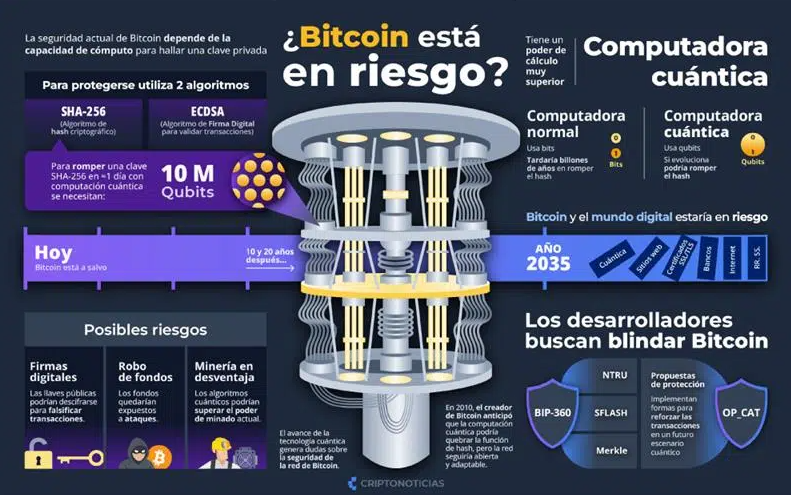
Is cryptography the same as encryption?
The cryptography It is a broad discipline that includes different techniques to protect information. Within it are both encryption (or encryption, which is used to hide data) and digital signatures, which allow verification of authenticity and integrity without hiding the content.
Bitcoin uses cryptography, but not encryption within its consensus system. The transactions are validated through digital signatureswhich prove that whoever spends funds has the corresponding private key.
In Bitcoin, the most commonly used algorithm for this is ECDSA, and more recently Schnorr, another cryptographic signature scheme added with the Taproot update.
The debate continued among Bitcoin specialists
In that sense, an X user, under the pseudonym “storm”, continuous with the previous debate.
He noted that even if Bitcoin does not use encryption in the strict sense, the value is still stored in ECC-based wallets that could be compromised in the future.
In another thread, Back broad his argument and argued that even if quantum computing managed to break symmetric or public key encryption schemes, that would not involve forging digital signatures in Bitcoin.
“If digital signatures are not broken, no Bitcoin transactions will suffer from forged quantum signatures,” he explained.
He also indicated that Bitcoin only uses encryption to protect local files in wallets stored on disks, which aims to prevent theft through physical access. no remote attacks on the network.
He also mentioned that encryption in communications between nodes is optional and serves a privacy function, non-consensus security. Even if it were completely disabled, it would not allow bitcoin theft on the network.
From his perspective, Back considers that quantum risk is often exaggerated by mixing different layers of the system: the Bitcoin consensus, wallets and data transport.
Finally, the Bitcoin Core client contributor known as Murch explained that the Encryption is just a subcategory of cryptography and that Bitcoin uses digital signatures, not encryption, in its consensus system.
Another Core Developer agreed in that much of the debate arises because many confuse cryptography with encryption, and that is what Back tries to clarify.