

The dynamics of the digital asset market are undergoing a structural transformation that could culminate in an imbalance between institutional production and consumption.
Bitwise Chief Investment Officer Matt Hougan projects a scenario where demand for ETFs on bitcoin supply in 2026 will be massive, driven by the integration of the world’s largest financial advisory platforms.
This phenomenon does not respond to a temporary euphoria, but to a historical pattern of behavior in exchange-traded funds that, according to the executive, It is barely going through its initial stage of expansion towards traditional capital.
The ETF Demand Growth Cycle
Hougan’s thesis is based on the observation of how financial instruments of this type mature. Bitcoin ETFs Own 114 billion dollars in assets under management. Far from representing a roof, This figure marks the starting point of an upward trend that will fuel the demand for ETFs and the supply of bitcoin in 2026 will be compromised.
The manager establishes a direct analogy with gold to explain the trajectory he expects in the coming years. “If you take the gold ETF, it had 3 billion inflows in its first year, then $5 billion, then $7 billion, then $10 billion, then $18 billion. It increased for seven years in a row. So this is simply what happens in ETFs,” explains the specialist.
The chart shows the evolution of net inflows into gold ETFs over the past five years.
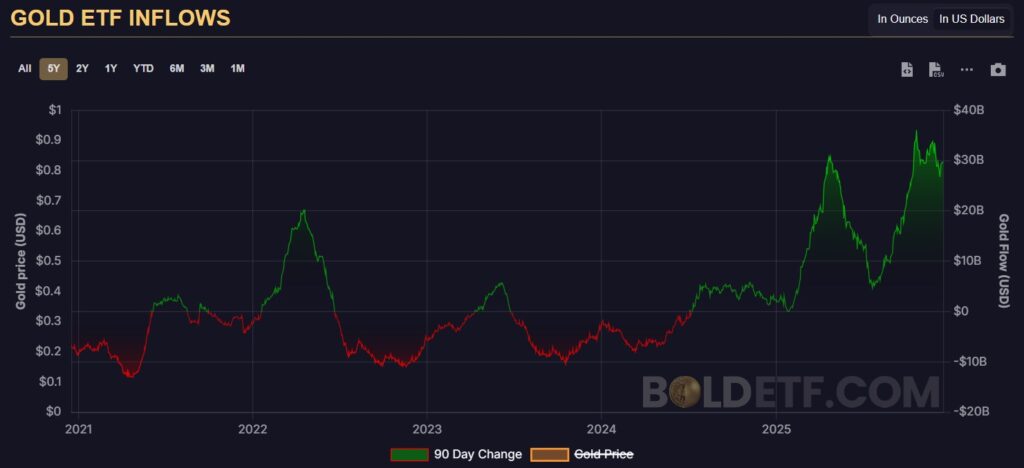
Under this logic, the first year of bitcoin funds is usually the most modest compared to capital flow which is activated once the product is normalized in investment portfolios.
This acceleration is reinforced by the opening of the distribution channels of the large banks. Hougan explains that “large advisory platforms like Morgan Stanley and Merrill Lynch take a long time to enable exposure to ETFs.” [de bitcoin y criptomonedas]. In fact, it has only been in the last six months that advisors at Morgan Stanley, Merrill Lynch, UBS and Wells Fargo were even able to invest in bitcoin or ether (ETH) ETFs.
Now, those ‘doors are wide open. So we’re dealing with a different audience,” says Hougan, referring to a sector that together manages more than 10 billion dollars.
The gap between issuance and institutional demand
Hougan’s central thesis lies in a supply and demand calculation that projects a deficit of units available for the institutional market.
The executive details that the prices of digital assets are set by supply and demand. According to their analysis, while the network has a fixed issuance source, there is “this novel source of incredible demand that is ETFs.”

When looking towards the near future, the specialist is blunt: “if we look towards 2026, you can be very precise.” Projections suggest that the Bitcoin network will produce approximately $15.1 billion in new coins, but institutional demand could absorb more than $24 billion, the specialist says.
«We are right in the sweet spot of adoption. “I know it’s hard for people to believe, but we’ve been doing this at Bitwise for eight years,” Hougan points out.
The arrival of patient capital
One of the factors that explains why this phenomenon will consolidate in 2026 – according to Hougan’s hypothesis – is the time required for the traditional investor to enter the BTC market. The specialist emphasizes that “the average institutional investor requires a long due diligence process.”
For the expert, many of the processes that began with the launch of BTC funds in January 2024, as reported by CriptoNoticias, are culminating right now.
This dynamic is not just limited to bitcoin. Hougan projects that the situation is even more drastic for ETH. «Next year we estimate about $3 billion in net new supply of ETH. We’ve had $10 billion in ETF inflows this year, we’ll probably hit $11 billion by the end of the year. “That could be 15 or 20 billion next year.” That is to say, the demand for ETH by financial instruments would be up to five times greater than the net supply.
Even other cryptocurrencies are showing signs of this supply depletion. Hougan observes that Solana ETFs (SOL) have already raised more than $600 million in a short timeshaping up to surpass its own annual emission rate.
Hougan concludes that the market is heading towards an “adoption sweet spot” where the Wall Street machine will mobilize capital at a speed that the network cannot match with its scheduled issuance, which will inevitably pressure prices upward due to the lack of sufficient net supply.