
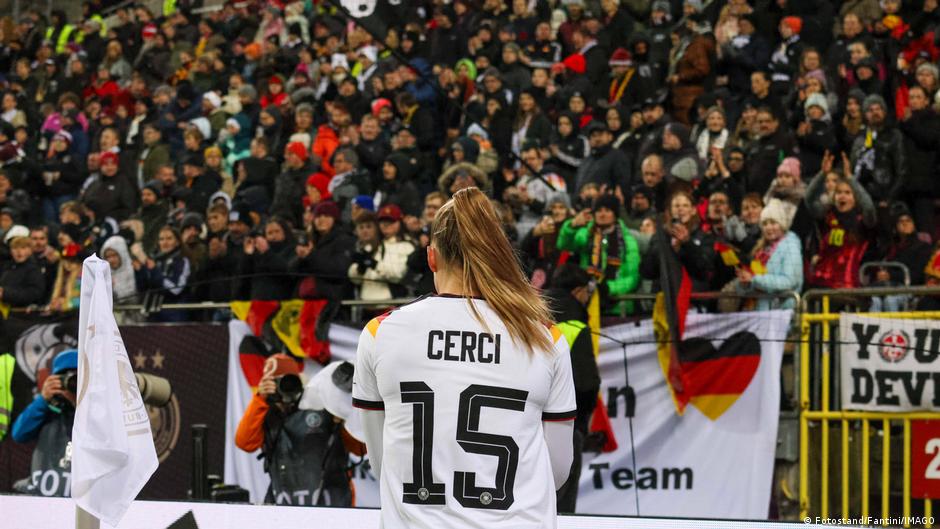
The Women’s European Championships is coming home to its record champion. Germany, eight-time winners of the competition, is hosting its first Women’s Euro since 2001 and the German FA (DFB) is heavily focused on its goal of making the tournament the first profitable Women’s Euro.
“The symbolism of the ‘beneficial’ women’s euro is powerful, but it is not a guarantee of long-term health. The benefits in 2029 should be assessed by what it leaves for girls and women in Germany, not just by the closing balance sheet,” Poppy Sotiriadou told DW.
Sotiriadou is an associate professor in the Department of Tourism and Marketing at Griffith University in Australia and an expert in the business of women’s sport.
The DFB’s plan to make a profit is based on sales of over one million tickets, financial commitments from each host city and support from German business. Sotiriadou believes that if Germany can hit or surpass With a goal of one million tickets, rising media rights values, and locking in a smart, multi-year sponsorship portfolio, turning a profit is realistic.
“A profitable women’s euro could either be a headline or a turning point. The difference will be whether those profits are channeled to women and girls, or quietly absorbed into existing structures.”
The 14 Bundesliga clubs recently founded the FBL (Women’s Bundesliga Association), designed to improve the marketing and commercialization of the league. That this has been done without the DFB is a surprise, and the lack of alignment is not ideal. Indeed, it is now unclear what will happen to the DFB’s €100 million ($117.6 million) commitment to women’s football. However, there is some assumption that the DFB will eventually become involved.
Establishment of financial platform
Alex Kalvin is the director of women’s football at FIFPRO, the international football players’ union. The former player believes the women’s tournament will ultimately be profitable as investing in the women’s game already makes good business sense.
“I think investing in the women’s game has proven to be a smart business idea,” said Culwin, who believes what is valuable in women’s soccer is not the same as what is valuable in the men’s game.
“It’s essentially a startup. So (you) have to have a startup mentality and that’s why venture capitalists do so well in women’s football because they see it as just a product,” said Kalvin.
“How do I make it commercially profitable and viable? I do that by taking advantage of the type and profile of the game and selling it in a way that is marketable and profitable and commercially viable for institutions to invest.”
The DFB’s pitch certainly suggests this will be considered and done, but there are also questions about whether the value of the players will even be taken into account.
“The players are very interesting to me,” Calvin said. “At their core, they’re activists because they’ve spent a lot of time working on the margins, so they understand what it feels like to be discriminated against. So, of course, they want to reduce discrimination while leaving a legacy on and off the field. And I think for me, if I were an investor, that’s commercially valuable.”
Women become changemakers when they work together
The financial aspect of this tournament is inevitable, but there is clearly a lot more to it.
Germany captain Giulia Gwynn recently admitted on a podcast that combating sexism in sport has been one of the toughest battles she has ever faced. Indeed, patriarchy remains an issue for many women in professional sport in Germany. Germany’s current women’s team has been vocal on a number of issues, including recently taking a leading role in the “Orange the World” campaign, which protests violence against women and girls.
For Kalvin, if these campaigns are linked to the team’s wishes it could send a powerful message, but the onus should not be on the country’s leading footballers to drive it forward.
“I think it’s always unfair to expect marginalized people to spark progressivism. You see it all the time, black people are the ones to explain to white people why racism is offensive, women are the ones to explain sexism to men. It’s a very unfair responsibility to have that,” said Calvin.
“But I really believe that women’s football and players are transformative when they work collectively to do something, to achieve something, and I think players always want to use what little privilege they have to make a meaningful impact,” she said.
“Whether it makes a difference, I don’t know, but I think the players’ intention to have solidarity with women around the world is a testament to them as a group of players.”
Germany women are a vocal group and their activities off the field speak to their character as a collective. Clearly, making Euro 2029 a profitable tournament is an important step towards achieving increased success in women’s football in the country. But the tournament’s legacy extends beyond the profit-loss margin. Will hosting Euro 2029 lead to more girls playing football, will more people attend Women’s Bundesliga games, will media coverage increase? Will the perceptions towards women in the society change?
These symbolize the true legacy of the tournament. If achieved, the summer of 2029, like both the summers of 2006 and 2024 for men, has a chance to be socially and culturally influential for Germany.
Edited by: Chuck Penfold