
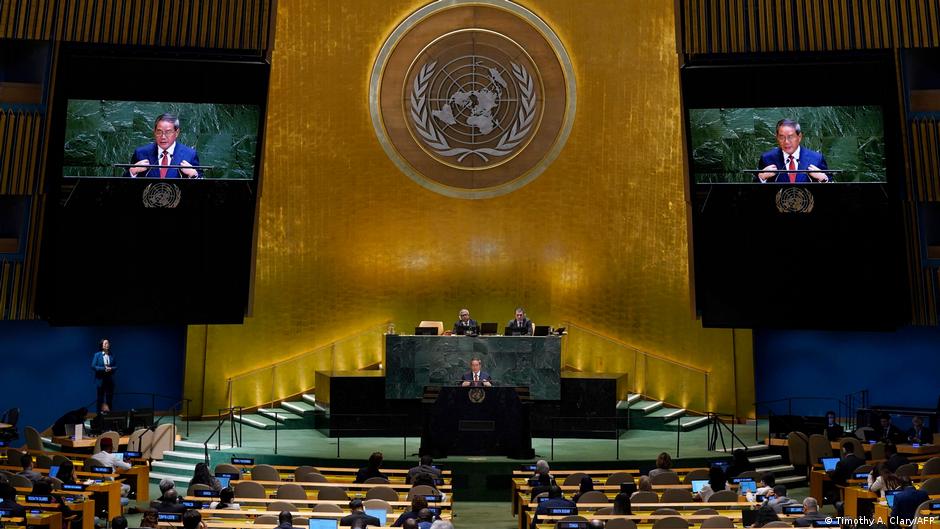
Record numbers of Japanese citizens are working for United Nations agencies around the world.
The increase is the result of a five-year plan to install experts in key positions at the giant international organization and counter Tokyo’s perception of China as using the UN to exert greater influence over other countries.
While experts, analysts and bureaucrats working for the UN are supposed to be non-partisan in their decision-making, Japan is among the countries that have become concerned that rather than remaining neutral, China is using the UN to advance its own geopolitical goals.
Some Japanese observers say that while Beijing uses large amounts of aid to woo developing countries and is rapidly expanding its military capabilities, diplomacy through a multilateral organization like the United Nations gives it another tool to influence other countries.
Are Chinese UN staff pursuing Beijing’s interests?
“China wants the United Nations to have a broad range of staff who are representative of their population and the volume of their contributions,” said Stephen Nagy, a professor of international relations at Tokyo’s International Christian University.
“And they’re trying to get their people into many of the most important committees, with very little success,” he told DW.
One area about which Beijing has been particularly sensitive is criticism of its human rights record against the Uyghur ethnic minority in Xinjiang.
Critics have accused China of attempting to cover up abuses and interfering in the preparation of the UN report by the Office of the High Commissioner for Human Rights (OHCHR), which was published in August 2022 after months of unexplained delays. The document details serious human rights violations in Xinjiang, but Beijing has consistently dismissed its findings as fabrications.
In July 2024, A report released by the UN Watch NGO claimed that “the UN is broken”. Following a further review of its human rights record.
“China and other dictators have hijacked the mechanism to create a platform for dictators to praise each other and legitimize their rules, sanctioned by the United Nations,” the report said.
While the US and the United Kingdom criticized China at a UN Human Rights Council meeting, Russia, Zimbabwe, Venezuela, Tunisia and Algeria praised Beijing for “promoting development and diversity in Xinjiang”.
Tokyo pushes back
Negi said Japan was pushing back in the only way it could.
“Japan is responding because it clearly feels that there is a decline in leadership within the UN and that it needs to strengthen its presence and make the organization more effective again,” he said.
Japan’s Foreign Ministry announced on 9 December that 979 Japanese citizens were employed in UN agencies by the end of 2024, the most since records were first collected in 1990. As announced in 2021, the target of a total of 1,000 employees is being met by this year.
Japanese nationals are also rapidly rising to influential positions, holding a record 94 positions at deputy director level or above in 44 UN agencies.
However, in contrast, there were 794 Chinese employed by the United Nations in 2009, a figure expected to rise to 1,647 in 2023, according to data from the UN website.
Tokyo was prompted to increase its presence at the United Nations in early 2021, when Chinese nationals took the lead on four UN bodies, including the Food and Agriculture Organization, the International Telecommunication Union and the International Civil Aviation Organization. Similarly, nine of the 15 UN agencies had Chinese representatives.
Japan’s National Security Secretariat and the Ministry of Foreign Affairs were charged with taking on a global leadership role and developing personnel with the skills needed to prevent Japan from being sidelined.
Tokyo is also working hard to attract more international presence to Japan. The United Nations University is already headquartered in Tokyo, but the city is also lobbying hard to be selected to host the Asia branch of the International Criminal Court, which is based in The Hague.
Japan, an ‘idealistic nation’
Others suggest that Japan is motivated primarily by a desire to play its own role rather than to counter the growing influence of other countries.
“Japan is an idealistic nation and has believed since its formation that the United Nations would be ready to step in at any time in any situation,” said Hiromi Murakami, a professor of political science at Temple University’s Tokyo campus.
He said, “Even though that approach may be outdated, Japan still expects the United Nations to be able to step in to resolve crises.” “Japan wants to get involved and the best way to do that is to increase its presence within the organization,” Murakami said.
“And I think Japan will continue to move forward on this path under the leadership of Prime Minister Sanae Takaichi because he has the same vision for Japan moving forward.”
Edited by: Srinivas Majumdaru